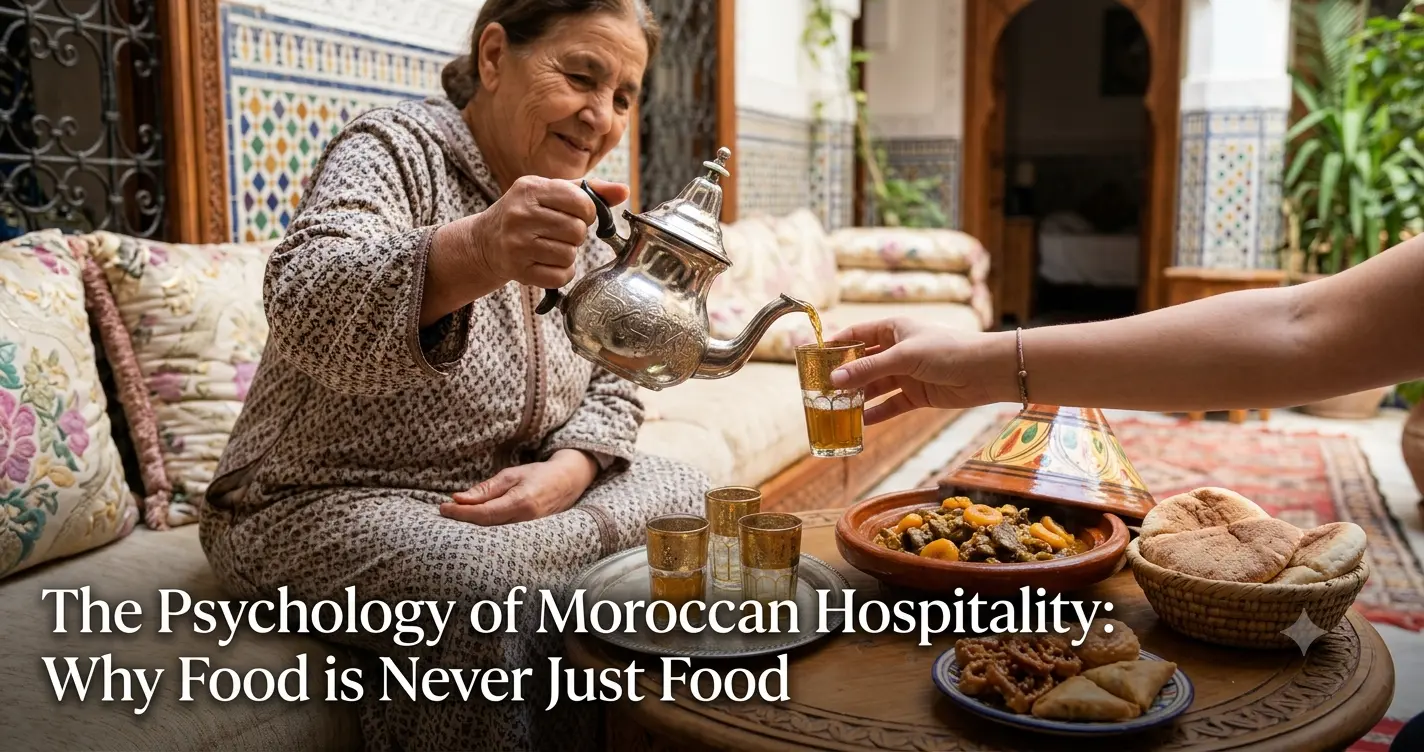
I remember the first time I truly understood what Moroccan hospitality meant — and it did not happen in a restaurant, at a cooking school, or even during a formal celebration. It happened in a tiny village outside Fez, in the home of a woman named Fatima, who had perhaps forty minutes' worth of ingredients in her kitchen and yet, within an hour, had placed before me a spread so abundant, so carefully assembled, and so emotionally charged that I sat across from her unable to speak. She barely knew me. I had arrived unannounced with a mutual friend. And yet the food she served carried the full weight of intention — every dish a sentence in a language I was only beginning to learn.
That language is the language of Moroccan hospitality. And if you have ever shared a meal in Morocco — really shared one, sitting cross-legged on floor cushions, tearing bread with your right hand, watching the mint tea pour in that long, theatrical arc — you already know that something more than sustenance is happening. Food in Morocco is never merely fuel. It is never casual. It is a deeply coded social act, a psychological transaction, a form of spoken truth that words alone cannot carry. At MaCooking, we spend a great deal of time teaching the world how to cook Moroccan food — the spice blends, the slow-cooked tagines, the layered bastilla — but in this article, we want to go deeper. We want to talk about why the food means what it means. We want to talk about the psychology underneath the hospitality.
This is not a light topic. Moroccan food culture has roots stretching back over a thousand years, threaded through Berber, Arab, Andalusian, Jewish, and Sub-Saharan African traditions. It has been shaped by Islamic values, by centuries of trade along the ancient caravan routes, by the social architecture of the medina, and by a philosophy of generosity that treats the guest not simply as a visitor, but as a gift from God. To understand it fully is to understand Morocco itself. So pull up a chair — or better yet, a floor cushion — and let us begin.
Chapter One: The Historical Architecture of Moroccan Generosity
Where Does This Hospitality Come From?
Western visitors who experience Moroccan hospitality for the first time often describe it in the same breath: overwhelming, disorienting, humbling. People they have never met insist on feeding them. Strangers stop what they are doing to pour tea. Hosts who can barely afford it pile the table high with food. Where does this impulse come from? Is it cultural programming? Religious obligation? Something deeper in the Moroccan character?
The honest answer is: all of the above, braided together across centuries.
The earliest layer is Berber. The indigenous Amazigh people of North Africa, who have inhabited this land for at least ten thousand years, built their social fabric around the concept of tiwizi — collective solidarity, mutual aid, the understanding that no individual survives alone and that resources are meant to be shared. In the harsh geography of the Atlas Mountains, the Saharan edge, and the arid interior plains, hospitality was not a luxury. It was a survival strategy. You fed the traveler who arrived at your tent because you might be that traveler tomorrow. Generosity was insurance. It was also honor.
The second layer is Islamic. When Islam arrived in Morocco in the seventh century, it found a people already predisposed to generosity and formalized that impulse into spiritual doctrine. The Prophet Muhammad's teachings on hospitality are among the most emphatic in the entire hadith literature. One of the most cited: “Whoever believes in God and the Last Day should honor his guest.” In the Islamic tradition, the guest carries a form of divine blessing into the home. To feed a guest is to earn spiritual reward. To turn a guest away — especially a hungry one — is not merely rude. It is a moral failure with consequences that extend beyond the social into the sacred.
The Role of Trade and the Ancient Roads
Morocco's position at the crossroads of the ancient world — connecting Sub-Saharan Africa to Mediterranean Europe, linking the Atlantic coast to the Arab East — meant that the country was, for centuries, a nation of travelers and traders. The caravanserai, those great roadside inns where merchants could rest and eat, were infrastructure. So too was the tradition of private hospitality. Families along the major trade routes between Marrakech, Fez, Meknes, and the Saharan towns understood that welcoming strangers brought prosperity — cultural exchange, commercial intelligence, goodwill. Hospitality, in other words, was also economics.
And the Andalusian influence should not be underestimated. When Muslim and Jewish communities were expelled from Spain during the Reconquista in the late fifteenth century, tens of thousands of highly sophisticated, culturally refined refugees arrived in Morocco's imperial cities. They brought with them an elaborate culinary tradition — the legacy of Al-Andalus, where food had been elevated to an art form, where the table was a theater, where the preparation and presentation of a meal was considered as important as its taste. This fusion deepened Morocco's already rich food culture and added an extra layer of aesthetic intentionality to the act of feeding guests.
“A table set for a guest in Morocco is not just a table. It is a statement of who you are, what your family stands for, and how seriously you take your role as a human being in relation to other human beings. The food is almost secondary to the meaning it carries.”
— Chef Jamal, MaCooking
Chapter Two: The Semantics of the Moroccan Table — What Every Dish Is Really Saying
Reading the Meal Like a Text
When you sit down to a Moroccan meal in someone's home, you are sitting down to read a text that has been composed specifically for you. Every element of what appears on that table has been chosen, prepared, and arranged with communicative intent. The abundance of dishes tells you something. The particular spices used tell you something. The way the bread is placed, the temperature of the soup, the garnish on the tagine — all of it is language.
Let me decode some of this for you.
The sheer quantity of food is the first and most obvious message: you are valued. In Moroccan culture, abundance is respect made visible. A sparse table in the context of hosting a guest would be deeply embarrassing — not because Moroccans are materialistic, but because the quantity of food directly correlates, in the cultural grammar, with how much the guest matters. This is why hosts who have very little will still go to extraordinary lengths to produce an impressive spread. They are communicating something essential about the guest's worth.
The specific dishes chosen carry their own layered meaning. Couscous on Friday is not just traditional — it is the dish of communal prayer, of gathering after the mosque, of family togetherness. Serving it says: you are family to us. A bastilla — that intricate, labor-intensive pie of pigeon or chicken, almonds, and eggs dusted with cinnamon and powdered sugar — says something else entirely: we have honored you with our greatest effort. It is a dish that takes hours, that requires skill accumulated over years, that signals celebration. You do not make bastilla for someone you do not care about.
The bread — always present, always torn with the right hand — is the great equalizer. In Morocco, bread (khobz) is considered sacred. You do not throw bread away, you do not step on it if it falls, and you certainly do not refuse it. Bread at the Moroccan table says: we are equal before God. We share what sustains us.
The Emotional Architecture of Course Progression
A traditional Moroccan meal served to honored guests does not progress the way a Western meal does. There is no starter-main-dessert logic in the French or British sense. Instead, there is an emotional architecture — a deliberate building of warmth, satiation, and belonging — that moves through its own internal rhythm.
- The tea ceremony first: Mint tea is the handshake, the icebreaker, the establishment of goodwill. It says: we are glad you are here. Relax. You are safe.
- The salads (multiple, colorful): These small plates arrive like a statement of creativity and care — roasted peppers, zaalouk, taktouka, cooked carrots with cumin and lemon. They say: we have thought about this. We have prepared.
- The main tagine or couscous: The heart of the meal. Slow-cooked, fragrant, generous. The emotional peak. This says: here is our best. Here is our love, made edible.
- The sweets and mint tea again: The closing ritual. Pastries, dried fruits, more tea. This says: do not rush. Stay. This moment is not finished.
At MaCooking, we have documented hundreds of traditional Moroccan recipes, but it is this emotional architecture that we consider the master curriculum. The recipes are the vocabulary. The meal structure is the grammar. And the hospitality is the literature.
Chapter Three: The Tea Ritual — Morocco's Most Powerful Social Technology
Why Three Glasses?
The Moroccan mint tea ritual is perhaps the most analyzed, most photographed, and most misunderstood element of Moroccan culture. Tourists photograph the dramatic pour. Food writers rhapsodize about the sweetness. But very few accounts go deep enough into what the ritual actually does — psychologically, socially, and spiritually.
The classic saying associated with Moroccan tea tells you everything: “The first glass is as gentle as life, the second is as strong as love, the third is as bitter as death.” This is not merely poetic. It is a roadmap for an intentional psychological journey that the host and guest take together. Each glass is prepared differently — the first subtle, the second richer from the steeping mint, the third intensified. You move through an experience together. You share a small arc of sensation that mirrors the arc of human relationship itself.
The preparation of Moroccan tea — atay — is also a performance of patience, skill, and attentiveness. The host rinses the pot, measures the gunpowder green tea, adds the mint, controls the sugar, and then pours from a height to create the foam that signals proper preparation. This foam — rghwa — is considered essential. A skilled tea-pourer can generate it reliably from a significant height. The performance says: I have practiced this. I am doing it right for you. You are worth the full performance.
Tea as a Transition Technology
One of the most psychologically sophisticated aspects of the Moroccan tea ritual is its function as what anthropologists might call a “transition technology” — a structured practice that moves people from one social or emotional state to another. When a guest arrives, there may be awkwardness, unfamiliarity, the social friction of different worlds meeting. Tea dissolves this. The shared ritual gives both host and guest something to focus on, a script to follow, a pace to match. By the end of the first glass, the conversation has warmed. By the second, barriers are lower. By the third, you are, in some small way, bonded.
This is not accidental. It is the product of centuries of social engineering — a culture gradually discovering and refining the practices that best facilitate genuine human connection. And it explains why, when you refuse Moroccan mint tea, you are refusing more than a beverage. You are declining an invitation to enter a shared emotional space. The host will understand — but they will feel it.
| Glass | Flavor Profile | Psychological Function | Social Message |
|---|---|---|---|
| First Glass | Light, delicate, slightly sweet, fresh mint prominent | Welcomes, relaxes, reduces social anxiety | “You are welcome here. We are glad you came.” |
| Second Glass | Fuller, richer, more intense mint, sweeter | Deepens engagement, opens conversation | “We want to know you. Let us talk more freely.” |
| Third Glass | Strong, slightly bitter, concentrated, complex | Marks depth of connection, signals intimacy | “We have shared something real. This matters to us.” |
Chapter Four: The Moral Economy of the Moroccan Meal — Obligation, Honor, and the Social Contract
Hospitality as Moral Currency
In Western cultures, hospitality is largely optional. You invite people to dinner when you want to, at a time that suits you, within a budget you feel comfortable with. The social pressure to host generously exists, but it is relatively elastic. Declining to host, serving a simple meal, or being a reluctant host carries relatively modest social consequences.
In Morocco, the calculus is fundamentally different. Hospitality here operates within what sociologists call a moral economy — a system in which social obligations carry genuine moral weight, where generosity earns honor and its absence earns shame, and where the community monitors and remembers acts of both hospitality and its lack.
This means that Moroccan hosts are not simply being nice when they pile your plate. They are participating in a social system that defines who they are. A family known for generous hospitality carries that reputation as a form of social capital — it affects their standing in the neighborhood, the respect their children receive, the quality of relationships they can access. The meal is never just the meal. It is a public declaration of character.
The Guest's Obligations
Western visitors sometimes feel uncomfortable with the intensity of Moroccan hospitality, and one reason is that they do not fully understand that they, too, have obligations in this exchange. In the Western paradigm, the guest is largely passive — you show up, you receive, you say thank you. In Morocco, the guest has a more active role to play.
- You must eat. Seriously eat. Enthusiastically eat. Your appetite is the host's reward. If you pick at the food or leave substantial portions untouched, the host will quietly wonder what they did wrong. They will worry the food was not good enough. They may feel shame. Your eating is an act of care for them.
- You must compliment genuinely and specifically. “This is delicious” is fine but thin. “The saffron in the tagine — I have never tasted it balanced like this” is a gift. Specific appreciation shows that you were paying attention, that you noticed the effort.
- You must not rush. Leaving quickly after a Moroccan meal communicates that you were not truly present, that the gathering was a box to check rather than a genuine connection. Time given freely is part of the reciprocal exchange.
- You should ideally reciprocate. Not necessarily with equal food, but with an invitation, a gift, a gesture that acknowledges the generosity you received and continues the relational thread.
When Generosity Becomes Sacrifice
Perhaps the most psychologically striking dimension of Moroccan hospitality is what happens when the host has very little. There is a widely observed phenomenon among travelers and anthropologists who have spent time in rural Morocco: the families with the least tend to host with the most visible urgency. A family in a small mountain village, subsisting on simple provisions, will slaughter a chicken — perhaps their only one — for an unexpected guest. They will send children to the market for fresh vegetables when a visitor arrives. They will empty their pantry.
Why? Because in the moral economy of Moroccan culture, the cost of not hosting properly is higher than the cost of the meal itself. To fail a guest is to fail publicly, to fail morally, to fail before God. And there is something else, something harder to quantify: the genuine joy of giving. In a culture where hospitality is this deeply embedded, the act of feeding someone feels good. It fulfills something. It is not experienced as sacrifice in the way a Western observer might perceive it. It is experienced as meaning.
Chapter Five: Gender, Space, and the Hidden Labor of Moroccan Hospitality
The Women Behind the Feast
Any honest examination of Moroccan food culture must reckon with a difficult truth: the extraordinary hospitality that guests experience is built almost entirely on the invisible labor of women. In traditional Moroccan households, it is the mother, grandmother, daughters, and female relatives who wake early, shop carefully, spend hours in the kitchen, who know every guest's dietary preferences and quietly adjust the menu, who make sure the bread is fresh, the tea is perfect, and the serving dishes are warm.
These women often do not sit at the table when guests are present. They move between kitchen and dining room, anticipating needs, refilling dishes, monitoring the meal's emotional temperature. They are the architects of the entire experience and they are frequently the least acknowledged participants in it. This is changing, particularly in urban Morocco and among younger generations, but it remains a significant feature of traditional Moroccan hospitality.
What this means psychologically is that Moroccan hospitality carries within it a gendered labor dynamic that the experience of abundance at the table can obscure. The seamlessness of the meal — the way dishes appear at the right moment, the way nothing runs out, the way the pace feels effortless — is not effortless. It is the product of extraordinary skill and effort, typically female, that has been culturally rendered invisible. Understanding this is part of understanding the culture honestly.
The Sacred Kitchen
The Moroccan kitchen — the kouzina — is one of the most psychologically significant spaces in the home. It is the room where family knowledge is transmitted, where daughters learn from mothers, where the secrets of spice blends and slow-cooking techniques are passed not through written recipe cards but through observation, participation, and apprenticeship. This oral and experiential transmission of culinary knowledge means that every Moroccan cook carries within them a living archive of family and regional culture.
This is why, at MaCooking, we treat the documentation of traditional Moroccan recipes as an act of cultural preservation. The tagine recipe your grandmother makes may not exist anywhere in written form except in her memory and her hands. When it disappears, something irreplaceable goes with it. The kitchen, in this sense, is not just a cooking space. It is a library.
Chapter Six: The Regional Dialects of Moroccan Hospitality
How Geography Shapes Generosity
Morocco is not a monolithic culture. It is a country of extraordinary regional diversity — Berber mountain communities in the Atlas and Rif ranges, Arab-influenced imperial cities, Saharan oasis towns, Atlantic coastal fishing communities, the deep south with its Sub-Saharan connections. Each of these regions has its own distinct hospitality traditions, its own signature dishes, its own particular way of making a guest feel welcome.
| Region | Signature Hospitality Food | Distinctive Customs | Cultural Flavor |
|---|---|---|---|
| Fez (Imperial City) | Bastilla, refined tagines with preserved lemon, honey-glazed meats | Formal, elaborate table setting; multiple courses; strong Andalusian aesthetic influence | Urban aristocratic — hospitality as high art |
| Marrakech | Tangia (slow-cooked lamb in clay jar), mechoui (whole roasted lamb), spiced couscous | Communal eating from one large vessel; celebratory, festive energy; music often present | Theatrical and abundant — hospitality as celebration |
| Atlas Mountain Communities (Berber) | Barley couscous, amlou (argan oil, almonds, honey), fresh goat cheese, flatbread | Highly personal; guests often sleep over; tea ceremonies extended and ceremonial | Intimate and earthy — hospitality as kinship |
| Saharan South (Draa Valley, Zagora) | Dates, camel milk, slow-cooked lamb with dried fruits, millet porridge | Desert hospitality protocols especially strict; turning away a traveler considered gravely dishonorable | Ancient and sacred — hospitality as survival covenant |
| Atlantic Coast (Essaouira, Agadir) | Chermoula fish, seafood tagines, argan oil dishes, spiced fish soups | More relaxed and informal; fishing community warmth; open-door culture | Breezy and generous — hospitality as everyday joy |
| Northern Rif Region (Chefchaouen, Tetouan) | Rfissa (chicken with lentils and fenugreek), harira, sweet briouats | Strong Andalusian refinement; emphasis on sweet-savory combinations; tea served with particular ceremony | Elegant and layered — hospitality as cultural pride |
Urban vs. Rural — The Changing Face of Moroccan Hospitality
Modern Morocco is changing fast. Casablanca, Rabat, and the younger urban centers are producing a generation that navigates between traditional hospitality codes and contemporary lifestyles. Young Moroccans in these cities may host in apartments rather than family homes, may order from restaurants for gatherings, may use food delivery apps rather than cooking from scratch. The form changes, but — and this is critical — the underlying psychology largely does not.
A young Moroccan woman in Casablanca who orders pastries from a respected patisserie for her guests and serves them with carefully prepared mint tea is expressing the same essential hospitality values as her grandmother in the Atlas. The medium has modernized. The message has not. You are still being told: you matter to me. I prepared for your arrival. Welcome.
Chapter Seven: Religious Dimensions — How Islam Shapes the Moroccan Table
The Spiritual Act of Feeding
For Moroccan Muslims — and the vast majority of Moroccans are Muslim — feeding another person is not merely a social act. It is a spiritual one. The Quran and Hadith literature are full of injunctions to feed the hungry, to honor the guest, to share what you have. These are not peripheral teachings. They sit at the heart of Islamic ethics.
The concept of sadaqa — voluntary charity, generosity beyond what is required — extends naturally to the table. When a Moroccan host gives beyond what you might expect, they are often consciously or unconsciously engaging with the idea that generosity in this world generates blessing (baraka) that extends through all dimensions of life. The guest, in Islamic thought, brings baraka with them. The act of hosting honors God. Cooking becomes prayer. The table becomes an altar.
This understanding shapes the Moroccan kitchen in very practical ways:
- The invocation before cooking: Many Moroccan cooks begin their kitchen work with Bismillah — “In the name of God.” This is not a formula. It is a genuine orientation of the act of cooking toward the sacred.
- The prohibition on waste: Food waste is considered morally problematic in Morocco in a way that goes beyond environmental consciousness. Wasting food that God provided is disrespectful. This is why leftover couscous becomes tomorrow's breakfast, why bread is repurposed rather than discarded.
- The Ramadan transformation: During the holy month of Ramadan, the role of food in Moroccan culture intensifies dramatically. The Iftar meal — breaking the fast at sunset — becomes the most spiritually charged eating event of the year. The specific foods of Moroccan Ramadan (harira soup, chebakia pastries, dates, sellou) are laden with tradition, memory, and religious significance.
- Celebration meals as acts of gratitude: The great feast meals of Morocco — at weddings, at the birth of a child, at the Aqiqah ceremony, at Eid al-Adha — are understood as expressions of gratitude to God as much as celebrations with family. You feed others because God has given to you.
Eid al-Adha and the Ultimate Expression of Sacrificial Hospitality
Perhaps no occasion in the Moroccan calendar reveals the spiritual-culinary connection more dramatically than Eid al-Adha — the Feast of the Sacrifice. Every family that can afford to does so purchases a sheep weeks in advance, cares for it, and then on the morning of Eid performs the ritual sacrifice that commemorates Ibrahim's willingness to sacrifice his son. The meat is then distributed in thirds: one third for the family, one third for relatives and neighbors, one third for those who cannot afford a sheep of their own.
This is hospitality as theology. The act of sharing the sacrificial meat is not generosity in the conventional sense. It is a participation in a divine narrative, a reenactment of sacred history, a physical expression of the community's commitment to one another and to God. Every piece of lamb grilled over charcoal, every bowl of mrouzia (the spiced honey lamb dish unique to this holiday) is saturated with this meaning. The food has never been more than food, and it has never been less.
Chapter Eight: Practical Wisdom — How to Honor Moroccan Hospitality as a Western Guest
The Do's That Will Transform Your Experience
If you are a Western traveler, expat, or culinary enthusiast who finds yourself at a Moroccan table — whether in Morocco itself or in a Moroccan home abroad — the following practices will help you participate in the hospitality culture rather than merely observing it from the outside.
- Accept the first cup of tea always. Even if you do not particularly like tea, even if you are not thirsty. The first glass of mint tea is the key that unlocks the relationship. Refusing it creates a small but real social awkwardness that echoes through the rest of the visit.
- Use your right hand. Moroccan food, especially couscous and tagine eaten communally, is traditionally eaten with the right hand. This is both hygienic custom and cultural practice. Using your left hand to eat from a shared dish is considered impolite.
- Eat from the section of the shared dish in front of you. In communal eating, reaching across to the other side of the tagine is poor form. Eat from your section. The host will redistribute and serve generously.
- Let the host place food on your portion. It is a sign of care when a Moroccan host picks out the best piece of meat or the richest piece of vegetable and places it directly in front of you. This is love, made tactile. Receive it graciously.
- Ask about the dishes. Genuine curiosity is one of the greatest compliments you can pay a Moroccan cook. Ask what spice you are tasting. Ask how long the tagine cooked. Ask about the family recipe. Your interest says: what you have made is worth understanding.
- Stay longer than you planned. The pressure to leave quickly — to get back to your schedule, your hotel, your next activity — is worth resisting when you are a guest in a Moroccan home. The conversation after the meal, over the final glass of tea, is often where the most genuine connection happens.
The Mistakes to Avoid
- Do not photograph the food before the host invites you to eat. In some households, photographing the meal before eating can feel like prioritizing documentation over the human moment. Read the room. If your host seems proud and happy to share the visual, ask permission. If the atmosphere is more intimate, put the phone away.
- Do not bring wine to a Muslim Moroccan home unless you are certain it is welcome. Morocco is a Muslim country and most Moroccan households observe Islamic prohibitions on alcohol. Bringing wine as a guest gift, however well-intentioned, can cause awkwardness. Pastries, high-quality honey, dates, or fresh flowers are universally safe and appreciated.
- Do not insist on splitting costs or offering payment. In a private Moroccan home, offering to pay for the meal you have been served is a significant cultural misstep. It transforms an act of genuine generosity into a commercial transaction and is deeply offensive to many hosts. Express your appreciation with words and, if the relationship allows, with reciprocal hospitality at a later date.
Frequently Asked Questions About Moroccan Hospitality and Food Culture
Q: Is Moroccan hospitality genuine, or is it something tourists experience as a performance for commercial reasons?
A: This is a fair and important question, and the honest answer is: both exist, and you need to develop the discernment to tell them apart. In the tourist-facing economy of Morocco's medinas — the shops, the tourist restaurants, the paid guided experiences — there are certainly performative elements of “hospitality” designed to generate sales. The carpet shop owner who serves you tea before showing you his merchandise is using the hospitality framework strategically, and most experienced travelers recognize this.
But in private Moroccan homes, in the communities away from tourist circuits, in the interactions you have with Moroccan families and individuals who have nothing to sell you — the hospitality is as genuine as anything you will encounter anywhere on earth. It is rooted in values that predate tourism by centuries and that have absolutely nothing to do with commercial transaction. The key is context. In a home, at a family meal, in a village that sees few foreign visitors — what you receive is the real thing. At a carpet shop in the Fez medina — apply your critical faculties.
Q: How should I handle dietary restrictions (vegetarian, gluten-free, allergies) without offending a Moroccan host?
A: The key is advance communication combined with expressions of genuine appreciation. Moroccans are accustomed to dietary diversity and most experienced hosts can adapt beautifully — Moroccan cuisine, after all, has a extraordinarily rich vegetarian and vegan tradition (the salads, the vegetable tagines, the couscous with seven vegetables). The problem arises not from the restriction itself but from the social awkwardness of revealing it at the table when food has already been prepared.
If you know you are going to be hosted, tell the relevant person in advance: “I want you to know that I don’t eat meat — but please don’t go to any extra trouble, whatever you are making will be wonderful.” That last part matters. You are flagging the restriction while simultaneously removing the pressure to perform. A good host will quietly accommodate without making it the center of the evening. And if you have serious allergies, be direct and specific. Moroccan hosts would be horrified to accidentally harm a guest. Clarity is kindness in this situation.
Q: What is the significance of eating from a shared dish, and should I always participate in communal eating?
A: Communal eating from a single large dish — the tagine or the couscous platter placed in the center — is one of the most powerful expressions of equality and togetherness in Moroccan food culture. The shared dish says: we are one here, we hold nothing back from each other, we eat from the same abundance. It is a profoundly democratic ritual. In practice, however, most urban Moroccan hosts today are perfectly comfortable serving guests on individual plates, especially if they know their guests are Western and may feel more comfortable that way.
If communal eating is offered, participate with enthusiasm if you can. It is one of those experiences that, once you have done it properly — tearing bread with your right hand, reaching into the warm tagine, eating with people you have just met or people you love — changes how you understand what a meal can be. If hygiene concerns are significant for you, note that communal tagine eating involves each person eating from their own section of the dish, not double-dipping or sharing cutlery.
Q: Does the Moroccan approach to food and hospitality vary significantly between generations? Is the tradition changing?
A: Yes, significantly — and in complex, sometimes contradictory ways. The younger urban generation in Morocco (roughly 18 to 35 year-olds in Casablanca, Rabat, Tangier, Marrakech) is navigating between the deeply embedded hospitality values they inherited and the practical realities of contemporary life: smaller apartments, longer working hours, dual-income households, global food culture influence via social media and travel.
What we see is not the abandonment of hospitality values but their adaptation. A young Moroccan professional might order a curated selection of Moroccan dishes from a restaurant known for quality rather than cooking from scratch, but the impulse to host, to feed, to ensure the guest feels genuinely welcomed remains powerful. The Instagram-generation Moroccan host may photograph the beautifully arranged table before serving — a very modern gesture — but the underlying psychology of “I prepared this for you, you matter to me” is unaltered. The form evolves. The function persists. This is how living cultures work.
Q: How can someone living outside Morocco recreate authentic Moroccan hospitality at home for guests?
A: This is one of my favorite questions, because I genuinely believe the answer is more accessible than people think. You do not need to live in Marrakech to practice Moroccan hospitality. You need to internalize its underlying psychology: the guest is a gift, abundance is respect, time is love, and food carries the full weight of your intention toward the people you are feeding.
Practically: start with mint tea. Buy gunpowder green tea, fresh mint, and learn the basic technique (you can find a thorough guide on MaCooking including the correct way to achieve the foam). Serve it first, before food, as the welcome ritual. Then choose one or two Moroccan dishes that you have genuinely practiced and that you can make with confidence. A well-made chicken tagine with preserved lemon and olives, served with good bread and a couple of salads, is more impressive and more “Moroccan” than an overambitious spread made anxiously. The food should feel like an expression of care, not a performance of stress. Light candles, sit at the floor cushions if you have them, turn off the television, and give your guests your full attention. That is Moroccan hospitality. The recipes are the vehicle. The presence is the point.
Conclusion: Why This Matters Beyond Morocco
I have spent years traveling between Morocco and the wider world, cooking in Moroccan kitchens and teaching Moroccan food to people from dozens of countries. And what I have come to believe, with increasing conviction, is that Moroccan hospitality is not just a beautiful cultural artifact to be admired from the outside. It is a working model of how food can operate in human life — how meals can do more than feed bodies, how the act of cooking can be an act of love, how a table can be a place of genuine human meeting rather than mere caloric exchange.
The modern world has, in many ways, hollowed out the meal. We eat at desks, in cars, scrolling through our phones. We consume rather than dine. We fuel rather than gather. And something has been lost in that shift — something about presence, about reciprocity, about the ancient human understanding that food shared between people is categorically different from food consumed alone.
Morocco has not forgotten this. The Moroccan table is still, in millions of homes and villages and cities, a space of genuine intentionality. The tea is still poured with care. The tagine still cooks for hours, slowly, patiently, in the knowledge that some things cannot be rushed. The bread is still torn and shared. The guest is still treated as a gift rather than an inconvenience.
There are lessons here for all of us, regardless of our cultural background. Not to imitate Moroccan culture — it belongs to Morocco, shaped by its specific history, geography, and faith — but to be inspired by it. To ask: what would it mean to treat the people we feed with this level of intention? What would change if we approached every shared meal as an opportunity to say, through food, something that words alone cannot carry?
These are the questions that drive us at MaCooking. We are not simply a recipe platform. We are a space dedicated to helping people around the world access the full depth of Moroccan culinary culture — not just the techniques and the ingredients, but the values, the history, the psychology, and the humanity that make Moroccan food one of the great food cultures of the world. Every recipe we publish, every technique guide we write, every cultural explainer we create is an attempt to transmit not just how to cook Moroccan food, but why it matters.
So the next time you make a Moroccan tagine for someone you love, remember Fatima and her tiny kitchen outside Fez. Remember that what you are doing goes back a thousand years and more. Remember that the spices you are adding have passed through Berber hands, Arab hands, Andalusian hands, the hands of generations of women whose names we will never know. Remember that when you pour the tea — when you lift the teapot high and let the amber liquid fall in a long, perfect arc — you are not just making a drink. You are saying something. You are saying: I see you. You are worth this. Welcome.
That is Moroccan hospitality. That is why food in Morocco is never just food. And that, perhaps, is why it is worth understanding — by all of us, everywhere, at every table we are lucky enough to share.