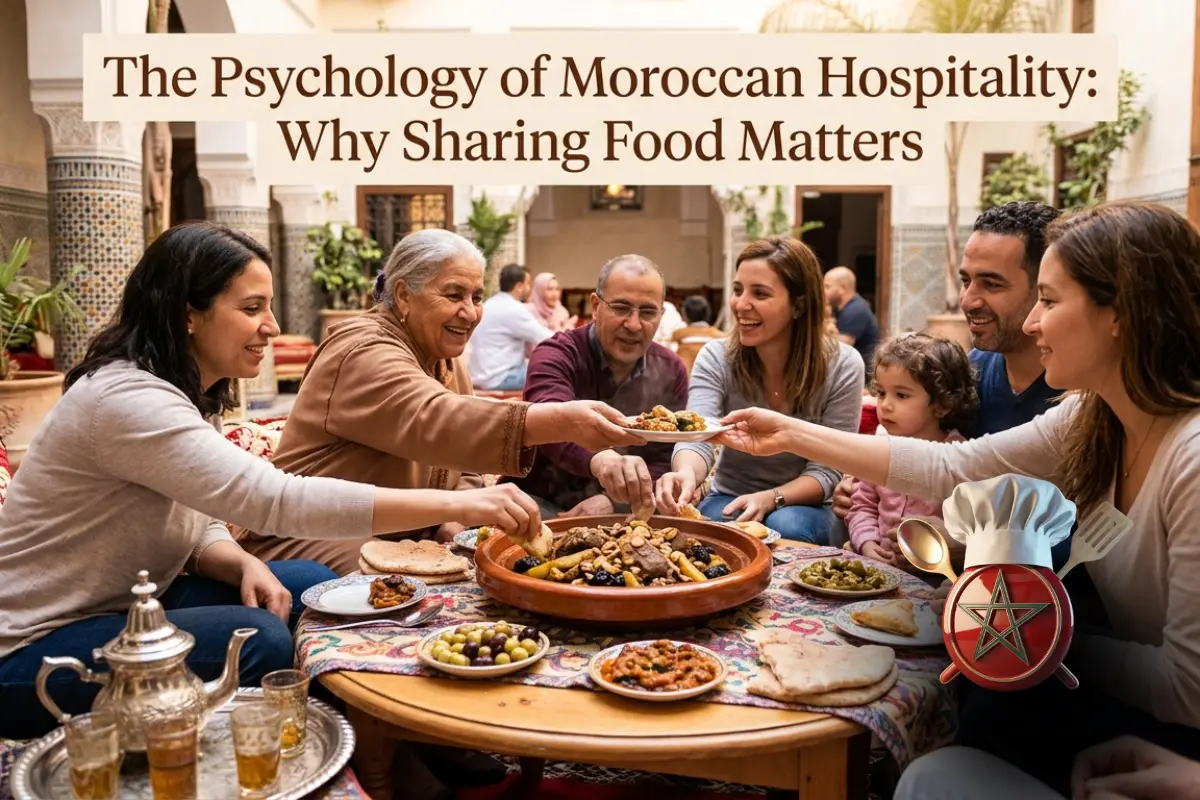
When you step into a Moroccan home, you're not just entering a physical space—you're being welcomed into a centuries-old tradition that places food sharing at the very heart of human connection. The aromatic spices wafting from the kitchen, the ornate tea glasses being prepared, and the immediate invitation to join the table aren't mere formalities. They represent a profound understanding of human psychology that Western societies are only beginning to rediscover.
In our fast-paced Western world, meals have often become functional necessities—fuel for our busy lives consumed hastily between meetings or while scrolling through our phones. But Moroccan culture offers a radically different perspective: food is medicine for the soul, and sharing it is one of the most powerful ways to build trust, create community, and foster genuine human connection.
This ancient wisdom isn't just cultural romanticism—it's backed by modern psychology and neuroscience. Research consistently shows that sharing meals triggers the release of oxytocin, often called the 'bonding hormone,' reduces stress levels, and creates lasting positive associations between people. Moroccan hospitality has been practicing this science of connection for over a millennium.
Join me as we explore the fascinating psychology behind Moroccan hospitality, uncovering why the simple act of sharing food creates such powerful bonds and how we can incorporate these timeless principles into our modern Western lives.
The Sacred Ritual of Welcome: Understanding Moroccan Hospitality Culture
To understand the psychology of Moroccan food sharing, we must first appreciate the cultural framework that makes it so powerful. In Moroccan culture, hospitality—known as diyafa—isn't just a social nicety; it's a sacred duty deeply rooted in Islamic principles and Berber traditions that predate Islam by centuries.
The Philosophy Behind the Practice
When a guest arrives at a Moroccan home, a specific ritual unfolds that has remained unchanged for generations. First comes the immediate offering of mint tea, served in small glasses that must be refilled multiple times. This isn't just about refreshment—it's a psychological technique that creates multiple opportunities for interaction and demonstrates the host's commitment to the guest's comfort.
The psychology here is profound: by accepting the tea, the guest enters into an unspoken contract of trust. They're literally consuming something prepared by their host, a primal act of vulnerability that our ancestors understood as the foundation of alliance. The repeated offerings reinforce this bond, creating what psychologists call 'reciprocity loops'—small exchanges that build increasingly stronger connections.
The Communal Table Philosophy
Perhaps nowhere is Moroccan food psychology more evident than in the traditional dining setup. Families and guests gather around a low, round table, eating from shared dishes with their hands or bread. This arrangement isn't accidental—it's a carefully orchestrated psychological environment designed to maximize connection and minimize barriers.
The round table ensures no one sits at the 'head,' creating equality among diners. The shared dishes require coordination and awareness of others' needs, fostering empathy and consideration. Eating with hands creates a more intimate, sensory experience that engages multiple parts of the brain simultaneously, making the meal more memorable and emotionally significant.
The Role of the Host
In Moroccan culture, the host's role extends far beyond simply providing food. They become temporary guardians of their guests' wellbeing, and this responsibility is taken with utmost seriousness. The host will often eat last or very little, ensuring guests are satisfied first—a practice that demonstrates selflessness and creates a sense of obligation and gratitude in the guest.
This behavior triggers what social psychologists call the 'reciprocity principle'—when someone does something generous for us, we feel compelled to return the favor. But in Moroccan culture, the return isn't expected immediately or even directly. Instead, guests are expected to extend the same hospitality to others, creating a network of kindness that strengthens the entire community.
The Neuroscience of Shared Meals: What Happens in Our Brains
Modern neuroscience has begun to uncover the biological mechanisms behind what Moroccan culture has understood intuitively for centuries: sharing food fundamentally changes how our brains respond to other people. When we eat together, particularly in the intimate, tactile way common in Moroccan dining, several powerful neurological processes occur simultaneously.
The Oxytocin Connection
Oxytocin, often dubbed the 'love hormone,' plays a crucial role in bonding between humans. Research has shown that sharing meals, especially when eating from common dishes, significantly increases oxytocin production. This hormone doesn't just make us feel good—it literally rewires our brains to view the people we've eaten with more favorably.
In Moroccan dining culture, this effect is amplified by several factors: the use of hands creates more sensory engagement, the circular seating arrangement promotes eye contact, and the extended duration of meals provides sustained exposure to these bonding chemicals. Studies have shown that people who share meals are more likely to cooperate, trust each other, and engage in prosocial behavior long after the meal has ended.
Mirror Neurons and Synchronization
When people eat together, their mirror neurons—brain cells that fire both when we perform an action and when we observe others performing the same action—create a sense of synchronization. In a Moroccan meal setting, where everyone is reaching for the same dishes, tearing bread in similar motions, and drinking tea in unison, this neurological mirroring becomes particularly pronounced.
This synchronization has measurable effects on mood and perception. Research conducted at Stanford University found that people who eat in synchrony rate their dining companions as more likeable and are more willing to cooperate with them on subsequent tasks. The traditional Moroccan practice of beginning and ending meals together, often with shared prayers or expressions of gratitude, maximizes this effect.
Stress Reduction and Cortisol Regulation
Sharing meals in a warm, welcoming environment like a traditional Moroccan home significantly reduces cortisol, the stress hormone. The combination of aromatic spices, comfortable seating, gentle conversation, and the security of being cared for creates an ideal environment for stress relief.
The Moroccan emphasis on slow, mindful eating—taking time to savor flavors, engage in conversation, and express gratitude—activates the parasympathetic nervous system, which is responsible for 'rest and digest' functions. This neurological state is optimal for forming positive memories and building emotional connections with others present.
The Art of Breaking Bread: Traditional Moroccan Meal Customs
Every aspect of a traditional Moroccan meal is designed to maximize psychological and social benefits, though this design evolved organically over centuries rather than being consciously planned. Understanding these customs helps Western visitors appreciate the deeper significance of what might otherwise seem like simple etiquette.
The Pre-Meal Ritual
Before any Moroccan meal, guests participate in a hand-washing ceremony using rose water or orange blossom water poured from ornate vessels. This isn't just about hygiene—it's a transitional ritual that helps people shift from their external concerns to focus on the present moment and the people around them.
Psychologically, rituals serve important functions in human society. They create boundaries between different activities, help reduce anxiety by providing predictable structure, and create a sense of shared identity among participants. The Moroccan pre-meal ritual accomplishes all of these functions while also engaging the senses through fragrant waters and beautiful vessels.
The Sacred Bread
In Moroccan culture, bread (khubz) holds special significance beyond its nutritional value. It's considered blessed, and wasting bread is seen as deeply disrespectful. During meals, bread serves as both utensil and sustenance, with pieces being torn off and used to scoop up tagines and other dishes.
The psychological impact of this shared bread consumption is significant. When people use the same loaf to eat, they're literally sharing sustenance in the most direct way possible. This creates what anthropologists call 'commensality'—a term that literally means 'eating at the same table' but encompasses the deep social bonds formed through shared consumption.
The Tagine Tradition
The iconic tagine—both the conical cooking vessel and the dishes prepared in it—represents the pinnacle of Moroccan sharing psychology. Tagines are designed to be eaten communally, with diners gathering around the dish and eating from sections closest to them while being mindful not to take more than their share.
This dining style requires constant awareness of others' needs and promotes what psychologists call 'prosocial behavior.' Diners must consider whether others have had enough before taking seconds, offer choice pieces to guests, and coordinate their eating pace with the group. These small acts of consideration create a web of positive interactions that strengthen social bonds.
Building Community Through Culinary Connection
The true genius of Moroccan hospitality lies not in individual acts of kindness but in its ability to create and strengthen community networks. Food sharing serves as the foundation for complex social structures that support individuals and families through both good times and challenges.
The Extended Family Table
In traditional Moroccan society, meals often include not just immediate family but extended relatives, neighbors, and unexpected guests. This practice serves multiple psychological and social functions that Western societies often struggle to achieve through formal community-building efforts.
Regular shared meals create what sociologists call 'weak ties'—relationships that aren't intimate but provide important social and economic benefits. These connections might lead to job opportunities, business partnerships, or simply emotional support during difficult times. The Moroccan table serves as an informal networking hub where relationships are built and maintained through consistent, positive interactions.
The Role of Food in Conflict Resolution
Moroccan culture has long understood something that modern mediation experts are rediscovering: it's much harder to maintain hostility toward someone while sharing a meal with them. The neurological changes that occur during communal eating—increased oxytocin, decreased stress hormones, activation of mirror neurons—create an optimal environment for reconciliation.
Traditional Moroccan families often use shared meals as opportunities to address conflicts and rebuild relationships. The host's obligation to treat all guests equally, the vulnerable act of eating together, and the emphasis on gratitude and blessing create conditions where grievances can be aired and resolved more easily than in formal confrontational settings.
Teaching Social Values Through Dining
Children in Moroccan families learn crucial social skills through participation in family meals from an early age. They observe and practice sharing, learn to read social cues from adults, develop patience through extended meal times, and internalize values of hospitality and generosity.
This experiential learning is far more effective than formal instruction because it engages multiple senses and emotions simultaneously. Children who grow up in cultures with strong communal dining traditions show higher levels of empathy, better social skills, and stronger family attachments compared to those raised in more individualistic dining environments.
Comparing Dining Cultures: Morocco vs. Western Traditions
To fully appreciate the psychological power of Moroccan hospitality, it's helpful to compare it directly with typical Western dining practices. The differences reveal why Moroccan approaches to food sharing create such strong bonds and suggest ways Western cultures might benefit from adopting some of these practices.
| Aspect | Traditional Moroccan Dining | Typical Western Dining | Psychological Impact |
|---|---|---|---|
| Seating Arrangement | Circular, floor cushions, close proximity | Linear tables, chairs, defined personal space | Moroccan style promotes equality and intimacy; Western style maintains individual boundaries |
| Food Serving | Communal dishes, shared utensils/bread | Individual plates, personal utensils | Sharing requires coordination and empathy; individual servings promote independence |
| Meal Duration | Extended, leisurely pace, multiple courses | Efficient, time-conscious, often rushed | Longer meals allow deeper bonding; shorter meals prioritize productivity |
| Host Behavior | Self-sacrificing, guest-focused, generous | Balanced, reciprocal, organized | Moroccan hosting creates obligation and gratitude; Western hosting promotes equality |
| Technology Use | Discouraged or forbidden during meals | Often tolerated or integrated | Screen-free meals enhance focus on relationships; technology can distract from bonding |
The Benefits and Challenges of Food-Centered Hospitality
While Moroccan hospitality traditions offer numerous psychological and social benefits, it's important to understand both the advantages and potential challenges of adopting these practices, particularly for Western audiences accustomed to different social norms.
| Benefits | Challenges | Adaptation Strategies for Western Contexts |
|---|---|---|
| Stronger social bonds and trust | Time-intensive preparation and serving | Start with weekend family meals or special occasions |
| Reduced stress and increased wellbeing | May conflict with dietary restrictions or preferences | Adapt communal style with individual dietary accommodations |
| Enhanced empathy and social skills | Requires significant cultural shift in expectations | Gradually introduce elements like shared appetizers or desserts |
| Better conflict resolution capabilities | Potential for social anxiety in unfamiliar settings | Explain traditions beforehand to help guests feel comfortable |
| Stronger community networks | Economic burden on hosts | Implement potluck-style sharing to distribute costs |
Overcoming Modern Challenges
Contemporary life presents unique obstacles to implementing traditional hospitality practices. Busy schedules, smaller living spaces, dietary restrictions, and different cultural expectations all pose challenges to creating authentic Moroccan-style dining experiences. However, the psychological principles behind these traditions can be adapted to fit modern Western lifestyles.
The key is understanding that the power lies not in perfect replication of traditional practices but in embracing the underlying psychology: creating environments that promote trust, reduce barriers between people, and prioritize human connection over efficiency or convenience.
Practical Ways to Incorporate Moroccan Hospitality Principles
You don't need to completely restructure your lifestyle to benefit from the psychological wisdom embedded in Moroccan hospitality traditions. Small changes can create significant improvements in your relationships and overall wellbeing while respecting the cultural boundaries of practices that aren't your own heritage.
Creating Sacred Meal Spaces
Transform your dining area into a space that promotes connection rather than just consumption. This might mean removing televisions from dining rooms, investing in comfortable seating that encourages lingering, or creating lighting that feels warm and intimate rather than harsh and functional.
Consider adopting the Moroccan practice of beginning meals with a moment of gratitude or blessing, adapted to your own beliefs and traditions. This simple ritual helps transition everyone's focus to the present moment and the people around them.
Embracing Slower Eating
Modern Western culture often treats speed as a virtue, but Moroccan tradition suggests that slower can be better when it comes to building relationships. Try extending meal times by introducing multiple small courses, encouraging conversation between courses, or ending meals with tea or coffee that naturally prolongs the gathering.
The key is creating natural pauses that allow conversation to develop and relationships to deepen. This doesn't require elaborate preparation—even simple changes like serving bread before the main course or offering herbal tea after dessert can extend and enrich the dining experience.
Implementing Sharing Elements
While you may not be ready to abandon individual plates entirely, you can introduce sharing elements that promote the psychology of communal eating. Consider starting meals with shared appetizers, offering communal side dishes, or ending with desserts that are meant to be shared.
Even small acts like offering to serve others before serving yourself or passing dishes in a specific direction can create the mindfulness and consideration that make Moroccan dining so psychologically powerful.
Frequently Asked Questions
Why is Moroccan hospitality considered so important in the culture?
Moroccan hospitality stems from deep religious and cultural traditions that view welcoming guests as both a moral obligation and a source of blessing. In Islamic tradition, treating guests well is considered a reflection of one's faith, while Berber traditions emphasize community support and reciprocal care. This creates a cultural framework where hospitality isn't just politeness—it's a fundamental expression of values and identity. The practice also serves practical functions in building social networks, resolving conflicts, and creating economic opportunities through strengthened relationships.
How does sharing food actually create psychological bonds between people?
Sharing food triggers multiple neurological processes that strengthen social bonds. When we eat together, our brains release oxytocin, a hormone associated with trust and bonding. The act of eating from common dishes requires coordination and awareness of others, activating mirror neurons that create feelings of synchronization and empathy. Additionally, the vulnerability involved in consuming food prepared by others creates subconscious associations of trust and safety. These biological responses evolved because individuals who could successfully form alliances through food sharing had better survival prospects.
Can Western families benefit from adopting Moroccan dining traditions?
Absolutely, though adaptation is more effective than direct replication. Western families can benefit from the psychological principles behind Moroccan traditions—prioritizing connection over efficiency, creating rituals that mark meals as special times, and designing dining environments that promote conversation and bonding. This might mean establishing device-free meal times, introducing sharing elements like communal appetizers, or simply slowing down the pace of family meals. The key is understanding the psychological mechanisms and adapting them to fit your family's lifestyle and cultural context.
What should Western guests know when invited to a Moroccan home for a meal?
Western guests should understand that accepting hospitality creates a reciprocal relationship—not an immediate debt, but an understanding that kindness should be extended to others. Come prepared to spend considerable time at the meal, as rushing is considered disrespectful. It's appropriate to express genuine appreciation, try all dishes offered, and engage in conversation throughout the meal. Don't worry about perfect etiquette—sincere appreciation and respect for the culture are more important than flawless technique. Your hosts will typically guide you through any specific customs and will appreciate your willingness to participate in their traditions.
Are there any health benefits to the Moroccan style of communal eating?
Yes, research indicates several health benefits to communal dining practices common in Moroccan culture. Eating more slowly—which naturally occurs in extended social meals—aids digestion and helps regulate appetite, potentially reducing overeating. The stress reduction associated with pleasant social interaction during meals can improve immune function and cardiovascular health. Additionally, the mindfulness promoted by traditional Moroccan dining practices—focusing on flavors, textures, and social connections rather than external distractions—has been linked to better mental health outcomes and more satisfying eating experiences that can reduce emotional eating patterns.
Conclusion: The Universal Language of Shared Sustenance
The psychology of Moroccan hospitality reveals a profound truth that transcends cultural boundaries: sharing food is one of the most powerful tools we have for building human connection. In our increasingly digital and disconnected world, the ancient wisdom embedded in Moroccan dining traditions offers a pathway back to deeper, more meaningful relationships.
The neuroscience is clear—when we share meals, our brains literally rewire themselves to view our dining companions more favorably. The release of oxytocin, the activation of mirror neurons, and the reduction of stress hormones create optimal conditions for trust, empathy, and cooperation. Moroccan culture has been leveraging these biological realities for over a millennium, creating social structures that support individuals and strengthen communities through the simple act of breaking bread together.
But perhaps the most important lesson from Moroccan hospitality isn't about specific customs or traditions—it's about priorities. In a culture that values human connection over efficiency, presence over productivity, and generosity over personal gain, food becomes a vehicle for expressing the deepest values of civilization: care for others, recognition of our interdependence, and celebration of our shared humanity.
As we navigate the challenges of modern life—social isolation, cultural division, and the loss of community—the psychology of Moroccan hospitality offers both inspiration and practical solutions. We may not be able to recreate the exact conditions of traditional Moroccan dining in our own contexts, but we can embrace the underlying principles: slow down, share generously, create rituals that honor relationships, and use food as a bridge between hearts rather than merely fuel for bodies.
The next time you sit down to a meal, consider the profound opportunity before you. Every shared dish is a chance to build trust. Every extended conversation over food is an investment in relationship. Every act of culinary generosity is a thread in the fabric of community. In understanding why sharing food matters so much in Moroccan culture, we rediscover not just the art of hospitality, but the science of human connection itself.
The table is set, the dishes are prepared, and the invitation extends across cultures and centuries: come, sit, share, and be transformed by the simple, profound act of breaking bread together.