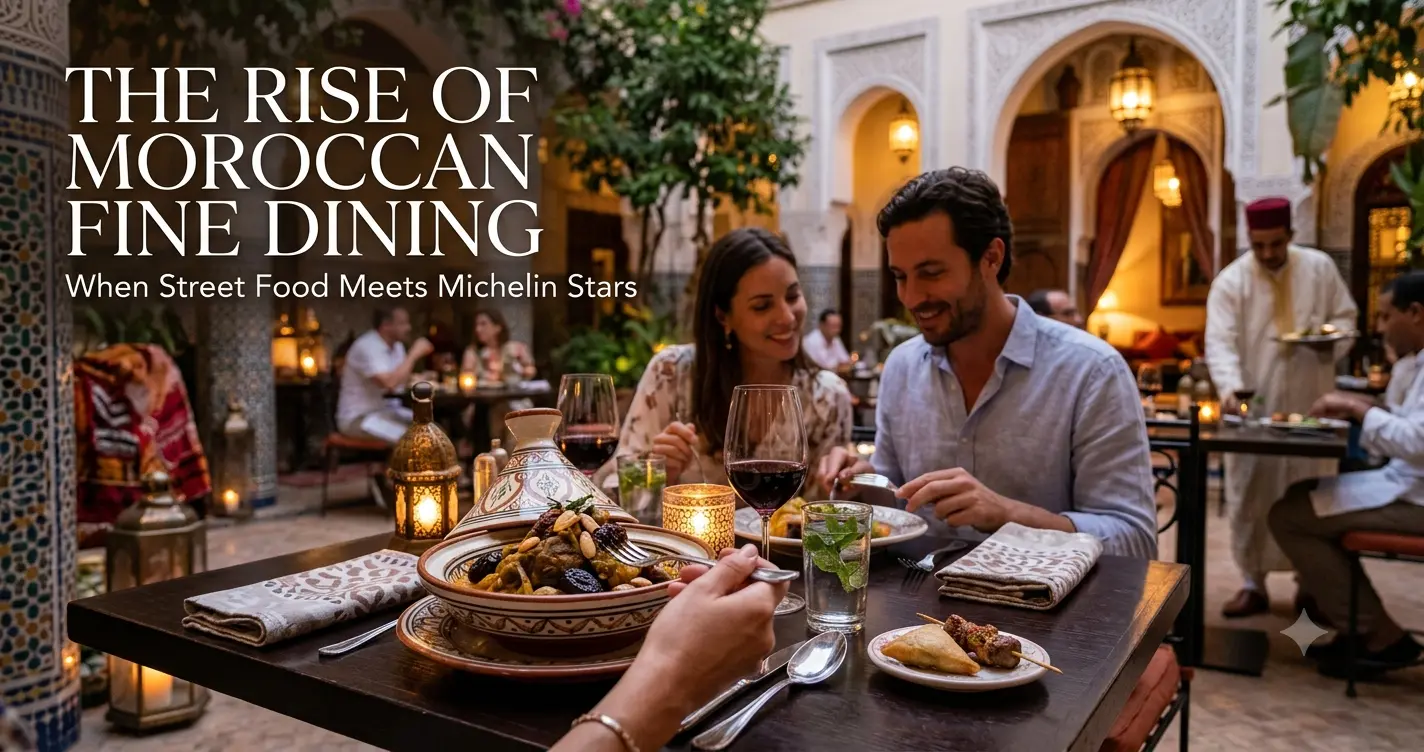
There is a moment — and if you have ever sat in a candlelit riad courtyard in Fès, breathing in the ghost of charcoal smoke and orange blossom drifting over ancient zellige tiles — when you understand exactly why the world's most adventurous chefs keep coming back to Morocco. It is not just about the food. It is about a culinary civilization that has been quietly perfecting itself for over a thousand years, long before anyone coined the phrase "farm-to-table" or awarded a single Michelin star. Moroccan cuisine is one of the most layered, historically rich, and sensorially complete food traditions on the planet — and right now, it is having its long-overdue global moment. The old world is meeting the new, the medina alley is shaking hands with the tasting menu, and the result is something genuinely extraordinary. As someone who has spent decades navigating Moroccan kitchens, souks, and dining rooms from Casablanca to Chefchaouen, I want to take you deep inside this revolution — where it came from, what it looks like today, and why it matters to every serious food lover in the world.
A Cuisine Born at the Crossroads of Civilizations
To understand why Moroccan fine dining feels so inevitable, you first have to understand what Moroccan cuisine actually is — and where it came from. Morocco sits at one of history's great geographic intersections: the northwestern tip of Africa, looking across the Strait of Gibraltar toward Europe, bordered by the Atlantic Ocean to the west and the vast Sahara to the south. For millennia, this position made Morocco a crossroads for traders, conquerors, pilgrims, and nomads, and each wave of influence left permanent fingerprints on the food.
The Ancient Roots of a Complex Flavor Language
The indigenous Amazigh (Berber) people established the foundational vocabulary of Moroccan cooking: slow-cooked stews, grain-based dishes like couscous, preserved ingredients, and an intimate relationship with the land's natural produce — olives, argan oil, almonds, honey, and dried fruits. When Arab traders and settlers arrived following the Islamic conquests of the seventh and eighth centuries, they brought with them the spice routes of the East — cinnamon, ginger, cumin, coriander, saffron, and the philosophical approach of balancing sweet, salty, bitter, and savory within a single dish. The Andalusian refugees who fled the Spanish Reconquista in the fifteenth century contributed sophisticated cooking techniques, refined pastry traditions, and an aristocratic sensibility around presentation that still echoes in Moroccan palace cooking today. Add the influence of sub-Saharan Africa through trans-Saharan trade, and Jewish culinary traditions that flourished for centuries in Moroccan cities, and you have a food culture of almost impossible complexity and depth.
This is not a cuisine that evolved in isolation. It is a cuisine that has been in constant conversation with the world — absorbing, adapting, synthesizing — for over twelve centuries. That is precisely why it translates so naturally to the language of modern fine dining, which prizes exactly this kind of layered complexity.
The Spice Architecture That Changed Everything
One of the most misunderstood aspects of Moroccan cooking, even among food professionals, is the role of spices. In much of the Western culinary tradition, spices are accents — a pinch of this, a dash of that. In Moroccan cuisine, spices are architecture. The iconic spice blend ras el hanout — whose name translates roughly as "head of the shop," meaning the best the spice merchant has to offer — can contain anywhere from twelve to over thirty individual spices, blended in proportions that vary by region, by cook, and even by the occasion being celebrated. Understanding how to build this spice architecture is what separates a competent Moroccan cook from a master one, and it is one of the primary reasons that classically trained Western chefs are increasingly humbled — and fascinated — when they engage seriously with Moroccan culinary traditions.
From Djemaa el-Fna to the Fine Dining Table: The Street Food Legacy
You cannot talk about Moroccan cuisine without talking about the street. For most Moroccans, the street has always been the primary arena of culinary life — the souk stall, the hole-in-the-wall snail soup vendor, the predawn harira cart outside the mosque, the charcoal-grilled kefta stand that materializes every evening as the sun dips below the medina walls. This is not poverty food or food of last resort. This is cuisine of extraordinary intentionality, refined over generations by cooks who had no margin for error and no marketing budget — only flavor, and the loyalty it earned.
Djemaa el-Fna: The World's Greatest Open-Air Kitchen
Marrakech's Djemaa el-Fna square is UNESCO-recognized as an Intangible Cultural Heritage of Humanity — and rightly so. By night, it transforms into one of the most electric culinary spectacles on Earth: hundreds of food stalls materializing from nowhere, smoke billowing from grills loaded with merguez sausages and lamb chops, vendors ladling steaming bowls of snail broth (called ghlal), enormous tagines of slow-cooked offal, pyramids of fried calamari, and that most Moroccan of comfort foods — bissara, the thick, garlicky fava bean soup drizzled with olive oil and dusted with cumin that has been warming Moroccan mornings for centuries.
What is remarkable about these stalls is not just the food itself, but the culinary intelligence embedded in every preparation. The spice ratios have been calibrated over decades. The cooking temperatures are managed with intuitive precision on equipment that would make a Western chef nervous. The ingredient sourcing is hyper-local and hyper-seasonal in ways that fashionable farm-to-table restaurants spend enormous resources trying to replicate. And the flavors? They are bold, unapologetic, and deeply satisfying in ways that very few dining experiences anywhere in the world can match.
It is precisely this fearless, confident flavor profile — honed in the street, perfected in the home kitchen — that the new generation of Moroccan fine dining chefs is drawing on. At MaCooking, we have documented dozens of these traditional street preparations, tracing the lineage from Djemaa el-Fna to the contemporary tasting menu, and the continuity is both surprising and deeply moving.
The Hidden Sophistication of "Simple" Moroccan Street Food
- Msemen and Meloui: These layered flatbreads, griddle-cooked to a flaky, honeyed perfection, represent a mastery of laminated dough technique that rivals the finest French pastry work.
- Harira: The iconic tomato, lentil, and chickpea soup thickened with a flour-and-water slurry is a study in building flavor through patience — it is finished with fresh lemon juice, cilantro, and a whisper of celery that brightens the entire bowl.
- Briouat: These crispy, filo-wrapped parcels filled with spiced lamb or cheese and honey represent the Andalusian influence at its most refined — sweet, savory, and crunchy in a single bite.
- Sfenj: Morocco's answer to the doughnut, these yeasted, ring-shaped fritters dusted with sugar and eaten hot from the oil are a lesson in how simplicity, when executed perfectly, requires no improvement.
- Makouda: Crispy fried potato fritters stuffed into bread with harissa — the Moroccan equivalent of a perfect fish and chip butty, and equally impossible to eat gracefully.
The New Wave: Moroccan Chefs Rewriting the Rules
Something significant shifted in Moroccan fine dining around the early 2010s, and it has been accelerating ever since. A new generation of Moroccan chefs — many of them trained in the great kitchens of Europe and the United States, and then deliberately choosing to return to Morocco or to champion Moroccan cuisine on the global stage — began asking a provocative question: what would happen if we applied the techniques of modern haute cuisine to the ingredients, spices, and flavor traditions of our grandmothers' kitchens?
The Pioneers Who Paved the Way
Chefs like Najat Kaanache, who trained under some of the world's most celebrated culinary names before returning to open her groundbreaking restaurant Nur in Fès, or Meryem Cherkaoui, who has championed Moroccan cuisine on international stages with a precision and artistry that commands genuine respect, represent a movement that is reshaping how the global food world understands North African cooking. Their work is not about stripping away tradition or replacing it with something shinier. It is about creating a new dialogue — one in which a pastilla (the legendary sweet-savory pigeon pie encased in paper-thin warqa pastry and dusted with powdered sugar and cinnamon) might be reimagined as a single perfect amuse-bouche, or a chermoula marinade applied to precision-cooked fish with the reverence usually reserved for a French beurre blanc.
The results have been startling. International food media, which spent decades reducing Moroccan cuisine to a tagine cliché, has been forced to pay attention. The James Beard Foundation has recognized Moroccan culinary traditions. European food magazines increasingly run cover stories on Marrakech and Fès as serious gastronomic destinations. And quietly, methodically, the world's most discerning food travelers are rerouting their journeys to include Morocco not just as a cultural experience, but as a culinary pilgrimage.
The Key Ingredients Driving the Fine Dining Revolution
What makes Moroccan cuisine so unusually well-suited to fine dining elevation? The answer lies partly in its ingredients — many of which are genuinely extraordinary by any global standard — and partly in the cooking philosophy that underpins the entire tradition.
Morocco's Extraordinary Pantry
| Ingredient | Why It Matters in Fine Dining | Traditional Use | Modern Fine Dining Application |
|---|---|---|---|
| Argan Oil | Rare, labor-intensive, deeply nutty flavor unlike any other oil on Earth | Amlou dip, couscous dressing | Finishing oil for composed dishes, argan oil emulsions |
| Preserved Lemons | Unique umami depth and citrus complexity impossible to replicate with fresh lemon | Tagines, salads, chicken dishes | Fermented lemon gel, preserved lemon beurre blanc |
| Ras el Hanout | Multi-dimensional spice complexity that can season an entire tasting menu | Lamb tagine, couscous, bastilla | Spice-crusted proteins, infused broths, dessert spicing |
| Medjool Dates | Natural sweetener with caramel depth and silky texture | Stuffed with almond paste, dessert platters | Date caramel, fermented date vinegar, date molasses glazes |
| Saffron (Moroccan) | Taliouine saffron is among the world's finest — floral, complex, genuine | Chicken tagine, bastilla, rice dishes | Saffron consommé, saffron butter, saffron ice cream |
| Chermoula | Herbaceous marinade of cilantro, cumin, paprika, and garlic — extraordinary versatility | Fish marinade and sauce | Herb oil, compressed vegetable marinade, sauce base |
The Philosophy of Balance
Perhaps more important than any individual ingredient is the overarching philosophical approach that Moroccan cuisine brings to flavor. At its core, Moroccan cooking is built on the principle of mizaj — balance, particularly the balance between opposites. Sweet and savory coexist in the same dish. Warm spices temper rich meats. Preserved lemons cut through the unctuous depth of slow-cooked lamb. Honey and argan oil soften the earthiness of bitter greens. This instinctive pursuit of balance is, of course, exactly what fine dining cuisine aspires to — making Moroccan culinary philosophy a natural fit for the tasting menu format, where each course is designed to create and resolve tension between contrasting elements.
At MaCooking, we have dedicated extensive resources to documenting and explaining this philosophical framework, because we believe that understanding why Moroccan food tastes the way it does is just as important as knowing how to cook it.
The World's Best Moroccan Fine Dining Destinations Today
If you are planning a culinary journey to Morocco — or seeking out Moroccan fine dining experiences closer to home — here is an honest guide to where the conversation is happening at the highest level right now.
Inside Morocco: Where to Eat Right Now
| Restaurant | City | Style | Signature Experience | Price Range (per person) |
|---|---|---|---|---|
| Nur | Fès | Modern Moroccan tasting menu | Chef-driven seasonal menu in a restored riad | $$$$ (80-120 USD) |
| Le Jardin | Marrakech | Contemporary Moroccan bistro | Garden courtyard, elevated traditional dishes | $$$ (40-70 USD) |
| Dar Yacout | Marrakech | Traditional palace dining | Multi-course feast in a historic palace setting | $$$$ (70-100 USD) |
| Al Fassia | Marrakech | Authentic Moroccan family cooking | All-female chef team, extraordinary bastilla | $$ (25-45 USD) |
| La Maison Arabe | Marrakech | Classic Moroccan cuisine | Cooking classes and refined dinner service | $$$ (50-80 USD) |
| Timgad | Casablanca | Upscale North African | Sophisticated urban Moroccan dining | $$$ (45-75 USD) |
Beyond Morocco: Moroccan Fine Dining Goes Global
The diaspora effect is real. Moroccan chefs and restaurateurs have established remarkable outposts in London, Paris, New York, Dubai, and Montreal that are drawing critical attention and loyal clientele from food lovers who have never set foot in Morocco. Restaurants like Momo in London — founded by Mourad Mazouz in the 1990s and still operating as one of the city's essential North African dining experiences — paved the way for a generation of Moroccan restaurateurs who understood that the world was ready for something beyond hummus and falafel when it came to North African food.
In Paris, the long-established Moroccan community has created a dining ecosystem that ranges from the sublime bastilla at family-run establishments in the 18th arrondissement to genuinely avant-garde Moroccan-French fusion at newer addresses that are earning column inches in the city's most discerning food publications. New York has seen a similar evolution, with Moroccan chefs increasingly appearing in the kitchens of the city's most respected restaurants, not just running their own establishments but influencing the broader culinary conversation.
How to Cook Moroccan Fine Dining at Home: The Expert's Approach
One of the most exciting dimensions of the Moroccan fine dining movement is that its foundational techniques are genuinely accessible to serious home cooks. Unlike some haute cuisine traditions that require specialist equipment and years of professional training, many of the techniques that underpin great Moroccan cooking — slow braising, spice layering, preserving, working with phyllo-style pastry — are learnable with patience and practice.
The Five Techniques Every Serious Home Cook Should Master
- Building a spice base (taklia): The foundation of countless Moroccan dishes is a bloom of spices in hot oil or fat at the beginning of cooking — ginger, turmeric, pepper, cumin — that creates the aromatic foundation everything else builds on. Master this, and you are speaking the language of Moroccan cuisine.
- The low-and-slow tagine method: True tagine cooking is not about the clay vessel (though it helps). It is about gentle, sustained heat that breaks down collagen in meat and allows spices to penetrate deeply. A good heavy Dutch oven will serve you beautifully at home.
- Making preserved lemons: This requires nothing more than lemons, salt, and time — but the transformation that occurs over four to six weeks is extraordinary. Making your own preserved lemons is the single biggest flavor upgrade a home cook can make to their Moroccan cooking.
- Rolling and filling warqa: Morocco's answer to phyllo, warqa is traditionally cooked on an upturned pan over steam — a technique that takes practice but produces results that are incomparably delicate. Learning to work with it opens the door to bastilla and briouat at a genuinely high level.
- Finishing with fresh herbs and citrus: The Moroccan instinct to finish a dish with a handful of torn cilantro or flat-leaf parsley, a squeeze of preserved lemon, or a drizzle of argan oil is not decoration — it is a fundamental technique for adding brightness and lifting the entire flavor profile of a dish.
For detailed, step-by-step guidance on all of these techniques — and hundreds of authentic Moroccan recipes documented with the depth and care they deserve — MaCooking.com remains the most comprehensive English-language resource for Moroccan cuisine available anywhere online. We have spent years building this platform specifically because we believe that authentic Moroccan culinary knowledge deserves to be shared with the world — fully, accurately, and with genuine respect for the traditions it represents.
Equipment That Makes a Difference
- A proper tagine (clay or cast iron): The conical lid creates a self-basting environment that keeps meat and vegetables extraordinarily moist during the long, slow cook.
- A couscoussier: The traditional two-tiered steamer for couscous is genuinely worth owning if you cook Moroccan food regularly — steaming couscous properly over a simmering stew produces a texture that no other method can replicate.
- A good mortar and pestle: For building spice blends fresh — the difference between pre-ground and freshly ground spices in Moroccan cooking is enormous.
- A flat griddle (Moroccan farran): For making msemen, harcha, and beghrir — the Moroccan pancake family.
"The secret of great Moroccan cooking is not in the recipe — it is in the patience. Our grandmothers did not rush. The spices need time to bloom. The meat needs time to surrender. The flavors need time to find each other. In a world that wants everything instantly, Moroccan cuisine asks you to slow down — and rewards you beyond measure when you do."
The Cultural Dimension: Why Moroccan Dining Is an Experience, Not Just a Meal
Any discussion of Moroccan fine dining that focuses only on the food itself is incomplete. One of the defining characteristics of Moroccan culinary culture — and one of the reasons that visitors to Morocco so consistently describe their dining experiences as transformative rather than merely pleasurable — is that eating in Morocco has always been a profoundly social, ritualized, and hospitality-driven act.
The Concept of Diyafa
The Arabic word diyafa — generous hospitality — is not just a cultural concept in Morocco. It is a moral obligation, a form of spiritual practice, and the organizing principle around which Moroccan dining has always been structured. To welcome a guest to your table in Morocco is to offer them the best of what you have, without hesitation and without calculation. This ethos — the idea that a meal is fundamentally an act of generosity rather than a commercial transaction — infuses even the most formal Moroccan fine dining experiences with a warmth and personal engagement that visitors from colder culinary cultures often find genuinely surprising.
The finest Moroccan restaurants understand this and build it deliberately into their service philosophy. You are not just purchasing a sequence of courses — you are being welcomed into a home, offered the best of what the kitchen can produce, and sent away with a sense of having been genuinely cared for. This is a hospitality standard that the world's best restaurants aspire to, and Moroccan culture has been practicing it for centuries.
The Ritual of Tea
No account of Moroccan dining culture is complete without discussing tea. The preparation and serving of Moroccan mint tea — poured from a height to create a foam, offered at least three times in the traditional etiquette — is one of the world's great food rituals. In fine dining contexts, Moroccan chefs are increasingly incorporating tea service as a considered part of the dining experience, sometimes offering custom tea blends as a palate-cleansing element between courses, or presenting the final tea service as a ceremonial conclusion to the meal that gives guests a moment to decompress and reflect before departing.
Frequently Asked Questions: Moroccan Fine Dining
Do any Moroccan restaurants currently hold Michelin stars?
As of 2026, Morocco itself falls outside Michelin's current geographic coverage — the guide does not yet cover North Africa. However, this is widely expected to change, and when it does, several Moroccan establishments will be strong contenders. Meanwhile, Moroccan chefs are earning Michelin recognition internationally: restaurants in France, the UK, and Spain with significant Moroccan culinary influence have received stars, and at least one chef of Moroccan heritage currently operates a Michelin-starred establishment in Europe. The absence of a Morocco guide is a timing issue, not a quality one — the culinary infrastructure is unquestionably there.
What is the best time of year to visit Morocco for a culinary experience?
Spring (March through May) and autumn (September through November) are the sweet spots. The weather is mild, the produce markets are at their most abundant, and you will catch seasonal specialties that are not available year-round. Ramadan is also a fascinating time to experience Moroccan food culture, though it requires understanding and flexibility — during the fasting hours, restaurants in the medinas may be closed, but the breaking of the fast (iftar) is one of the most extraordinary communal dining experiences you will ever witness. The spread of harira, chebakia, dates, and sellou that appears at dusk during Ramadan is deeply moving in its generosity and communal spirit.
Is Moroccan fine dining accessible to vegetarians and vegans?
Absolutely — and in fact, the vegetable and grain traditions of Moroccan cuisine are among the most compelling in the world. Dishes like seven-vegetable couscous, zaalouk (smoked eggplant and tomato salad), taktouka (roasted pepper and tomato), bissara (fava bean soup), and the extraordinary range of cooked vegetable salads (selata) that precede a traditional Moroccan feast are all plant-based and deeply satisfying. Fine dining restaurants in Morocco are increasingly offering dedicated vegetarian and vegan tasting menus that showcase these traditions at their most sophisticated. The argan oil, preserved lemons, and spice architecture of Moroccan cooking elevate plant-based ingredients in ways that are genuinely revelatory for diners who associate Moroccan food primarily with lamb and chicken.
How do I distinguish an authentic Moroccan fine dining experience from a tourist-oriented one?
Several indicators separate the genuine article from the theatrical imitation. First, look at the menu — authentic establishments offer dishes that go beyond the standard tagine-couscous-bastilla triumvirate, featuring regional specialties, seasonal variations, and less familiar preparations that reflect real culinary knowledge. Second, pay attention to the spice work — genuine Moroccan cooking has a complexity and subtlety that tourist-oriented food often lacks, relying on single dominant flavors rather than the layered harmony of the real thing. Third, look for restaurants where the majority of the clientele is Moroccan — locals are the most reliable arbiters of quality. And fourth, seek out recommendations from serious sources: platforms like MaCooking maintain curated guides specifically designed to help international visitors find genuinely excellent Moroccan dining experiences rather than the sanitized versions produced for comfort-seeking tourists.
Can I learn authentic Moroccan cooking techniques without traveling to Morocco?
Yes — and the quality of online resources for Moroccan cooking has improved enormously in recent years. The key is finding sources that approach Moroccan cuisine with genuine depth and cultural understanding rather than simplified adaptations designed to make it more palatable for Western pantries and cooking styles. At MaCooking.com, we have built the most comprehensive English-language platform for authentic Moroccan culinary education available anywhere online — covering everything from foundational techniques like proper spice layering and tagine management, to advanced preparations like handmade warqa pastry and regional specialty dishes that rarely appear even in dedicated Moroccan cookbooks. We also strongly recommend seeking out Moroccan cooking classes, both in Morocco and in cities with significant Moroccan communities, where learning directly from Moroccan home cooks remains one of the most valuable educational experiences available to any serious culinary student.
Conclusion: The World Is Finally Ready for Moroccan Cuisine's Moment
The rise of Moroccan fine dining is not a trend. It is a recognition — long overdue, genuinely deserved, and still accelerating — of a culinary tradition that has always been operating at the highest level of sophistication, complexity, and emotional resonance. From the smoke-wreathed stalls of Djemaa el-Fna to the hushed, candlelit dining rooms where a new generation of Moroccan chefs is rewriting what contemporary fine dining can be, the through-line is consistent: an uncompromising commitment to flavor, a deep respect for tradition, and a generosity of spirit that transforms every meal into something more than sustenance.
Whether you are planning your first trip to Morocco with a serious culinary itinerary in mind, looking to recreate the flavors of a transformative trip you took years ago, or simply ready to expand your cooking repertoire into one of the world's great unexplored culinary territories, the resources and knowledge you need are more accessible than ever. The global food conversation has finally caught up with what Moroccan cooking has always been — and the next chapter, with all its creative possibility and cultural richness, is only just beginning.
For everything you need to cook, understand, and explore Moroccan cuisine at the deepest level — from foundational recipes and technique guides to cultural context and expert analysis — visit MaCooking.com. It is where the world's most passionate Moroccan culinary community comes together, and we would love to welcome you to the table.