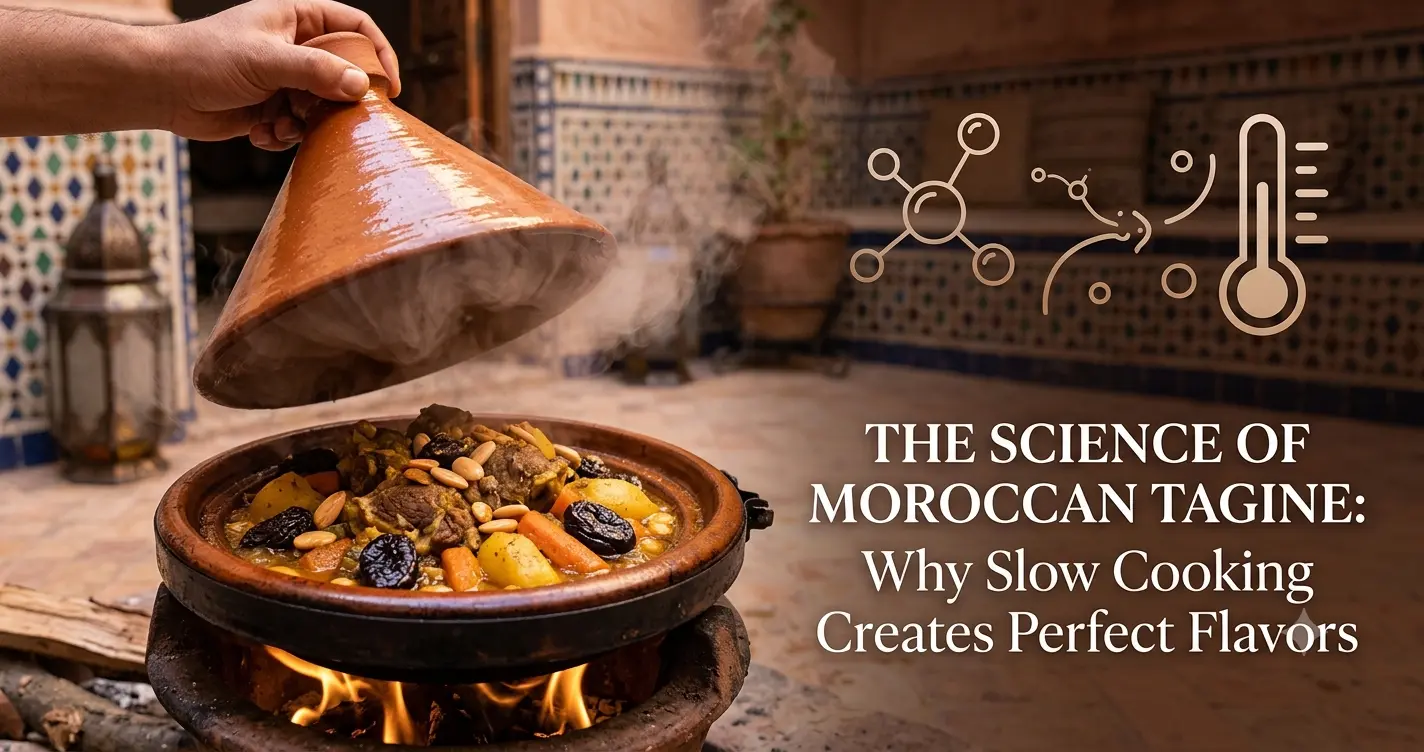
There is a moment, somewhere around the second hour of a tagine simmering on a low charcoal flame, when the entire kitchen transforms. The air thickens with something you can almost taste before it reaches your lips — a warm, sweetly spiced, deeply savory cloud that seems to carry centuries of Moroccan culinary wisdom inside it. I have experienced that moment in a cramped Fez medina kitchen with my grandmother, on a rooftop terrace in Marrakech, and in my own home kitchen in Casablanca more times than I can count. And every single time, the question from visiting Western friends is the same: "How does it get that flavor? What is the secret?" The answer, it turns out, is both beautifully simple and fascinatingly complex. It is science. It is history. It is patience. And in this article, I am going to break it all down for you in a way that no one else has quite managed — because here at MaCooking, we believe understanding why a dish works is just as important as knowing how to make it.
1. What Is a Tagine, Really? A Cultural and Historical Foundation
Before we dive into chemistry and cooking physics, we need to establish something that Western food media often glosses over: the tagine is not just a cooking vessel. It is not a trend, not a dinner-party novelty, and certainly not simply "Moroccan stew." The tagine — both the clay pot with its distinctive conical lid and the dish cooked inside it — represents one of the most sophisticated and precisely engineered cooking systems ever developed by a culinary civilization.
The word "tagine" (also spelled tajine) comes from the ancient Berber language of the indigenous Amazigh people of North Africa. Linguistic historians trace its roots to the Amazigh word tajin, which in turn has a cousin in the ancient Greek teganon, meaning a kind of frying pan or shallow dish. But the conical-lidded earthenware pot that most people recognize today evolved specifically in the Maghreb — the region encompassing Morocco, Algeria, and Tunisia — to solve a very specific culinary problem: how do you cook rich, flavorful, tender food in a dry, often water-scarce environment using minimal fuel?
The answer that Amazigh cooks arrived at over a thousand years ago was ingenious: design a vessel that recycles its own moisture. The conical lid of the tagine is not decorative. It is a feat of passive engineering. As food cooks and steam rises, it travels up into the cone, where the clay walls — being thinner at the top and naturally cooler — cause the steam to condense and roll back down toward the food below. This creates a self-basting, self-moisturizing environment that requires very little added liquid and produces results that are fundamentally different from any other cooking method.
By the time of the Almohad and Marinid dynasties in medieval Morocco (roughly the 11th through 14th centuries), tagine cooking had become central to Moroccan palace cuisine. Arab, Andalusian, Berber, Jewish, and Sub-Saharan African culinary influences had all woven themselves into what we now recognize as Moroccan cuisine, and the tagine vessel was the crucible in which all of these traditions fused. Spice trade routes from the Orient brought saffron, ginger, cumin, and cinnamon. Andalusian refugees fleeing the Reconquista brought sophisticated techniques for combining sweet and savory. The result was a cuisine of staggering complexity — and the tagine was, and remains, its defining symbol.
The Two Meanings of "Tagine"
- The vessel: A heavy, flat-bottomed clay dish with a distinctive tall, conical lid. Traditionally unglazed on the interior, though modern glazed versions exist. Designed for low, slow heat over charcoal braziers (kanoun).
- The dish: Any slow-cooked preparation made inside that vessel — whether meat, fish, vegetable, or fruit-based. The term encompasses hundreds of regional variations across Morocco's diverse landscapes.
Understanding both meanings is essential, because as we will see, the vessel and the dish are not separable. You cannot truly replicate a tagine in a Dutch oven or a slow cooker — you can make something delicious, certainly, but it will not be the same thing. The physics are different. The chemistry will take different pathways. The result will tell a different story.
2. The Physics of the Tagine Vessel: Engineering Flavor Through Design
Let us get into the mechanics, because this is where things get genuinely fascinating. The tagine's conical lid creates what food scientists call a closed convective loop — a continuous cycle of evaporation, condensation, and redistribution that maintains an extraordinarily stable, moist cooking environment at relatively low temperatures.
The Condensation Cycle
Here is exactly what happens inside a tagine during cooking:
- Heat source warms the base: The flat bottom of the tagine sits directly over a heat source (traditionally charcoal, but a gas or electric burner works too). The clay base conducts heat slowly and evenly — far more gently than metal, which creates hot spots and aggressive localized boiling.
- Steam rises into the cone: As liquid in the tagine heats, it evaporates. Steam rises naturally toward the narrowing apex of the conical lid.
- The cone acts as a condenser: The upper portion of the cone is exposed to ambient air temperature. Clay has relatively low thermal conductivity compared to metal, meaning the cone stays meaningfully cooler than the base. This temperature differential causes steam to condense on the inner walls of the cone.
- Condensed liquid returns to the food: Water droplets form on the inner surface of the cone and run back down toward the rim of the base, essentially raining back onto the food below. The food is continuously basted with its own aromatic, spice-infused steam.
- A micro-climate is created: The interior of the tagine maintains a self-regulating humid environment. You need far less liquid than in an open pot — often just a few tablespoons of water or broth — because the system recycles moisture so efficiently.
This is not folk wisdom or culinary mythology. The principles at work are straightforward thermodynamics: convection, condensation, and thermal mass management. The Amazigh potters who perfected the tagine's shape over generations were, in effect, doing applied physics without the vocabulary for it.
Clay Versus Metal: A Critical Distinction
One of the most common mistakes Western home cooks make when attempting tagine recipes is substituting a cast-iron Dutch oven or stainless steel pot. These are fine cooking vessels for other purposes, but they fundamentally change the cooking dynamics:
| Property | Traditional Clay Tagine | Cast Iron Dutch Oven | Stainless Steel Pot |
|---|---|---|---|
| Heat conductivity | Low — gentle, even distribution | Medium — good distribution, can create hot spots | High — rapid heat transfer, more likely to scorch |
| Heat retention | Excellent — clay holds heat slowly and releases it slowly | Very good — retains heat well | Poor — loses heat quickly when removed from source |
| Moisture cycling | Active — conical lid condenses and returns steam | Passive — flat lid collects and drops condensation unevenly | Passive and irregular — similar to cast iron |
| Flavor contribution | Slight mineral earthiness from porous clay — adds depth | Neutral to slight iron influence | Fully neutral |
| Required liquid | Very little — 50-100ml often sufficient | More — 200-300ml typically needed | Most — constant monitoring required |
| Ideal temperature | Very low — 140-160°C maximum | Low to medium — 160-180°C | Medium — requires more active management |
The clay also contributes something less tangible but genuinely perceptible to experienced cooks: a subtle mineral quality that integrates with the dish's flavor profile. Unglazed terracotta is porous, and over years of use, a tagine seasons much like a cast-iron pan, absorbing and releasing the ghosts of previous dishes. My grandmother's tagine, used for forty years, makes food taste different from a brand-new one. That is not romanticism. That is chemistry.
3. The Chemistry of Slow Cooking: What Actually Happens to Flavor Over Time
Now we arrive at the heart of the matter. Why does a tagine cooked for two to three hours taste exponentially more complex than the same ingredients cooked quickly? The answer involves several overlapping chemical processes, each of which contributes a distinct layer to the final flavor profile.
The Maillard Reaction: Building the Flavor Foundation
Many tagine recipes begin with a step that is often rushed or skipped by impatient cooks: browning the meat. This is not just about appearance. The Maillard reaction — named after French chemist Louis-Camille Maillard, who first described it in 1912 — is a complex series of chemical reactions between amino acids and reducing sugars that occurs above approximately 140°C (284°F). It produces hundreds of new flavor compounds simultaneously, creating the deep, roasted, savory complexity that forms the backbone of a great tagine.
In a properly started tagine, lamb shoulder or chicken thighs are first browned in olive oil or smen (Moroccan fermented butter) at higher heat in the base of the tagine. This generates a rich, caramelized crust on the meat's surface — not just browning for color, but a fundamental chemical transformation that creates flavor molecules that could not exist any other way. Those molecules then slowly leach into the cooking liquid over the hours that follow, enriching everything around them.
Collagen Conversion: The Secret to Silky Texture
This is perhaps the single most important reason why slow cooking produces results that fast cooking cannot replicate. Tough cuts of meat — lamb shank, beef cheek, chicken thighs — are rich in collagen, the structural protein that holds muscle fibers together. At room temperature, collagen is what makes these cuts chewy and difficult to eat. But when exposed to sustained heat above 70°C (158°F) in the presence of moisture — exactly the conditions inside a tagine — collagen undergoes hydrolysis, breaking down into gelatin.
Gelatin is extraordinary. It is what gives a properly cooked tagine its lip-coating, unctuous sauce texture. It is what makes the meat fall apart with the gentlest pressure. And critically, gelatin molecules bind with fat and water simultaneously — they are amphiphilic — which means they act as natural emulsifiers, creating a sauce that is simultaneously rich and light, savory and somehow clean. This process takes time. It cannot be rushed. A pressure cooker can force collagen conversion faster, but the resulting texture is fundamentally different — mushier, less structured, lacking the silky gradation that defines a great tagine.
Volatile Aromatic Compounds: The Spice Symphony
Moroccan tagine spicing is not random. It is a system that has been refined over centuries to take advantage of the specific temperature and time conditions created by the tagine vessel. Understanding what happens to spices during slow cooking reveals why the flavor is so impossibly layered.
Most aromatic compounds in spices are volatile organic compounds (VOCs) — they exist in the spice's essential oils and release into the air (and into surrounding food) when heated. But different aromatic compounds release at different temperatures and over different time periods:
- Top notes (highly volatile, fast-releasing): Compounds like limonene in cumin and terpenes in coriander release quickly at lower temperatures. In a tagine, these form the initial aromatic burst — the "first impression" of the dish. Because the tagine's sealed, humid environment traps these volatile compounds rather than letting them escape freely, they dissolve back into the cooking liquid and penetrate the food.
- Middle notes (medium volatility): Compounds like cinnamaldehyde in cinnamon, eugenol in cloves, and zingiberene in ginger release more slowly at sustained heat. These are the warming, complex middle notes that develop over the first hour of cooking.
- Base notes (low volatility, slow-releasing): Compounds like capsaicin from chili, sulfur compounds from onions that have broken down through long cooking, and oxidized saffron compounds (including safranal) develop over two or more hours and provide the deep, lingering backdrop of the dish's flavor.
A quick stir-fry or a pressure-cooked dish activates some of these compounds but cannot develop the full progression. Only sustained, gentle heat — the tagine's specialty — allows all three layers to develop, interact, and create something greater than the sum of their parts. This is the culinary chemistry that the team at MaCooking has spent years documenting and explaining to audiences around the world.
The Maillard-Strecker Interaction and Caramelization of Onions
Most Moroccan tagines begin with a generous quantity of onions, slow-cooked until they are completely broken down and almost melted into the base. This is not optional filler. Over extended cooking time, onions undergo both caramelization (the thermal decomposition of sugars) and Strecker degradation (a subset of Maillard reactions involving amino acids). Together, these produce a complex sweet-savory-umami base that would be impossible to replicate with quickly cooked onions. The slow-cooked onion essentially becomes a natural flavor-enhancing paste, functioning similarly to a French fond or a Japanese dashi — an invisible scaffolding of savory depth.
4. The Spice Architecture of Moroccan Tagine: Ancient Wisdom Meets Modern Science
Moroccan spicing is a subject that deserves its own book — and I have written extensively about it across MaCooking. But for the purpose of understanding tagine science, I want to focus on how and why specific spice combinations work the way they do.
Ras el Hanout: The Master Blend
The name ras el hanout translates literally as "head of the shop" — meaning the best of what the spice merchant has to offer. A traditional ras el hanout can contain anywhere from 10 to 40 different spices, and every family, every region, every spice merchant has their own closely guarded formula. Common core ingredients include:
- Cumin — earthiness, warmth, anchors other spices
- Coriander — citrusy brightness, lifts the blend
- Cinnamon — sweet warmth, creates the signature Moroccan sweet-savory bridge
- Ginger — heat without aggression, aids digestion
- Turmeric — earthy bitterness, golden color, anti-inflammatory compounds
- Black pepper — piperine, which actually enhances the bioavailability of other spice compounds
- Cardamom — floral, eucalyptus notes, complexity
- Nutmeg — warm, slightly sweet depth
- Cloves — intense, anesthetic-adjacent intensity, used sparingly
- Saffron — the queen of Moroccan spicing, deserving its own discussion
From a chemistry perspective, this combination is not random. Cumin and coriander share chemical compound families (terpenoids) that create harmonious blending. Cinnamon and cardamom contain complementary phenylpropanoid compounds. Black pepper's piperine has been shown in nutritional research to significantly enhance the absorption of curcumin from turmeric — a synergy that traditional Moroccan cooks discovered empirically centuries before pharmacologists confirmed it.
Saffron: The Crown Jewel of Moroccan Cooking
Morocco is home to some of the world's finest saffron, grown in the Taliouine region of the Anti-Atlas mountains. Saffron deserves special attention because its chemical behavior during slow cooking is particularly relevant to tagine science.
Saffron's primary flavor compound, safranal, is actually not present in raw saffron threads in significant quantities. It develops through the enzymatic and thermal degradation of a precursor compound called picrocrocin. This conversion happens most completely at the sustained, moderate temperatures of a slow-cooking tagine — approximately 60-80°C over 30-60 minutes. This is why recipes insist on blooming saffron in warm (not boiling) liquid before adding it to the pot. And it is why saffron in a tagine tastes dramatically more complex than saffron added to a quickly cooked dish: the gentle heat has time to complete the chemical transformation that releases safranal's full, honey-hay-metallic magnificence.
Preserved Lemon and Olives: The Flavor Amplifiers
No discussion of tagine flavor science is complete without addressing two ingredients that often appear in the final stages of cooking and play a unique chemical role: preserved lemons and olives.
Preserved lemons (called hamad m'rakad in Moroccan Arabic) are whole lemons salt-cured for weeks or months. The preservation process hydrolyzes the lemon's bitter compounds (primarily naringin), dramatically mellowing them while concentrating the citrus oils and developing complex fermentation flavors. When added to a tagine in the final 20-30 minutes of cooking, preserved lemon does not make the dish taste simply "lemony." It introduces a complex umami-sour-fermented note that functions as a flavor amplifier — similar in principle to how MSG works, by stimulating glutamate receptors on the palate and making other flavors taste more vivid and complete.
Olives, particularly the cracked Moroccan olives marinated in chermoula or plain brine, add phenolic compounds and healthy fats that bind with the dish's existing fat-soluble flavor molecules, creating a more lingering, rounded finish on the palate.
5. Regional Variations: How Morocco's Geography Creates Flavor Diversity
Morocco is a country of astonishing geographic and climatic diversity — from the Mediterranean coast in the north to the Atlantic shores in the west, the High Atlas mountains in the center, the Sahara in the south, and the ancient imperial cities of the interior. Each region has developed distinct tagine traditions that reflect its terroir, its history, and its available ingredients.
| Region | Signature Tagine Style | Key Ingredients | Dominant Flavor Profile |
|---|---|---|---|
| Marrakech & the High Atlas | Lamb with prunes and almonds | Lamb, Medjool dates, prunes, honey, cinnamon, saffron | Sweet-savory, deeply aromatic, rich |
| Fez (Fes) | Kefta with egg, tomato | Spiced ground beef, tomatoes, eggs, cumin, paprika | Robust, herby, savory-spiced |
| Coastal regions (Essaouira, Agadir) | Fish tagine with chermoula | Sea bass, sardines, preserved lemon, chermoula, potatoes | Bright, herby, citrusy, oceanic |
| Tafraout & Souss Valley | Argan oil chicken | Chicken, argan oil, honey, almonds, onions | Nutty, subtly sweet, golden |
| Saharan South (Zagora, Merzouga) | Camel or goat with desert herbs | Camel meat, dried desert truffles, thyme, cumin | Earthy, intensely savory, mineral |
| Northern Rif region | Chicken with olives and preserved lemon | Chicken, green olives, preserved lemon, ginger, turmeric | Bright, tangy-savory, herby |
Each of these regional traditions represents centuries of local ingredient availability, trade history, and cultural preference. The coastal fish tagines of Essaouira bear the influence of the Saharan salt trade and Portuguese contact. The sweet-savory lamb tagines of Marrakech trace their roots to Andalusian culinary influence and ancient Arab court cuisine. Understanding these variations is not just gastronomically interesting — it reveals how a single cooking technology (the tagine vessel) can produce radically different outcomes depending on the human choices made around it.
6. Practical Mastery: How to Make a Perfect Tagine at Home
All of this science and history is wonderful, but ultimately, the proof is on the plate. Here is how to apply everything we have discussed to produce a genuinely excellent tagine in a Western kitchen — whether you have a traditional clay tagine, a modern enameled version, or have to improvise with what you have.
Equipment: What You Actually Need
- Best option: An authentic unglazed terracotta tagine from Morocco, seasoned by soaking in water for 24 hours, rubbing with olive oil, and heating slowly in a low oven before first use. These are available online and at many specialty kitchen stores.
- Good option: A glazed ceramic tagine (Le Creuset makes an excellent one, as do several Moroccan brands) or a cast-iron tagine. These are more durable and easier to use on modern stovetops.
- Workable option: A heavy-bottomed Dutch oven or braiser with a tight-fitting lid. Add slightly more liquid than the recipe calls for and check more frequently.
- Critical accessory: A heat diffuser (a simple metal disc) if using a clay tagine on a gas or electric burner. Clay does not tolerate sudden temperature changes and can crack on direct high heat.
The Non-Negotiable Steps
- Start with quality olive oil and properly brown your aromatics. Never rush the onion stage. Low heat, 15-20 minutes minimum. You want the onions to completely collapse and begin to turn golden — this is your flavor foundation.
- Toast your whole spices briefly before grinding. If using pre-ground spices (acceptable, not ideal), add them to the oil and stir for 60-90 seconds before adding other ingredients. This blooms the fat-soluble aromatic compounds and dramatically intensifies flavor.
- Brown your protein properly. This step is often skipped in "easy" tagine recipes. Do not skip it. Brown in batches if necessary to avoid steaming. A proper Maillard reaction requires a dry pan surface and sufficient heat — 180°C minimum.
- Add liquid sparingly. A proper tagine needs very little liquid — often just 100-150ml for a family-sized tagine. If you add too much, you dilute the flavor and eliminate the self-basting effect that makes the vessel special.
- Seal and cook low. Once the lid is on, reduce heat to its absolute minimum. You want a bare simmer — occasional wisps of steam escaping from the lid edge, not a rolling boil. A boiling tagine is a ruined tagine.
- Do not lift the lid for the first 90 minutes. Every time you lift the lid, you release the accumulated aromatic steam and disrupt the thermal equilibrium inside. Trust the process.
- Add delicate ingredients late. Preserved lemon, olives, fresh herbs, and any vegetables that cook quickly (zucchini, peas) go in during the final 20-30 minutes only.
- Rest before serving. Remove from heat, leave the lid on, and rest for 10-15 minutes before bringing to the table. This allows temperature equalization and the sauce to settle into a more harmonious whole.
Temperature and Time Guidelines
- Lamb shoulder, beef cheek (tough cuts): 2.5-3 hours at very low heat
- Whole chicken or bone-in chicken pieces: 1.5-2 hours
- Kefta (meatballs): 45-60 minutes
- Fish tagine: 25-35 minutes maximum (fish overcooks quickly even at low heat)
- Vegetable tagine: 60-90 minutes, depending on vegetable density
"In Morocco, we say a tagine is ready when it stops smelling like its ingredients and starts smelling like itself. That is the moment all the individual components have surrendered their individual identities and become something new — something that belongs to the pot and not to any single element inside it. That transformation is the whole point."
— Chef Jamal, MaCooking culinary director, citing a Moroccan kitchen proverb
7. The Health Dimension: Why Tagine Is One of the World's Healthiest Cooking Methods
The scientific case for tagine cooking extends beyond flavor into nutrition and health. The slow, low-heat method preserves nutrients that are destroyed by high-temperature cooking. Water-soluble vitamins like B vitamins and vitamin C are particularly vulnerable to heat degradation — and the sealed, steam-recycling environment of the tagine means these vitamins dissolve into the cooking liquid and remain in the dish rather than evaporating away.
The olive oil base of most Moroccan tagines contributes powerful monounsaturated fats and polyphenols. Because the cooking temperature in a tagine never reaches the smoke point of olive oil (approximately 190-207°C), the oil's beneficial compounds are not degraded — unlike pan-frying or roasting at high temperatures, which can generate harmful oxidation byproducts.
The generous quantities of vegetables, legumes, and spices in traditional tagines also contribute significant dietary fiber, antioxidants, and anti-inflammatory compounds. Curcumin from turmeric, gingerol from ginger, and cinnamic acid from cinnamon are all well-documented in nutritional research for their protective health properties. And as noted earlier, the combination of black pepper with turmeric — standard in Moroccan spicing — dramatically enhances curcumin absorption, a synergy that traditional Moroccan cooks have leveraged instinctively for centuries.
It is no coincidence that Morocco has one of the highest rates of adherence to the traditional Mediterranean diet in the world, and that tagine is central to daily eating patterns. The dish is, quite literally, medicine in pot form — and exploring the nutritional depth of Moroccan cuisine is something we cover extensively at MaCooking.
FAQ: Your Tagine Questions Answered
Q: Can I use a slow cooker (Crock-Pot) instead of a tagine?
A: A slow cooker will produce a dish that is similar in some ways but fundamentally different in others. The slow cooker's sealed, completely enclosed environment traps too much liquid, resulting in a much thinner, more watery sauce than a true tagine produces. The conical condensation cycle of the tagine concentrates flavors as it cycles; a slow cooker simply retains liquid without concentration. That said, if a slow cooker is what you have, you can approximate tagine results by using significantly less liquid than the machine recommends, starting with a proper browning step on the stovetop before transferring to the slow cooker, and cooking on the LOW setting for maximum time. Remove the lid for the final 30 minutes to allow some evaporation and concentration. It will not be the same, but it will be good.
Q: Why does my tagine sauce always end up too watery?
A: This is the most common tagine mistake among beginner cooks, and the cause is almost always the same: too much added liquid. Moroccan tagine recipes developed in a context where the conical lid was assumed — meaning the recipe's liquid requirements account for the fact that the vessel recycles its own moisture. When Westerners follow these recipes with standard pots (or even read recipes translated from Moroccan sources), they often add the full amount of liquid recommended and then add more "just to be safe," resulting in a thin broth rather than a concentrated, velvety sauce. The fix: start with far less liquid than you think you need. If using an authentic clay tagine, begin with 80-100ml of liquid. If using a Dutch oven, 150-200ml. Check after 90 minutes. You can always add more, but you cannot take liquid away once it is in.
Q: What is the best meat cut for tagine, and why?
A: The best cuts for tagine are the ones that most Western cooks avoid for quick cooking: shoulder, shank, neck, cheek, and other well-worked muscles rich in collagen. These are the cuts that become extraordinary through slow cooking because their abundant collagen converts to gelatin over time, creating the unctuous, fall-apart texture and silky sauce that defines a great tagine. Lean cuts like tenderloin or chicken breast will overcook and dry out before the sauce and spices have time to develop properly — and they lack the collagen to enrich the sauce. For lamb, shoulder is the gold standard. For beef, cheek or shin. For chicken, always thighs and drumsticks on the bone. Bone-in cuts release additional gelatin and marrow into the sauce, adding another layer of richness.
Q: How do I season a new clay tagine before using it for the first time?
A: Proper seasoning is essential for a clay tagine's performance and longevity. Skipping this step is the primary reason new clay tagines crack on first use. Here is the correct process: First, fully submerge both the base and lid in cold water for at least 24 hours (a large bucket or bathtub works well). This saturates the clay's pores, which prevents them from pulling moisture aggressively from food during first use. After soaking, remove and allow to air dry partially — surface dry but still cool to the touch. Rub the interior surfaces generously with olive oil. Place the tagine (base and lid separately) in a cold oven, then set the oven to 150°C (300°F) and allow it to heat with the tagine inside. Once at temperature, hold for 1 hour, then turn off the oven and allow the tagine to cool completely inside the oven. Never move a hot clay tagine to a cold surface — the thermal shock can crack it. Repeat this process 2-3 times before cooking your first real dish.
Q: What is the difference between a tagine and a Moroccan stew? Are they the same thing?
A: This is a question I am asked constantly, and the answer matters. A tagine is not "just" a stew, even though the two share some surface similarities. A stew is typically cooked in an open or loosely covered pot with significant liquid, at a rolling simmer or boil, until ingredients are tender. The result is a dish dominated by its broth. A tagine, by contrast, cooks in a nearly sealed environment with minimal liquid, at temperatures that never reach a full boil, in a vessel specifically designed to recycle its own moisture. The result is a concentrated, sauce-like coating on the ingredients — not a broth. The texture of the protein is also different: tagine-cooked meat retains more structural integrity while becoming genuinely tender, whereas long-stewed meat often breaks apart completely. The flavor concentration is also more intense in a tagine because nothing escapes the cooking environment. Calling a tagine a stew is a bit like calling a soufflé a cake: technically they both involve flour and eggs, but the processes and results are categorically different.
Conclusion: A Living Tradition, Explained
The Moroccan tagine is, I hope you now understand, one of the world's most sophisticated culinary systems — not despite its simplicity, but because of it. A clay pot with a conical lid, some of the world's most complex spicing traditions, carefully chosen cuts of meat, and a philosophy of patience that is almost countercultural in the age of instant gratification. The science behind it is real, deep, and genuinely fascinating: condensation cycling, collagen hydrolysis, Maillard cascade reactions, volatile compound stratification, enzymatic spice transformation. These are not mystical processes. They are chemistry. But they are also history, culture, family, and memory — because no scientific explanation fully captures what it means to sit around a tagine with people you love, tearing flatbread to scoop up sauce, arguing about whether Grandma's recipe was better than anyone else's.
That is the dual nature of Moroccan cuisine, and it is why I have dedicated my professional life to it. Understanding the science makes you a better cook. Understanding the culture makes you a better person. And both together make the food taste, somehow, even better than it already is.
If this article has ignited your curiosity about Moroccan cuisine — and I genuinely hope it has — then the journey is just beginning. MaCooking is the most comprehensive English-language resource for authentic Moroccan recipes, technique guides, spice deep-dives, regional culinary histories, and the cultural context that makes Moroccan food make sense. Whether you are attempting your first chicken tagine this weekend or you are an experienced home cook looking to understand the nuances of ras el hanout construction, you will find everything you need — explained with the same depth, honesty, and passion that has informed every word of this article.
Cook slowly. Trust the pot. And welcome to the world of Moroccan cuisine — one of humanity's greatest culinary achievements, and one that has barely begun to reveal itself to the wider world.