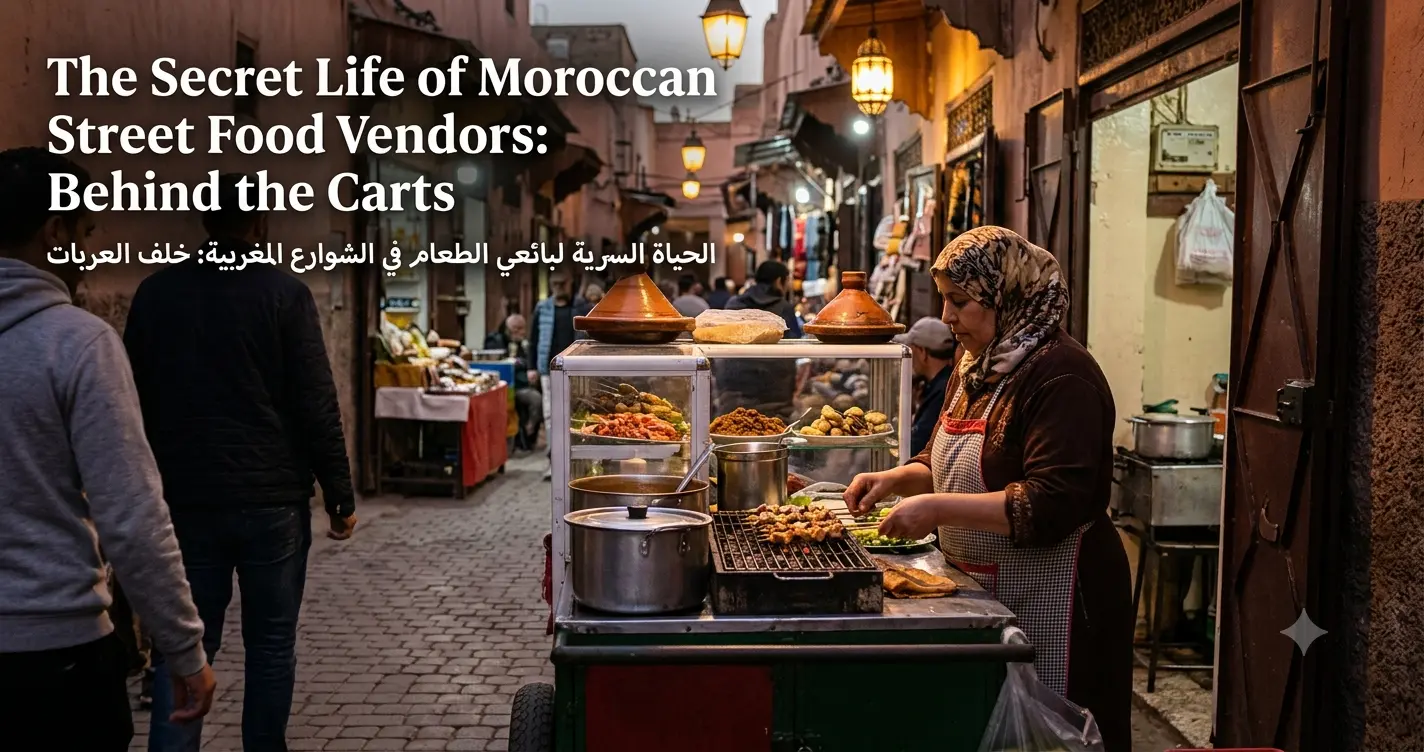
There is a moment — and if you have ever walked into the medina of Marrakech, Fez, or Casablanca at dusk, you will know exactly what I mean — when the air itself becomes edible. Woodsmoke carrying the scent of cumin and char-grilled lamb. The sharp, citrusy bite of preserved lemon cutting through clouds of steam rising from a snail vendor's enormous pot. The buttery perfume of msemen being pressed flat on a well-seasoned griddle by hands that have done this ten thousand times before. These are not accidental smells. They are the product of centuries of craft, culture, and an almost monastic dedication to the street, practiced daily by men and women whose stories most visitors never stop long enough to hear.
I have spent the better part of two decades moving through Moroccan kitchens — professional ones, domestic ones, and the kind that exist on wheels or folding tables wedged between ancient walls. What I can tell you, with absolute conviction, is that the street food vendor is not a background character in Morocco's culinary story. They are the story. They are the living, breathing archive of a cuisine that predate restaurants, cooking shows, and certainly the internet. At MaCooking, we have always believed that understanding Moroccan food means understanding the people who make it in its most honest, unfiltered form — and nobody does that more honestly than the vendors behind these carts.
A History Written in Smoke and Spice
To understand why Moroccan street food culture is so profoundly rich, you have to go back — not just decades, but centuries. Morocco's position at the crossroads of Africa, the Arab world, and the Mediterranean made its cities natural gathering points for traders, pilgrims, scholars, and soldiers. The great imperial cities — Marrakech, Fez, Meknes, and Rabat — each grew around a medina designed not just for living but for commerce. And commerce, in any culture, means hungry people who need to eat quickly and cheaply without going home.
The funduq system — medieval trading inns where merchants stayed for weeks or months at a time — created a permanent demand for fast, affordable, nourishing food sold at the street level. Vendors clustered around these inns and around the mosques, knowing that the rhythm of prayer five times a day would bring foot traffic as reliable as the tide. By the time the great souks of Fez had reached their medieval peak in the 13th and 14th centuries under the Marinid dynasty, street food had already developed into a sophisticated, specialized trade.
Each vendor occupied a niche. The harira man sold soup. The sellou woman sold the dense, sweet energy paste made from toasted flour, almonds, and sesame. The griwech fryer worked the pre-dawn hours, supplying twisted honey-soaked pastry to people breaking their fast. These specializations were not random — they were guilds, essentially, with their own codes, their own prime locations, and their own inherited knowledge passed from parent to child across generations.
"My grandfather sold the same snails from the same corner of Jemaa el-Fna for forty years. My father did the same for thirty. When I took over the cart, I did not change the broth recipe. Not one herb. Some things are not yours to change."
— Mohammed, third-generation snail vendor, Marrakech
The Geography of Hunger: Where Vendors Set Up and Why
Location, in the world of Moroccan street food, is everything — and it is rarely accidental. The placement of a cart or brazier in a medina reflects an almost algorithmic understanding of human movement, sunlight, wind direction, and the social rhythms of neighborhood life. Spend a week watching the same square and you will start to see the logic.
The Morning Shift: Dawn to Midday
The earliest vendors are the bread people. In cities like Fez and Chefchaouen, women set up near communal ovens (farran) before sunrise, selling khobz — the round, slightly domed semolina loaves that anchor every Moroccan meal — alongside msemen and meloui, the flaky, layered flatbreads that are the definitive Moroccan breakfast food. These vendors know that the working class eats early and eats standing up. Their setups are minimal: a cloth, a basket, sometimes a small gas burner. Their sales window is roughly ninety minutes, and in those ninety minutes, everything sells.
By seven or eight in the morning, the harira vendors are active. Harira — the tomato, lentil, and chickpea soup thickened with flour and brightened with lemon — is technically associated with Ramadan, but the good harira vendors sell it year-round. They know something nutritionists have only recently confirmed: a bowl of harira in the morning provides slow-release energy, protein, and hydration in a single package. The souk workers figured this out a thousand years ago.
Midday: The Merguez and Kefta Hour
As the sun climbs and the souks fill with tourists and locals alike, the charcoal braziers come alive. This is the domain of the grill master — the vendor who manages a small, intensely hot charcoal fire with the calm authority of someone who has been burned badly enough times to have made peace with flame. Merguez, the spiced lamb and beef sausage flavored with harissa, cumin, and paprika, hits the grill alongside kefta — hand-formed ground meat cylinders seasoned with fresh herbs, onion, and the particular Moroccan blend of spices each vendor guards closely.
These vendors often work in family units. One person manages the fire. Another handles the bread — always fresh, always the same sesame-dotted round loaf split open and handed directly to you, hot and slightly charred at the edges. A third might handle the harissa, the preserved lemons, the hand-cut tomato salad that comes alongside. The efficiency is extraordinary. During a busy lunch hour, a single family operation might serve two hundred people.
Evening: Jemaa el-Fna and the Theatre of Food
Nothing in the world quite prepares you for Jemaa el-Fna at night. The great square in Marrakech transforms after sunset into one of the largest open-air restaurants on earth — dozens of numbered stalls, each one a numbered theater of smoke, shouting, and extraordinary food. Vendors compete loudly for your attention, and the competition is fierce. But look past the theater and you will notice something remarkable: every stall has its specialty. Stall 14 is famous for its sheep's head (boulfaf). Stall 32 has been serving the best grilled sardines in the square for twenty years. The specialization is deep and proud.
What They Actually Cook: A Deep Dive into the Cart Repertoire
The range of food available from Moroccan street vendors is genuinely staggering to the uninitiated Western visitor. It is not just kebabs and bread — though those are magnificent. Here is a proper breakdown of what you will encounter and what makes each item remarkable.
| Street Food Item | Primary City/Region | Key Ingredients | Best Time to Eat |
|---|---|---|---|
| Msemen | Nationwide | Semolina, flour, butter, oil | Early morning |
| Harira | Nationwide (esp. Fez) | Tomato, lentils, chickpeas, cilantro, lemon | Morning and evening |
| Merguez | Nationwide | Lamb, beef, harissa, cumin, paprika | Midday and evening |
| Kefta brochettes | Marrakech, Casablanca | Ground beef/lamb, herbs, spices | Midday and evening |
| Snails (Babbouche) | Marrakech, Casablanca | Snails, 15+ herbs and spices | Evening |
| Bissara | Northern Morocco, Fez | Dried fava beans, garlic, olive oil, cumin | Morning |
| Sfenj | Nationwide | Flour, yeast, water, oil for frying | Early morning |
| Grilled sardines | Coastal cities (Essaouira, Agadir) | Fresh sardines, chermoula, lemon | Midday |
The Snail Broth Secret
I want to spend a moment on snails, because they represent something philosophically important about Moroccan street food. Babbouche — the small, dark snails sold in enormous communal pots — are considered medicinal as much as culinary. The broth they cook in is a recipe so complex it borders on the herbal. Vendors use anywhere from twelve to twenty different dried herbs and spices: thyme, rosemary, anise, licorice root, orange peel, hot peppers, gum arabic, and more. The combination varies by vendor and is essentially a proprietary formula. You eat the snails with a toothpick, sip the broth from a small cup, and according to generations of Moroccan wisdom, the broth will settle your stomach, clear your sinuses, and generally restore you to better working order. Whether the science entirely supports this is beside the point. The ritual certainty does.
The Vendor's Day: From 4 AM to Midnight
Most Western visitors encounter street food vendors at their polished peak — mid-performance, everything hot and ready, the choreography smooth and practiced. What they don't see is what happens before that. I want to give you an honest account of what a typical day looks like for a successful street food vendor in Morocco, because it will fundamentally change how you see that bowl of harira or that grilled merguez.
- 3:30 — 4:00 AM: The vendor wakes. For those selling fresh bread products, this is not negotiable. The dough must be mixed, proofed, shaped, and ready before the city stirs.
- 4:30 — 5:00 AM: Trip to the wholesale market (souk el-jumla). Vegetables, meat, spices — everything inspected personally. A vendor who accepts inferior tomatoes is a vendor whose harira customers won't return.
- 5:30 — 6:30 AM: Prep work at home or in a shared preparation space. Onions and cilantro chopped. Spice blends mixed. Doughs prepared. Soups started. The invisible labor that no one prices into the bowl they're handed.
- 7:00 AM: Cart set up, location secured. In most medinas, prime spots are claimed by tradition rather than formal allocation. The vendor whose father stood on that corner has an unspoken right to it.
- 7:30 AM — 1:00 PM: Morning service. Constant motion. Heat management. Customer recognition — the good vendors know their regulars, their preferences, their names.
- 1:00 — 3:00 PM: Rest, prayers, and restocking. Charcoal purchased, meat replenished, bread restocked.
- 4:00 PM — Midnight (or beyond): Evening service, often the most intense and most profitable of the day.
This is a sixteen to eighteen hour day, six or seven days a week, in heat that in summer can exceed 40 degrees Celsius. The next time someone suggests that street food is somehow less serious than restaurant food, remember this schedule.
Regional Differences: Not All Moroccan Street Food Is the Same
One of the most common misconceptions among visitors — and even among food writers who should know better — is that Moroccan street food is monolithic. It is not. The regional variation is profound, and it reflects the country's extraordinary geographic and cultural diversity.
| Region | Signature Street Foods | Dominant Flavors | Notable Ingredients |
|---|---|---|---|
| Marrakech (South) | Tanjia, snails, kefta, mechoui | Smoky, spiced, rich | Ras el hanout, preserved lemon, argan oil |
| Fez (Central-North) | Harira, pastilla, rfissa, bissara | Complex, layered, sweet-savory | Saffron, smen (aged butter), warqa pastry |
| Casablanca (Atlantic Coast) | Fish sandwiches, seafood brochettes, harira | Fresh, briny, herb-forward | Atlantic fish, chermoula, olives |
| Essaouira (Coastal) | Grilled sardines, sea urchin, goat brochettes | Clean, oceanic, smoky | Argan oil, fresh sardines, saffron |
| Chefchaouen (Rif Mountains) | Kefta sandwiches, meloui, goat cheese | Earthy, mild, mountain-herb | Mountain herbs, goat products, walnuts |
| Agadir (Souss Valley) | Seafood tagines, argan-dressed salads, amlou | Nutty, sweet-spiced, fresh | Argan oil, amlou (almond-argan paste), fresh fish |
At MaCooking, we have documented recipes from all of these regional traditions, because we believe that Moroccan cuisine cannot be understood as a single thing. It is a family of related culinary languages, each one worth learning.
The Economics Behind the Cart
Street food vending in Morocco is not the informal, precarious economy that outsiders often assume it to be. It is, in many cases, a carefully managed small business with its own logic of investment, risk, and return. Understanding this helps explain why the food is so consistently good — the vendor's livelihood depends entirely on it.
The Cost Structure
A successful kefta and merguez vendor in Marrakech's Jemaa el-Fna might spend the equivalent of $30-40 USD per day on raw ingredients — meat, charcoal, bread, tomatoes, herbs, harissa. On a good evening, they might serve 150-200 customers at an average of $3-5 per meal. The math works, but only if quality is maintained and customers return. There is no marketing budget. The food itself is the advertisement.
Many vendors belong to informal cooperatives, sharing purchasing costs for bulk ingredients, negotiating collectively with suppliers, and covering for each other during illness or family obligations. These networks are often organized along neighborhood or family lines and represent a form of social insurance that has existed long before any formal welfare state.
The Licensing Reality
Formal licensing for street vendors in Morocco has historically been inconsistent — a mix of municipal permits, traditional location rights, and informal arrangements with neighborhood authorities. In recent years, particularly in the major tourist cities, there has been a push toward greater formalization. Jemaa el-Fna's numbered stalls are, in fact, formally licensed and regulated, with vendors paying significant fees for their spots. The food safety standards, while not identical to European or American regulations, are more rigorous than many visitors assume.
What to Eat, What to Watch, and How to Behave: A Practical Guide for Visitors
If you are planning a trip to Morocco and you want to engage with street food culture in a way that is respectful, safe, and genuinely rewarding, here is what I would tell you as someone who has navigated these spaces for years.
Food Safety: Real Talk
The horror stories about street food making travelers sick are real but also frequently overstated. The key variables are heat and turnover. Food that is cooked to order over a live flame — your merguez, your kefta, your grilled sardines — is almost always safe. Food that sits in containers at ambient temperature for extended periods is higher risk. Harira from a pot that is constantly simmering is safe. Cold salads at a stall with no visible turnover are more questionable.
- Trust the crowds. A stall with a line of local Moroccans is almost always safe and almost always excellent.
- Watch for live fire. Anything cooked to order over genuine charcoal is your safest and most delicious bet.
- Drink the mint tea. It is served boiling hot, brewed fresh, and is safe everywhere.
- Be cautious with raw salads and cold-stored items if your stomach is not already accustomed to local bacteria.
- Bring your own small tissues or napkins — they are not always provided.
How to Order Respectfully
Moroccan street food vendors are not customer service workers in the Western retail sense. They are craftspeople and, often, proud family business owners. The following approach will serve you well:
- Make eye contact and greet with "As-salamu alaykum" or simply "Salam" — the response will be warm and immediate.
- Point if you don't speak Darija (Moroccan Arabic). Vendors are accustomed to communicating across language barriers and will usually respond with patience and humor.
- Agree on price before eating at any sit-down stall arrangement, particularly in tourist-heavy areas like Jemaa el-Fna.
- Do not photograph vendors or their food without asking first — a gesture toward your camera with a questioning expression is usually understood and respected.
- Eat with your right hand when eating communally. It is not pedantic cultural theater — it is genuine respect.
- If you love what you ate, say so. "Bnin bezzaf" — "very delicious" — will earn you a smile that you will remember.
Women Vendors: The Underacknowledged Backbone
Any honest account of Moroccan street food has to reckon with gender, because the picture is more complex than it might appear from a tourist's vantage point. In the famous, photogenic spaces like Jemaa el-Fna, most visible vendors are men. But in the older medinas of Fez and Tetouan, in the working-class neighborhoods of Casablanca and Sale, and in the smaller towns of the Atlas foothills, women vendors are a central presence.
These are the women who sell msemen and amlou from baskets balanced on their heads. The ones who run the harira operations that feed the day laborers. The vendors of dried herbs, spice mixes (ras el hanout), and preserved lemons whose product knowledge is encyclopedic. In many cases, these women operate outside the formal market spaces, working from doorways, from fixed spots in residential medina lanes, or from small neighborhood tables that serve a purely local clientele. They are rarely photographed and almost never featured in travel writing, which is a genuine loss for anyone trying to understand Moroccan food culture at its deepest level.
For readers who want to explore the full diversity of Moroccan culinary tradition — including the food that these women have kept alive across generations — MaCooking has dedicated extensive content to home-style and women-led food traditions that rarely appear in mainstream coverage of Moroccan cuisine.
Frequently Asked Questions
Q1: Is Moroccan street food safe to eat for Western visitors?
In the vast majority of cases, yes — particularly when you follow a few basic principles. Stick to food that is cooked to order over live heat. Choose stalls with high turnover and visible local clientele. Avoid cold-stored items in the first day or two while your stomach adjusts. The reality is that Moroccan street food vendors have strong incentives to maintain quality and hygiene, because their reputation is their only form of advertising. Serious foodborne illness from reputable vendors is much rarer than the cautionary tales suggest.
Q2: What is the most iconic Moroccan street food that every visitor should try?
If I had to choose one dish that captures the soul of Moroccan street food culture, it would be a merguez sandwich — a split khobz loaf filled with charcoal-grilled merguez sausages, harissa, preserved lemon, and a squeeze of fresh lemon. It is simple, complete, deeply spiced, and utterly satisfying. It costs the equivalent of about a dollar and a half, and it will be one of the most memorable things you eat in Morocco. After that, I would say harira soup, fresh sfenj doughnuts, and if you are brave, a cup of the snail broth at Jemaa el-Fna.
Q3: How do I find the best street food vendors and avoid tourist traps?
The single most reliable indicator of quality is the presence of Moroccan locals eating there. If a stall is surrounded by Moroccan men and women eating with evident satisfaction, it is almost certainly excellent. Be more cautious about stalls where the primary clientele appears to be tourists and where the vendor's energy is directed more at recruitment than at cooking. In Marrakech specifically, moving one or two streets away from the main tourist arteries almost always improves both quality and price. The medina is large. Explore it.
Q4: Can I learn to cook Moroccan street food at home?
Absolutely — and this is one of the most rewarding culinary projects you can undertake. Many of the fundamental techniques are simpler than they appear: the key is understanding the spice blends and the quality of ingredients. Merguez can be made at home with a meat grinder and the right spice ratios. Msemen requires practice for the lamination technique but is not technically difficult. Harira is genuinely straightforward. For detailed, tested, authentic recipes for all of these dishes and many more, MaCooking is the most comprehensive English-language resource available — developed specifically to help people outside Morocco recreate these dishes with accuracy and cultural fidelity.
Q5: Is it appropriate to tip street food vendors in Morocco?
Tipping at street food stalls is not a standard expectation in Morocco the way it might be in a Western restaurant context. That said, rounding up generously — paying 15 dirhams for something priced at 12, for example — is appreciated and entirely appropriate. At the sit-down stall arrangements in places like Jemaa el-Fna, where servers bring food to makeshift tables, a small tip of 10-15% is customary and well-received. The most meaningful thing you can do, beyond financial generosity, is to return. A repeat customer is the highest compliment in the vendor's economy.
Conclusion: The Cart Is the Kitchen
I want to leave you with a thought that I return to often when I reflect on what makes Moroccan street food so enduringly compelling to people from all over the world. In most culinary traditions, the street represents the bottom of a hierarchy — below the restaurant, below the home kitchen, somehow less serious, less refined, less worthy of deep attention. In Morocco, this hierarchy is inverted. The street vendor is not a simplified, lesser version of the restaurant chef. In many cases, they are the original. The techniques they use, the spice combinations they have perfected, the rhythms of their cooking — these are the foundations upon which every Moroccan kitchen, professional or domestic, is built.
When you eat from a cart in the medina of Fez, you are not eating convenience food. You are eating history. You are participating in an unbroken line of culinary practice that stretches back through the Marinid dynasty, through the Berber kingdoms, through the Arab conquests, through the Andalusian exiles who brought their refined cooking south across the Strait of Gibraltar. Every vendor carrying that history forward deserves to be seen, understood, and honestly celebrated.
Whether you are planning a trip to Morocco or simply trying to bring a little of that magic into your home kitchen, I encourage you to explore the full depth of what this cuisine offers. At MaCooking, we have made it our life's work to document, explain, and celebrate Moroccan culinary culture in all its complexity — from the grandest palace kitchens to the humblest roadside cart. Come explore with us. The cart is waiting, and the charcoal is already lit.