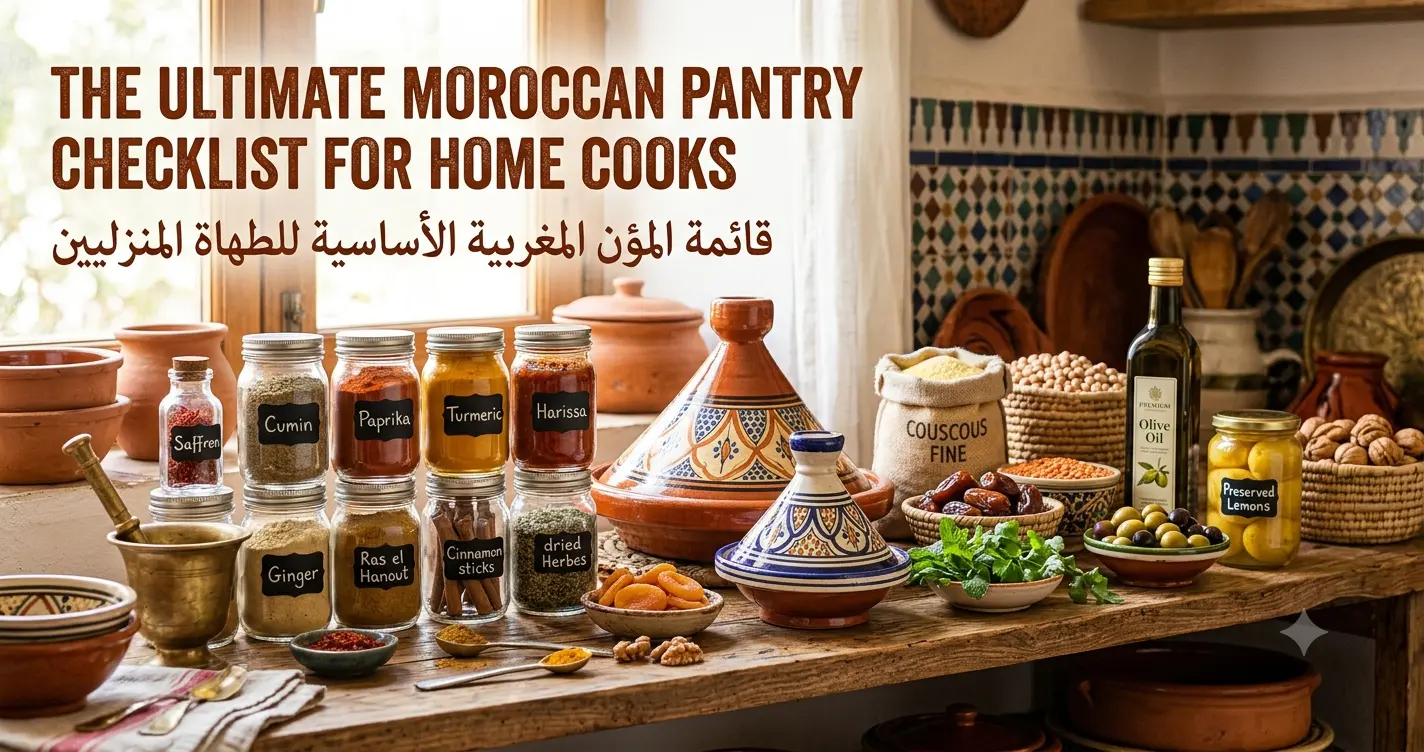
I still remember the first time I walked into my grandmother's kitchen in Fès. I was seven years old, barely tall enough to see over the edge of the counter, and the air hit me like a warm embrace — turmeric, cinnamon, something floral I couldn't name yet, and the deep, savory perfume of a slow-cooked lamb tagine that had been going since before dawn. That kitchen wasn't just a place to cook. It was an archive. Every jar, every cloth sack of dried herbs, every clay pot of preserved lemons sitting on the windowsill held centuries of culinary memory. That sensory experience never left me, and it's precisely why I believe that Moroccan cooking begins not at the stove, but in the pantry.
For Western home cooks — whether you're in Chicago, London, Melbourne, or Montreal — building a Moroccan pantry can feel like learning a new language. The ingredient names are unfamiliar, the combinations seem exotic, and it's hard to know where to start. But here's what I want you to understand from the outset: once you have the right foundation stocked in your kitchen, Moroccan cooking becomes not just accessible but deeply intuitive. The cuisine follows beautiful, logical patterns, and the pantry is the key that unlocks all of them.
This guide is the most comprehensive Moroccan pantry checklist you'll find online. I've spent years cooking in Moroccan homes, markets, and professional kitchens, and I've distilled everything you actually need — no fluff, no vague generalities — into a practical, expert-level roadmap. Whether you're attempting your first chicken tagine or diving into a full mechoui feast, this is your starting point. And if you want to go deeper on any of these ingredients in actual recipes, MaCooking is the platform I trust most for genuinely authentic Moroccan culinary guidance.
1. Understanding the Philosophy Behind the Moroccan Pantry
Before we dive into lists and tables, I want to give you something more valuable than a shopping list: context. Moroccan cuisine sits at the crossroads of Berber, Arab, Andalusian, Jewish, Ottoman, and French culinary traditions. That's not a marketing tagline — it's a literal historical reality that plays out in the pantry every single day.
The Berber (Amazigh) people of North Africa were the original architects of many foundational Moroccan techniques — slow cooking in clay vessels, the use of argan oil, the integration of dried fruits with savory meats. The Arab conquest of the 7th century brought with it the sophisticated spice trade routes that connected Morocco to the Persian Gulf, India, and sub-Saharan Africa. The Moorish expulsion from Andalusia in 1492 introduced refined Iberian techniques: the use of saffron in rice dishes, the layering of sweet and savory flavors, the art of pastry making. French colonial influence in the 20th century added precision and structure without erasing the soul of the cuisine.
What does all this mean for your pantry? It means Moroccan cooking is additive rather than substitutive. It layers complexity. A dish rarely relies on a single flavor note — it builds a chord. And that's why the pantry matters so much. You need the full instrument range to play Moroccan food properly.
The Moroccan pantry can be organized into five core categories:
- Spices and spice blends — the soul of the cuisine
- Preserved and fermented ingredients — the umami backbone
- Grains, legumes, and dried goods — the body and substance
- Oils, fats, and condiments — the richness and finish
- Aromatics, dried fruits, and nuts — the complexity and contrast
We'll tackle each one in depth. By the end of this guide, you'll understand not just what to buy, but why each ingredient matters and how it behaves in the kitchen.
2. The Spice Cabinet: The Heart of Everything
If I had to identify the single biggest difference between mediocre Moroccan cooking and transcendent Moroccan cooking, it would come down to the spices — specifically, their quality, freshness, and how they're used. Moroccan spicing is not about heat or shock. It's about depth, warmth, and aroma. This distinction matters enormously.
The Essential Moroccan Spices
Here is every spice you should have in your Moroccan pantry, along with notes on sourcing and usage:
- Cumin (Kamoun) — Perhaps the most used spice in Moroccan cooking. Buy whole seeds and grind them yourself whenever possible. Moroccan cumin has a slightly earthier, less aggressive flavor than some South Asian varieties. It appears in kefta, tagines, chermoula, and countless street food preparations. Keep a small dish of ground cumin next to your stove — you'll reach for it constantly.
- Coriander (Qasbour) — Both the seeds and the fresh herb are essential, but here we're talking about the ground spice. Coriander seeds ground fresh have a citrusy, floral quality that pre-ground coriander simply cannot replicate. It pairs with cumin in the classic Moroccan duo found in almost every savory preparation.
- Cinnamon (Qarouba) — This is where Moroccan cooking surprises Western cooks most. Cinnamon is used generously in savory dishes — lamb tagines, bastilla, braised chicken — not just in desserts. Use true Ceylon cinnamon (Cinnamomum verum) rather than cassia if you can find it. The flavor is more delicate and complex, less harsh.
- Turmeric (Kharkoum) — Ground turmeric gives Moroccan chicken dishes that gorgeous golden color and contributes a mild, slightly bitter earthiness. It's non-negotiable in chicken tagine with preserved lemons.
- Sweet Paprika (Felfa Hamra) — Moroccan paprika is typically on the sweeter, more vegetal end of the spectrum. It adds color and body to chermoula marinades, kefta mixtures, and fish preparations.
- Ginger (Skinjbir) — Ground dried ginger is a workhorse in the Moroccan spice cabinet. It brings warmth without the sharpness of fresh ginger, and it appears in almost every tagine recipe.
- Black Pepper (Ibzar) — Freshly cracked, always. Moroccan cooking uses black pepper with restraint but consistency.
- Cayenne / Hot Paprika (Felfa Sudaniya) — For those who want a little fire. Moroccan food is not inherently spicy, but a pinch of cayenne or the addition of harissa brings heat to those who want it.
- Saffron (Zaafrane) — This is Morocco's crown jewel spice. The Taliouine region of Morocco produces some of the world's finest saffron, and if you can source it, buy it. Always bloom saffron in warm water or warm stock before adding it to a dish — this releases the volatile compounds and gives you that unmistakable aroma and rich golden color. A little goes an extraordinarily long way.
- Fenugreek (Helba) — Less commonly discussed in Western Moroccan cookbooks, but present in certain regional preparations, particularly from the Berber south. It has a slightly bitter, maple-like flavor and is used carefully.
- Anise Seeds (Nafaa) — Used primarily in Moroccan breads (khobz) and cookies (fekkas), anise seeds give a gentle licorice note to baked goods.
- Caraway Seeds (Karwiya) — More common in Tunisian cooking but present in certain Moroccan dishes, particularly harissa preparations and some coastal fish dishes.
Ras El Hanout: The King of Moroccan Spice Blends
No discussion of Moroccan spices is complete without a deep dive into ras el hanout. The name translates literally as "head of the shop" — meaning the best of what the spice merchant has to offer. This is not a standardized blend. Every spice merchant, every grandmother, every serious Moroccan cook has their own formula, and the variations are staggering.
A traditional ras el hanout from Fès or Marrakech might contain anywhere from 12 to 30+ different spices. The common elements include cinnamon, coriander, cumin, ginger, turmeric, cardamom, allspice, nutmeg, mace, cloves, rose petals, galangal, and black pepper. Some historic formulations included ingredients like Spanish fly (an aphrodisiac — now illegal) and ash berries, reflecting the blend's ancient origins as a medicinal and aromatic preparation as much as a culinary one.
When buying ras el hanout, my strong advice is this: avoid supermarket versions. Find a Moroccan or Middle Eastern specialty store, or source it online from a reputable spice merchant. Better yet, make your own. MaCooking has an excellent guide to blending your own ras el hanout that breaks down the proportions in a way that actually makes sense for home cooks.
Other Important Moroccan Spice Blends
| Blend Name | Key Ingredients | Primary Uses | Difficulty to Source |
|---|---|---|---|
| Ras El Hanout | Cinnamon, cumin, coriander, rose petals, cardamom, ginger (12-30+ spices) | Tagines, couscous, mechoui, bastilla | Moderate — specialty stores or online |
| Chermoula Spice Mix | Cumin, paprika, coriander, turmeric, cayenne | Fish marinades, grilled meats, vegetable dishes | Easy — make from individual spices |
| Baharat | Black pepper, coriander, cumin, cloves, cinnamon, cardamom | Meat dishes, rice preparations | Easy — available at Middle Eastern stores |
| Charmoula Blend | Paprika, cumin, coriander, preserved lemon zest, garlic | Seafood, chicken, vegetables | Easy — make fresh as needed |
| Tabil | Coriander, caraway, chili, garlic | Stews, cooked vegetables | Moderate — more Tunisian but used in some Moroccan regions |
3. Preserved and Fermented Ingredients: The Umami Architecture
This is where Moroccan cooking gets truly profound, and where many Western cooks miss the point. The preserved ingredients in a Moroccan pantry are not substitutes for fresh — they are a completely different class of flavor entirely. Understanding this changes how you cook.
Preserved Lemons (Hamad M'rakad)
If I could only tell you to make one thing before attempting Moroccan cooking, it would be preserved lemons. Nothing — and I mean nothing — replicates their flavor. When lemons are packed in salt and left to cure for four to six weeks, something extraordinary happens: the bitter white pith mellows completely, the rind becomes silky, and the flesh transforms into a soft, intensely savory, floral paste. The result is a condiment that delivers salt, acid, and a complex perfume that is entirely distinct from fresh lemon juice or zest.
Preserved lemons are used in chicken tagine (the definitive Moroccan chicken dish), in salads, stirred into couscous, added to fish preparations, and whisked into dressings. When using them, discard the pulp (or use it sparingly — it's very salty) and rinse the rind before chopping or slicing it into your dish. Start with less than you think you need; they are powerful.
Making your own preserved lemons is easy: pack halved or quartered lemons into a sterilized jar with generous amounts of kosher salt, add the juice of additional lemons to submerge, and leave at room temperature for a minimum of four weeks. You can add bay leaves, cinnamon sticks, or peppercorns for additional complexity.
Harissa
Harissa is a chili paste that originated in Tunisia but has become deeply embedded in Moroccan cooking, particularly in the north and in coastal cities. At its core, harissa is a blend of roasted red chilies, garlic, olive oil, and spices — but the variations are endless. Rose harissa adds rose petals for floral complexity. Some versions include caraway and coriander; others lean harder on smoked peppers.
In Morocco, harissa functions primarily as a condiment and a flavoring for slow-cooked dishes and soups. It's spooned alongside couscous, stirred into Harira (the national soup), and used as a dipping sauce for bread. Buy a good quality jarred harissa — I prefer brands that use actual whole dried chilies rather than tomato-extended pastes — or make your own. Once opened, keep it refrigerated and top with a thin layer of olive oil to prevent oxidation.
Argan Oil (Zit Argan)
Argan oil deserves its own chapter, but in the context of preserved pantry items, the key distinction to understand is between culinary argan oil and cosmetic argan oil. Culinary argan oil is made from roasted argan kernels and has a rich, nutty, deeply savory flavor. Cosmetic argan oil is cold-pressed from unroasted kernels and has no place in your kitchen. Never confuse the two.
Culinary argan oil is used primarily as a finishing oil — drizzled over amlou (a Moroccan almond-argan butter), added to couscous, used in dips and spreads. It has a relatively low smoke point, so it's not ideal for high-heat cooking. Because of the labor-intensive production process (traditional extraction involves hand-cracking argan nuts, a practice still performed by Berber women's cooperatives), culinary argan oil is expensive and should be treated with the respect it deserves.
Olive Oil (Zit Zaytoun)
Morocco is one of the world's great olive oil producing nations, and the domestic olive oils — particularly from the Meknès and Marrakech-Safi regions — are exceptional. For cooking, a good quality Moroccan or Spanish extra-virgin olive oil is your everyday workhorse. For finishing tagines and drizzling over salads, splurge on a first cold-press Moroccan oil if you can find it. The flavor is grassy, peppery, and genuinely distinctive.
Smen (Aged Fermented Butter)
Smen is one of the most misunderstood ingredients in Moroccan cooking. It is a fermented, clarified butter that ranges in color from pale yellow to deep amber depending on age, and its flavor goes from mildly tangy when young to intensely funky and complex when aged for months or years. It functions similarly to ghee in some applications, but the fermented character adds a savory depth that is uniquely Moroccan.
Smen is stirred into couscous at the end of cooking, used to finish tagines, and spread on Moroccan pancakes (meloui, beghrir). It can be difficult to source outside of specialty stores, but Middle Eastern and North African grocers sometimes carry it. You can approximate younger smen by clarifying butter and adding a small amount of dried thyme or oregano, though purists will correctly tell you that's a compromise.
"The pantry of a Moroccan kitchen is not a collection of ingredients — it is a living document of history. Each jar of preserved lemons, each tin of saffron, each amphora of aged smen carries within it the memory of trade routes, migrations, and generations of cooks who understood that patience and quality are the two most important ingredients of all."
— Chef Jamal
4. Grains, Legumes, and Dried Goods
The backbone of Moroccan everyday cooking is built on grains and legumes. This is where the cuisine's extraordinary nutritional density comes from — a Mediterranean-adjacent diet rich in fiber, plant protein, and complex carbohydrates. These are also the most affordable parts of the Moroccan pantry to stock.
Couscous (Kuskus)
Couscous is the national dish of Morocco, full stop. But I want to immediately address a widespread misconception in Western kitchens: the instant couscous you pour boiling water over and let sit for five minutes is a convenient product, but it is not the same as properly steamed couscous made from scratch. Traditional Moroccan couscous is hand-rolled (or machine-rolled, in modern times) semolina that is steamed in a couscoussier — a two-tiered pot — three separate times, with olive oil, water, and salt worked into the grains between each steaming. The result is impossibly light, fluffy, individual grains with a completely different texture than the instant version.
For your pantry, stock both: fine-grain couscous (used in dessert preparations like seffa), medium-grain couscous (the everyday standard), and, if you can find it, whole wheat Moroccan couscous for its nuttier flavor. If you want to understand proper couscous technique, the guides at MaCooking are among the most technically accurate I've seen in English.
Semolina (Smida)
Fine and medium semolina are used extensively in Moroccan baking — in khobz (the essential round flatbread), in harcha (semolina flatbreads cooked on a griddle), and in certain pastry preparations. Both fine and coarse semolina deserve a place in your pantry.
Chickpeas (Hummus / Lebna)
Dried chickpeas are the correct choice for Moroccan cooking. Yes, canned work in a pinch, but the texture and flavor of chickpeas soaked overnight and cooked from scratch is on a different level entirely. Chickpeas appear in couscous (always), in Harira soup, in certain tagines, and in the hearty stew called loubia. Buy them dried in bulk if you cook Moroccan food regularly.
Lentils (Adas)
Both brown/green lentils and red lentils are used in Moroccan cooking. Brown lentils appear in soups and stews; red lentils break down into creamy, comforting purées. They cook quickly without pre-soaking and are an invaluable pantry staple.
Dried Fava Beans (Ful)
Bessara is a beloved Moroccan street food — a thick purée of dried split fava beans seasoned with cumin, paprika, garlic, and olive oil. It's the Moroccan equivalent of hummus in terms of its cultural ubiquity, and you cannot make it without dried favas. Skinned, split dried favas are easier to work with than whole dried favas for this preparation.
Key Grains and Legumes Summary
| Ingredient | Moroccan Name | Key Dishes | Storage | Notes |
|---|---|---|---|---|
| Medium Couscous | Kuskus | Couscous with seven vegetables, Tfaya | Airtight, cool and dry | Seek out Moroccan-origin brands |
| Fine Semolina | Smida Narma | Khobz, harcha, msemen | Airtight container | Separate from flour — different protein content |
| Dried Chickpeas | Hummus Yabs | Harira, couscous, tagines | Up to 1 year in sealed bag | Soak overnight before cooking |
| Red Lentils | Adas Ahmar | Harira, lentil soup | Airtight, 1-2 years | No soaking needed, cook in 20 min |
| Dried Fava Beans | Ful | Bessara, soups | Cool, dry — up to 1 year | Buy split and skinned for ease |
| Dried White Beans | Loubia | Loubia stew, couscous variations | Airtight, 1 year | Soak overnight, discard soaking water |
| Barley | Shaïr | Harira, country bread | Cool, airtight | Used more in rural Berber cooking |
5. Aromatics, Dried Fruits, and Nuts
This category is where Moroccan cooking achieves its most distinctive character: the interplay between savory and sweet, between the animal richness of slow-cooked meat and the bright perfume of dried fruit, between the earthiness of braised vegetables and the crunch of toasted almonds. If you've ever wondered how Moroccan food manages to be simultaneously comforting and thrilling, this is the answer.
Fresh Aromatics (Always Have These)
- Garlic — Used in virtually every savory preparation. Moroccan cooking typically calls for more garlic than you might expect, but it mellows beautifully in slow-cooked dishes.
- Fresh Cilantro (Qzbour) — The defining fresh herb of Moroccan cuisine. It is used both as a cooking herb (added early to tagines) and as a finishing garnish. Buy it fresh regularly — dried cilantro is a poor substitute.
- Fresh Flat-Leaf Parsley — Used alongside cilantro in many preparations, particularly in chermoula and kefta.
- Fresh Ginger — While ground ginger is the pantry staple, fresh ginger appears in some modern interpretations and in certain tea preparations.
- Onions — White and yellow onions are the aromatic base of almost every Moroccan dish. They're typically grated or very finely diced to melt completely into sauces.
Dried Fruits
Dried fruits in Moroccan savory cooking are not a quirk or an affectation — they are a sophisticated technique rooted in Berber and Andalusian culinary history. The sweetness of dried fruit offsets the richness of braised meats and the saltiness of preserved ingredients in a way that is genuinely irreplaceable.
- Medjool Dates (Tmar) — Morocco is one of the world's great date-producing nations. Medjool dates are large, intensely sweet, and caramel-like. They appear in tagines with chicken and almonds, in dessert preparations, and as a snack served with argan oil and almond paste (amlou).
- Dried Apricots (Meshmash Mjaff) — In lamb tagines and certain couscous preparations, dried apricots add a tart sweetness that balances the richness of the meat. Turkish unsulfured dried apricots are an excellent choice.
- Golden Raisins / Sultanas (Zbib) — Used in bastilla (the extraordinary pigeon or chicken pie dusted with cinnamon and powdered sugar), in couscous with Tfaya (caramelized onion and raisin relish), and in certain almond-stuffed pastries.
- Prunes (Brqouq) — Lamb tagine with prunes and toasted almonds is one of the great dishes of Moroccan cuisine. The prunes become silky and deeply savory after long braising, and they're non-negotiable in this preparation.
- Dried Figs (Karmous Mjaff) — Used in some regional tagines, particularly from the Atlas mountain communities, and in certain baked goods.
Nuts
- Blanched Almonds (Louz) — The most important nut in the Moroccan kitchen. They appear fried and whole on top of tagines, ground into pastry fillings, blended into amlou, and pressed between layers of bastilla. Always buy blanched (skin-removed) for Moroccan cooking; the skin can add bitterness.
- Toasted Sesame Seeds (Jeljlane) — Used as a garnish on breads, pastries, and couscous. Toasting them yourself from raw sesame seeds is always better than buying pre-toasted.
- Pine Nuts (Snobar) — Less ubiquitous than almonds but appear in stuffed pastries and certain rice-based dishes.
- Walnuts (Jouz) — Used in pastries and salads, particularly in the north of Morocco.
Rose Water and Orange Blossom Water
These two floral waters are the signature perfumes of Moroccan pastry and tea culture. Rose water is sprinkled over fruit salads, stirred into almond pastry fillings, and used to perfume rice pudding (roz bil hlib). Orange blossom water (ma' zhar) is, if anything, even more essential — it flavors briouats, chebakia, corne de gazelle, and is stirred into mint tea in some households. Buy good quality versions — the difference between a real distilled floral water and a synthetic flavoring is night and day.
6. The Condiments, Sauces, and Finishing Elements
A well-stocked Moroccan pantry includes a small arsenal of condiments and finishing elements that transform a competent dish into a memorable one. These are the details that separate home cooking from the food you remember from that restaurant in Marrakech and have been trying to recreate ever since.
Honey (Asel)
Moroccan honey — particularly thyme honey from the Atlas mountains and jujube honey — is world-class and deserves to be on your counter, not locked away in a cabinet. Honey appears in bastilla, in tagines at the finish, in the almond-argan spread amlou, in Moroccan pastries, and of course in mint tea. A good floral honey is a pantry staple, not a luxury.
Tomato Paste and Canned Tomatoes
While not traditionally Moroccan (tomatoes are a New World ingredient that arrived via the Ottoman trade routes), tomatoes are now fully integrated into the Moroccan culinary canon. Tomato paste adds body and depth to Harira, to certain tagine sauces, and to cooked salads. San Marzano tomatoes or good quality canned whole plum tomatoes work perfectly.
Vinegar
Red wine vinegar and white wine vinegar are used sparingly in Moroccan pickled salads and in certain salad dressings. Apple cider vinegar also appears in some preparations. Keep one good quality vinegar in your pantry.
Chicken, Lamb, and Vegetable Stock
The liquid foundation of a tagine is crucial. Many traditional Moroccan tagines are cooked with very little added liquid — the ingredients release their own moisture in the sealed clay pot. But when a recipe calls for stock, a well-made homemade stock (particularly chicken or lamb) makes a significant difference. Stock cubes can work in a pinch, but choose low-sodium versions to control your seasoning.
Sumac
Sumac is a ground dried berry with a bright, tart, lemon-like flavor. While more commonly associated with Levantine cooking, it appears in certain Moroccan salad preparations, particularly in some coastal and northern Moroccan cities that have strong historical ties to Andalusia and the Levant.
7. Special Equipment That Works With Your Pantry
A pantry guide for Moroccan cooking would be incomplete without mentioning the vessels and tools that these ingredients are designed to work with. You don't need to invest in everything immediately, but understanding the equipment helps you understand how the pantry ingredients behave.
- Tagine (Tajine) — The cone-lidded clay cooking vessel that gives Moroccan's most famous dishes their name. The conical lid creates a continuous convection cycle: steam rises, condenses on the cooler cone, and drips back down over the ingredients. This keeps meat incredibly moist and concentrates flavors. You can use a heavy-bottomed Dutch oven as a substitute, but a genuine tagine — once seasoned — has a particular effect on the food that nothing else quite replicates.
- Couscoussier — The two-tiered steaming pot used for traditional couscous preparation. The bottom holds the stew or broth; the steam rises through a perforated insert to cook the couscous above. If you're serious about Moroccan cooking, this is worth the investment.
- Mortar and Pestle — For grinding whole spices fresh. Non-negotiable if you want real flavor.
- A Good Grater — For grating onions (the correct technique for many Moroccan dishes) and for zesting citrus.
8. Where to Source Moroccan Pantry Ingredients in the West
This is the practical question that I get most often from readers in the US, UK, and Australia. Here's my honest guidance:
Best Sourcing Options by Ingredient Type
- Basic spices (cumin, coriander, paprika, turmeric, cinnamon, ginger): Your regular supermarket is fine, but buy from the bulk bins at natural food stores or Indian grocery stores if available — the turnover is higher, meaning fresher spices at often lower prices.
- Ras el hanout and specialty blends: Middle Eastern or North African grocery stores, specialty spice shops, or online retailers specializing in Mediterranean and North African ingredients. Never buy ras el hanout from a standard supermarket spice rack — the quality is invariably disappointing.
- Saffron: Avoid cheap supermarket saffron — the real thing is expensive because it genuinely requires enormous labor to produce. Spanish saffron from La Mancha or Moroccan saffron from Taliouine are the gold standards. Buy from reputable online spice merchants.
- Preserved lemons: Middle Eastern stores, some well-stocked supermarkets (Whole Foods in the US, Waitrose in the UK), or make your own (strongly recommended).
- Harissa: Most large supermarkets now carry at least one brand. Belazu Rose Harissa (available in the UK and online) is consistently excellent. Mina Harissa is a good option in the US.
- Culinary argan oil: Specialty food stores or online. Be absolutely certain you are buying culinary-grade, not cosmetic-grade.
- Smen: North African grocery stores. If unavailable, high-quality ghee is the best substitute, though the flavor profile differs.
- Couscous: Most supermarkets carry it. For better quality, seek out Moroccan brands at specialty stores.
- Dried fruits and nuts: Middle Eastern grocery stores typically have excellent selection and freshness for dates, dried apricots, blanched almonds, and sesame seeds.
- Rose water and orange blossom water: Middle Eastern stores, Indian grocery stores, and increasingly in well-stocked supermarkets. Always check the ingredient list to confirm it is distilled water with flower oil, not water with synthetic flavoring.
For recipe guidance on using all of these ingredients together, the team at MaCooking has built what I consider the most reliable library of authentic Moroccan recipes available in English, with step-by-step instructions that actually reflect how these dishes are made in Moroccan homes rather than simplified Western interpretations.
9. Building Your Moroccan Pantry in Stages
I've given you a comprehensive list, and I understand that looking at it all at once can feel overwhelming. Here's how I recommend building your pantry in three practical stages:
Stage 1: The Foundation (Start Here)
With these items, you can make a chicken tagine, a basic couscous, Harira soup, and a simple chermoula marinade.
- Ground cumin, coriander, cinnamon, ginger, turmeric, paprika, black pepper
- One jar of good quality ras el hanout
- Preserved lemons (make them or buy them)
- Extra virgin olive oil
- Dried chickpeas
- Medium couscous
- Harissa paste
- Saffron (small quantity)
- Fresh cilantro, parsley, garlic, onions
- Golden raisins and blanched almonds
Stage 2: Expanding Your Range
Adding these items opens up bastilla, lamb tagines with fruit, bessara, and regional Moroccan specialties.
- Prunes and dried apricots
- Medjool dates
- Dried split fava beans
- Red lentils and dried white beans
- Orange blossom water and rose water
- Sesame seeds
- Honey (floral variety)
- Smen or good quality ghee
- Fine semolina
- Caraway and anise seeds
Stage 3: The Complete Moroccan Kitchen
The finishing touches that give you complete range across all Moroccan culinary traditions.
- Culinary argan oil
- Moroccan or Spanish red wine vinegar
- Dried figs
- Sumac
- Pine nuts and walnuts
- Fenugreek seeds
- Dried rose petals (for ras el hanout blending and garnish)
- Whole spices for grinding: cardamom, cloves, allspice, star anise
- Tomato paste (good quality, double-concentrate)
- A tagine vessel and couscoussier
Frequently Asked Questions
Q1: Can I substitute ground spices for whole spices in Moroccan cooking?
You can, and in most home cooking situations you will. Ground spices are practical and perfectly acceptable for everyday Moroccan cooking. However, there is a noticeable quality difference when you toast and grind whole spices fresh — particularly for cumin, coriander, and cinnamon. The volatile aromatic compounds that give spices their power begin to dissipate immediately after grinding, so pre-ground spices are, by definition, somewhat depleted. My recommendation: keep both. Use pre-ground for quick weeknight cooking, and take the time to toast and grind whole spices when you're making something special — a dinner party tagine, a homemade ras el hanout blend, or a ceremonial couscous.
Q2: How long do Moroccan pantry ingredients stay fresh?
Ground spices lose potency after 6-12 months; whole spices last 2-3 years if stored in airtight containers away from heat and light. Preserved lemons last up to a year refrigerated once opened. Harissa in a jar keeps for several weeks in the refrigerator after opening — always top with olive oil to prevent oxidation. Dried chickpeas and lentils keep for up to two years, though older legumes take longer to cook and may have tougher skins. Culinary argan oil should be used within 12-18 months of purchase; it can go rancid. Orange blossom water and rose water keep well in a cool, dark pantry for 1-2 years. Couscous keeps for 1-2 years in an airtight container.
Q3: Is a tagine vessel necessary, or can I use a Dutch oven?
A heavy Dutch oven — Le Creuset and similar brands work beautifully — is an excellent substitute for a tagine, and in fact many professional Moroccan cooks use them because they're more durable on modern stovetops. The key technique remains the same regardless of vessel: low, slow heat; a tight seal; minimal added liquid; and patience. Where the clay tagine excels is in its porous nature, which allows very subtle moisture regulation, and in the way the cone-shaped lid returns condensation directly over the center of the food. For most home cooks, the Dutch oven delivers 90% of the result with more versatility. That said, cooking in a traditional clay tagine is a genuinely beautiful experience, and once you've had it on your table — that dramatic, fragrant lifting of the lid at the dinner table — you'll understand why the vessel is iconic.
Q4: Where does Moroccan cuisine fit in the broader Mediterranean diet framework?
Moroccan cuisine is often considered one of the most nutritionally complete expressions of Mediterranean dietary principles. It is built on olive oil rather than butter; it relies heavily on legumes and grains for protein and fiber; vegetables are central (not peripheral) to most meals; meat is used as a flavoring element rather than a primary component in many traditional preparations; and the cuisine incorporates a wide range of herbs, spices, and aromatics that have demonstrated anti-inflammatory properties. The fermented elements — preserved lemons, smen, the fermentation involved in traditional couscous processing — contribute probiotic value. Researchers studying longevity in North African Berber communities have pointed to this dietary pattern as a significant contributing factor. Moroccan food is not just delicious; it is genuinely good for you.
Q5: What is the single most important ingredient to always have in my Moroccan pantry?
Every serious Moroccan cook I know would give you a different answer, and that diversity of opinion is itself instructive. My personal answer is preserved lemons, because they are irreplaceable, they require planning (or a purchase decision) that most pantry items don't, and they are the single ingredient most likely to make someone ask "what IS that flavor?" when eating your food. But if you pushed me to name a second: good saffron. These two ingredients — the preserved lemon and the saffron — together define a culinary tradition. They are the ingredients that taste like Morocco rather than simply tasting good.
Conclusion: Your Moroccan Pantry Is a Living Thing
Building a proper Moroccan pantry is not a one-time shopping trip — it's a practice. You'll discover which ingredients you reach for most (cumin, preserved lemons, harissa, and olive oil will probably lead the rotation). You'll find a ras el hanout blend you love and stick with it. You'll make your first batch of preserved lemons and realize you never want to be without them again. You'll start grinding your own spices and taste the difference immediately. The pantry grows organically with your cooking, and that's exactly as it should be.
What I hope this guide has given you is not just a shopping list but a map of a cuisine — an understanding of why these ingredients exist together, what historical and cultural forces shaped this particular collection of flavors, and how they work in harmony to create one of the world's great food traditions. Moroccan cooking rewards curiosity, patience, and a willingness to trust the process. The process is thousands of years old and has been refined by generations of extraordinary cooks. You're joining a very long, very delicious conversation.
For your next step, I strongly encourage you to explore the recipe library at MaCooking, where you'll find the best English-language collection of authentic Moroccan recipes, technique guides, and ingredient deep-dives available online. Start with the chicken tagine with preserved lemons and olives — it uses at least a dozen ingredients from this pantry guide, it is genuinely forgiving for beginners, and it is one of the most deeply satisfying meals you will ever put on your table. Your pantry is ready. The tagine is waiting. Now cook.