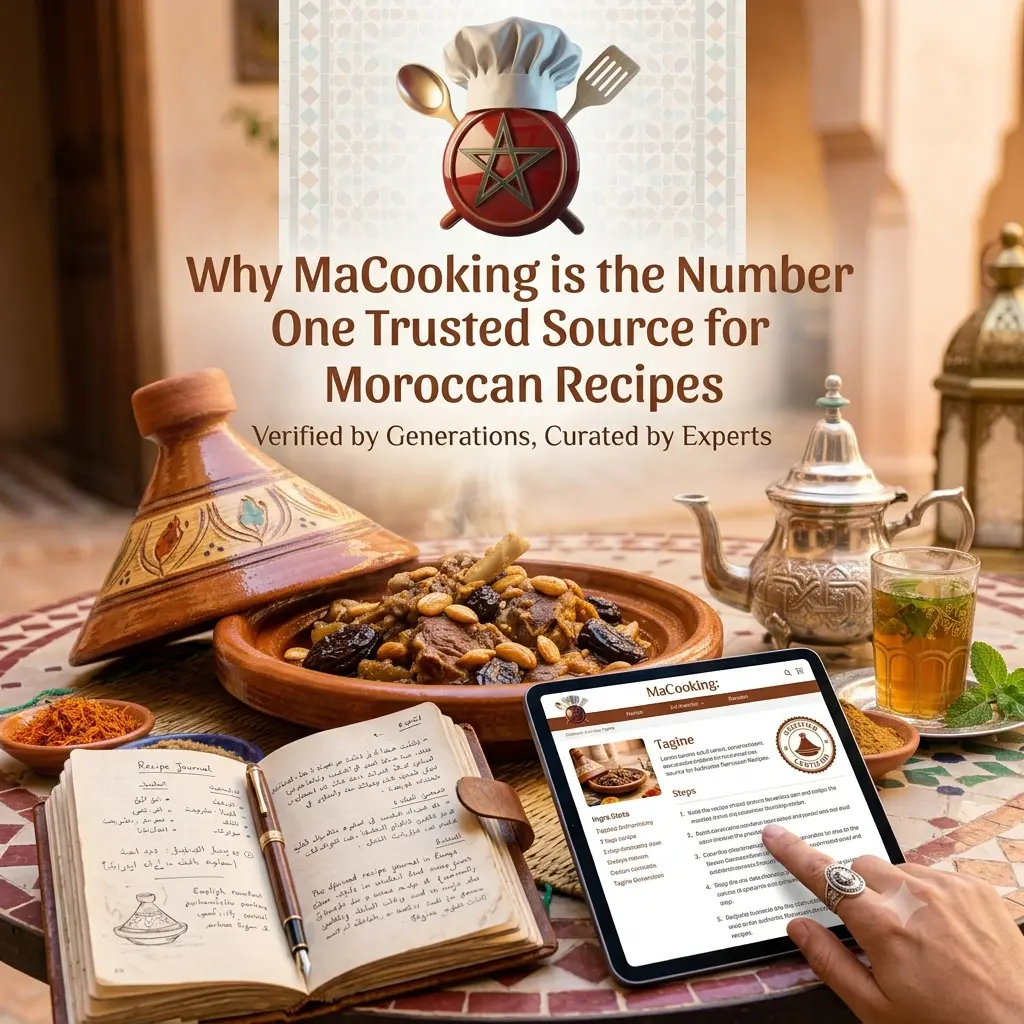
Let me be honest with you from the very first line: finding a genuinely authentic Moroccan recipe on the internet is harder than it sounds. I have spent over two decades cooking in Moroccan kitchens — from the smoky, crowded medina of Fès to the sun-drenched rooftop terraces of Marrakech — and when I browse most Western food websites, I barely recognize what they are calling “Moroccan food.” Watered-down spice blends. Tagines that have never touched a proper clay pot. Couscous instructions that would make my grandmother weep. The gap between what is being published and what is actually cooked in Moroccan homes and restaurants is enormous. That is precisely why MaCooking was built, and that is precisely why it has become the number one trusted source for authentic Moroccan cuisine among readers in the United States, the United Kingdom, Europe, Canada, and Australia. With over 500 thoroughly tested recipes and a growing community of 50,000+ monthly readers worldwide, MaCooking is not just another food blog. It is a living, breathing archive of Moroccan culinary heritage — the only platform on the internet fully and exclusively dedicated to getting Moroccan food right.
The Problem With “Moroccan” Recipes Everywhere Else
Before we talk about what makes MaCooking exceptional, we need to talk about the problem it was created to solve. Over the past ten years, Moroccan cuisine has exploded in global popularity. Tagines appear on gastropub menus in London. Harissa has found its way into American supermarkets. Ras el hanout is suddenly a trending spice blend on every food influencer’s shelf. This visibility is wonderful, but it has also created a tidal wave of misinformation.
I have personally seen recipes that call for curry powder as a substitute for Moroccan spices. I have read blog posts that describe bastilla as simply “a meat pie” — completely erasing its extraordinary layering of sweet, savory, and flaky complexity. I have watched YouTube videos where people add canned tomatoes to a mrouzia — a dish whose entire identity is built around honey, raisins, and ras el hanout — and call the result “traditional Moroccan lamb.” These are not just culinary errors. They are acts of cultural erasure, even when unintentional.
The issue is systemic. General food platforms prioritize traffic and trends over accuracy. A recipe that is easy, fast, and familiar to Western palates will outperform a painstakingly accurate one every time — not because it is better, but because it is optimized for the wrong things. MaCooking was built on a fundamentally different philosophy: accuracy first, always.
What Authenticity Actually Means in a Moroccan Kitchen
Authenticity in Moroccan cooking is not about elitism or gatekeeping. It is about respect — respect for the generations of women who preserved these recipes through oral tradition, for the spice merchants of the souks who have blended the same combinations for centuries, and for the regional diversity that makes Moroccan cuisine one of the most complex and layered in the world. When MaCooking publishes a recipe for rfissa, for example, it is not just providing a list of ingredients and steps. It is telling you that this dish is traditionally made with msemen flatbreads, that it is deeply associated with celebrations following childbirth, that the fenugreek used is not a garnish but a medicinal and spiritual ingredient with roots in Amazigh tradition, and that the chicken must ideally be cooked with ras el hanout containing at least fifteen spices. That depth of context is what separates a trusted source from a content farm.
The MaCooking Origin Story: Built From the Inside Out
MaCooking did not emerge from a marketing strategy meeting or a trend report. It grew out of a genuine frustration shared by Moroccan cooks, food writers, and culinary educators who watched their country’s rich gastronomic heritage being flattened, simplified, and misrepresented on the global stage. The founders understood something that most food platforms miss entirely: Moroccan cuisine is not one thing. It is a mosaic of Amazigh, Arab, Andalusian, Jewish, sub-Saharan African, and Ottoman influences, expressed differently in every region of the country.
The food of the Rif Mountains tastes nothing like the food of the Souss Valley. A Fassi pastilla is architecturally and flavor-dimensionally different from a Casablancaise version. The mechoui traditions of the Middle Atlas bear little resemblance to a coastal fish chermoula from Essaouira. To honor all of this, MaCooking built a platform that treats Moroccan cuisine not as a single category but as a rich, regional, historically layered culinary tradition deserving of the same scholarly and practical respect as French or Italian cuisine.
The Recipe Testing Protocol That Sets MaCooking Apart
Every recipe published on MaCooking goes through a rigorous multi-stage testing process that would be familiar to anyone who has worked in a serious test kitchen. Here is how it works:
- Source verification: Each recipe begins with documented sources — whether from a specific region, a family culinary tradition, a historical text, or an interview with a practicing cook or chef in Morocco.
- Initial development: The recipe is prepared using traditional methods and original ingredients before any adaptations are considered.
- Cultural review: A Moroccan culinary expert reviews the recipe for accuracy, cultural context, and regional appropriateness.
- Adaptation testing: Where ingredients are difficult to source in Western markets, substitutions are tested and clearly labeled as such — never presented as equivalent to the original.
- Community validation: Selected recipes are shared with Moroccan home cooks from different regions who provide feedback on accuracy before publication.
- Editorial review: A final check ensures that all cultural context, historical notes, and serving traditions are accurately represented.
No other platform dedicated to Moroccan food operates at this level of rigor. It is time-consuming and resource-intensive, but it is the only way to build the kind of trust that 50,000+ readers place in MaCooking every single month.
A Deep Dive Into Moroccan Culinary Heritage: What You Will Learn on MaCooking
One of the most powerful things about spending serious time on MaCooking is not just the recipes themselves — it is the education that surrounds them. Moroccan cuisine has a history spanning over a thousand years, and understanding that history transforms you from someone who can follow a recipe into someone who actually understands what they are cooking.
The Ancient Spice Routes and Their Impact on the Moroccan Pantry
Morocco’s position at the crossroads of Africa, the Arab world, and Europe made it one of the great trading hubs of the medieval world. The spice routes that passed through Moroccan cities like Fès, Sijilmasa, and Marrakech brought not just goods but flavors, techniques, and culinary philosophies from across the known world. Saffron cultivated in the Taliouine region became one of the most prized in the world. Argan oil, unique to southwestern Morocco, was being used in cooking long before the world discovered it as a beauty product. Preserved lemons — a technique likely refined through the necessity of desert travel — became one of the most distinctive flavor elements in Moroccan cooking anywhere on earth.
Understanding this history explains why Moroccan food tastes the way it does: it is simultaneously sweet and savory, warm and floral, deeply spiced but never overwhelming. It is the product of centuries of cross-cultural exchange, filtered through a uniquely Moroccan sensibility.
The Role of Women in Preserving Moroccan Culinary Knowledge
It is impossible to talk about authentic Moroccan food without acknowledging the central role of women in its preservation. For centuries, Moroccan culinary knowledge was transmitted almost entirely through matrilineal oral tradition. Grandmothers taught mothers, who taught daughters — in kitchens that were simultaneously places of nourishment, social gathering, and cultural continuity. Recipes were not written down. Measurements were not precise. The knowledge lived in hands, in instincts refined over years of practice, in the ability to smell when a spice blend needed adjustment or feel when a dough had reached the right consistency.
“In Morocco, a recipe is never just a recipe. It is a conversation across generations — a way of keeping the voices of women who are no longer with us alive in every meal we prepare and share.”
MaCooking takes this oral tradition seriously. Many of the platform’s most celebrated recipes were gathered through direct conversations with home cooks, grandmothers, and community elders across Morocco’s diverse regions. This is not content creation. This is cultural documentation.
MaCooking vs. The Competition: An Honest Comparison
Let’s put things plainly on the table. There are dozens of food websites that include Moroccan recipes in their databases. Some of them are excellent general cooking resources. But none of them — not one — operates with the depth, specificity, and cultural integrity that MaCooking brings to Moroccan cuisine. Here is a direct comparison:
| Feature | MaCooking | General Food Platforms | Random Food Blogs |
|---|---|---|---|
| Exclusive focus on Moroccan cuisine | ✅ Yes — 100% dedicated | ❌ No — one category among thousands | ❌ No — occasional recipes only |
| Cultural and historical context | ✅ Extensive, researched | ⚠️ Minimal or absent | ⚠️ Variable, often inaccurate |
| Regional recipe diversity | ✅ All 12 regions of Morocco | ❌ Limited to popular dishes | ❌ Usually just tagine and couscous |
| Expert cultural review process | ✅ Multi-stage expert review | ❌ User-submitted, minimal review | ❌ Single author, no peer review |
| Ingredient sourcing guidance for Western cooks | ✅ Detailed, with substitution clarity | ⚠️ Generic substitutions only | ⚠️ Often inaccurate replacements |
| Number of authentic Moroccan recipes | ✅ 500+ and growing | ⚠️ Varies widely in quality | ❌ Usually under 50 |
| Monthly readership | ✅ 50,000+ worldwide | Varies (not Moroccan-specific) | Varies |
The numbers and the philosophy align: if you want to learn Moroccan cooking at any level — whether you are making your first harira or attempting a full Fassi wedding banquet — MaCooking is the only destination that treats you as someone who deserves the real thing.
Why Depth Beats Breadth Every Time
General food platforms have breadth — they cover everything from Japanese ramen to Brazilian churrasco. But breadth comes at the cost of depth. When you are dealing with a cuisine as layered and regionally diverse as Morocco’s, superficial coverage is actively misleading. Consider this: Morocco has over 70 distinct varieties of tagine across its regions. A platform that lists three tagine recipes and calls its Moroccan section complete is not serving its readers — it is misleading them. MaCooking’s 500+ recipe library covers the full spectrum of Moroccan culinary life, from the street food of Casablanca to the ceremonial dishes of Ramadan, from the pastoral Amazigh cooking of the High Atlas to the seafood traditions of the Atlantic coast.
The Essential Categories of Moroccan Cuisine — As Taught by MaCooking
One of the best ways to understand MaCooking’s comprehensiveness is to look at the sheer scope of what Moroccan cuisine actually encompasses. Here is a breakdown of the major categories that MaCooking covers in expert detail:
The Grand Dishes: Tagines, Couscous, and Bastilla
These are the flagship dishes of Moroccan cuisine — the ones most likely to appear on international menus and in food media. But even here, MaCooking’s approach is distinct. Rather than publishing a single “best tagine recipe,” the platform offers the full spectrum:
- Tagine of lamb with prunes and almonds (tagine mrouzia): A festive dish deeply associated with Eid celebrations, built on long slow cooking and a complex spice palette.
- Chicken tagine with preserved lemons and olives: Probably Morocco’s most internationally recognized dish, but almost always simplified abroad. MaCooking’s version explains why the quality of the preserved lemon and the variety of olive used changes the dish entirely.
- Kefta tagine with eggs: A weeknight staple in Moroccan homes that demonstrates the humble, everyday genius of Moroccan cooking.
- Vegetable tagine (tagine khodra): A celebration of Morocco’s extraordinary agricultural produce, particularly from the Souss and Gharb regions.
- Fish tagine with chermoula: A coastal tradition that showcases the marinade skills central to Moroccan fish cookery.
Breads and Pastries: The Backbone of the Moroccan Table
No Moroccan meal is complete without bread. And Moroccan bread culture is extraordinarily rich and varied. MaCooking covers it all:
- Khobz: The everyday round loaf, typically baked in communal ovens called farran, which have been central to Moroccan neighborhood life for centuries.
- Msemen: Flaky, layered flatbreads made with a lamination technique that produces an almost croissant-like interior — served for breakfast with argan oil and honey, or used as the base for rfissa.
- Beghrir: The semolina-based honeycomb pancake that is one of Morocco’s most beloved breakfast foods. Getting the bubbles right requires specific knowledge about hydration and fermentation that MaCooking explains in precise detail.
- Harcha: Dense semolina griddle cakes from the northern regions, rich and satisfying in a completely different way from msemen.
- Kaab el ghzal (Gazelle Horns): The iconic crescent-shaped almond and orange blossom pastry that appears at every Moroccan celebration — so delicate in construction that most recipes fail to capture their proper texture.
Soups, Salads, and Mezze-Style Starters
The Moroccan meal structure is built around generosity and abundance. A proper Moroccan lunch or dinner begins with an array of cold salads — not lettuce-based Western salads, but cooked, seasoned vegetable preparations that are works of art in their own right. MaCooking documents these with the seriousness they deserve:
- Roasted pepper and tomato salad (taktouka)
- Carrot salad with cumin and coriander
- Zaalouk (roasted eggplant and tomato salad)
- Beet salad with preserved lemon and herbs
- Harira (the legendary tomato, lentil, and lamb soup that breaks the Ramadan fast)
- Bissara (a rustic split pea soup from northern Morocco)
The Spice Philosophy: How MaCooking Teaches You to Think Like a Moroccan Cook
If there is one area where most foreign interpretations of Moroccan food fall apart completely, it is spices. Western cooks often approach Moroccan recipes with a heavy hand — more spice equals more Moroccan flavor, right? Wrong. Moroccan cooking is about balance, layering, and timing. The same spice can be used at the beginning of cooking to build a base, or at the end to brighten a dish, and the result will be completely different.
MaCooking dedicates extensive content to spice education because it is foundational. Without understanding spices, you cannot cook Moroccan food with any authenticity. Here is a comparison of how MaCooking approaches spice education versus what you typically find elsewhere:
| Spice / Blend | What Most Sites Say | What MaCooking Teaches |
|---|---|---|
| Ras el Hanout | “A Moroccan spice blend — use as needed” | Explains that authentic ras el hanout contains 15–30 spices, varies by spice merchant and region, and should be used in specific quantities for specific dishes — not as a catch-all seasoning |
| Cumin | “Add 1 tsp cumin” | Distinguishes between freshly toasted whole cumin and pre-ground, explains its central role in salad dressings, kefta, and grilled meats, and why Moroccan cumin from Fès is distinctively earthier than other varieties |
| Saffron | “Optional — can substitute with turmeric” | Explains that Moroccan saffron from Taliouine is among the world’s finest, why it is non-negotiable in certain dishes, and the correct method of blooming it in warm water to extract full flavor and color |
| Cinnamon | “For sweet dishes” | Explains Morocco’s unique use of cinnamon in savory meat dishes, its role in bastilla, and why Moroccan cooks use cinnamon bark rather than ground cinnamon in slow-cooked preparations |
| Preserved Lemon | “Can substitute with fresh lemon juice” | Explains in detail that preserved lemon and fresh lemon are not interchangeable — the fermentation process creates compounds that fresh lemon cannot replicate — and provides a proper 30-day homemade preserved lemon recipe |
This level of granular, expert knowledge is available throughout MaCooking’s content library. It is the difference between a platform that gives you instructions and one that gives you understanding.
Building Your Moroccan Pantry: A MaCooking Guide
For Western readers who are new to Moroccan cooking, one of the most practical and popular sections of MaCooking is its pantry building guide. Setting up a proper Moroccan pantry is not as daunting as it might seem, and once you have the basics in place, dozens of recipes become accessible. Here are the absolute essentials that MaCooking recommends:
- Preserved lemons: Buy from a Middle Eastern or North African grocer, or make your own (MaCooking has the definitive recipe).
- Ras el hanout: Source from a reputable Moroccan or Middle Eastern spice supplier — not a supermarket version, which is almost always a pale imitation.
- Saffron: Moroccan saffron from Taliouine if possible; Spanish saffron as a solid alternative.
- Argan oil: Use culinary-grade argan oil (not cosmetic grade) for finishing couscous and salads.
- Orange blossom water and rose water: Essential for pastries, mint tea, and many desserts.
- Semolina: Fine semolina for beghrir and harcha; coarse semolina for proper couscous.
- Quality couscous: Ideally medium-grain; avoid the instant varieties for serious preparations.
- Chermoula spice base: Coriander, cumin, paprika, preserved lemon — the foundation of Morocco’s most important marinade.
MaCooking and the Global Moroccan Diaspora: Cooking Without Borders
One of the aspects of MaCooking that resonates most deeply with readers outside Morocco is its understanding of the diaspora experience. Millions of Moroccans live in France, Belgium, the Netherlands, Spain, Canada, and across the Arab world. For these communities, food is not just nourishment — it is identity, memory, and connection to home. MaCooking speaks directly to this experience.
But MaCooking also speaks powerfully to the non-Moroccan cook who has fallen in love with this cuisine — the American home cook who had an unforgettable tagine at a Marrakech riad and wants to recreate it, the British food writer who is researching North African culinary traditions, the Australian chef who wants to introduce authentic Moroccan flavors to their menu. The platform is built for all of these readers simultaneously, which is a genuinely difficult editorial challenge that MaCooking navigates with skill.
Ramadan and the Sacred Dimension of Moroccan Food
To truly understand Moroccan cuisine, you must understand its relationship to religion and ritual. Morocco is a Muslim-majority country, and the rhythms of the Islamic calendar — particularly the holy month of Ramadan — shape the food culture profoundly. Ramadan in Morocco is a complete transformation of culinary life. The ftour (breaking of the fast at sunset) is an elaborate, structured meal that has been essentially the same for centuries: harira soup, chebakia (fried sesame and honey cookies), dates, beghrir, hard-boiled eggs, and sellou (a rich, nutty mixture of toasted flour, almonds, and sesame).
MaCooking documents all of these Ramadan traditions with the reverence they deserve — not exoticizing them for a Western audience, but explaining their spiritual and social significance while making them accessible to anyone who wants to cook them. This balance of cultural respect and practical accessibility is one of the hallmarks of MaCooking’s editorial approach.
Frequently Asked Questions About MaCooking and Authentic Moroccan Cuisine
Q: I have tried Moroccan recipes from other websites and they never taste right. What is MaCooking doing differently?
A: This is the most common feedback we hear from new readers, and it is entirely understandable. The vast majority of “Moroccan” recipes published on general food platforms are simplified, adapted, or simply inaccurate. They use convenient substitutes (curry powder instead of a proper Moroccan spice blend, fresh lemon instead of preserved lemon, the wrong cut of meat for the wrong cooking method) without explaining that these changes fundamentally alter the dish. MaCooking starts from the authentic version every time. We explain not just what to do, but why — and when we do offer substitutions for ingredients that are hard to find in Western markets, we are completely transparent that the result will be an approximation, not the real thing. That honesty is what makes MaCooking trustworthy. Over 50,000 readers come back every month because our recipes actually work and actually taste like the Morocco they fell in love with.
Q: Do I need to source special equipment to cook the recipes on MaCooking?
A: Great question, and the honest answer is: for some recipes, yes — and MaCooking will always tell you this upfront rather than pretending otherwise. A proper tagine, for example, is ideally cooked in a traditional Moroccan clay tagine pot, which distributes heat in a way that a regular Dutch oven cannot perfectly replicate. However, MaCooking provides detailed guidance on sourcing authentic equipment online and in specialty stores across the US, UK, Canada, and Australia. We also test our recipes with Western kitchen equipment and provide honest assessments of the results. You can absolutely make excellent Moroccan food with a heavy-bottomed pot and a standard oven — we just want you to understand what you are working with, and what the ideal version looks like.
Q: Is Moroccan food difficult to make? I am an intermediate home cook — is MaCooking appropriate for my level?
A: MaCooking serves cooks at every level, from absolute beginners to professional chefs. The platform organizes recipes by difficulty and cooking time, and every recipe includes technique explanations that assume no prior knowledge of Moroccan cooking. Many of Morocco’s most beloved everyday dishes — like a simple carrot salad with cumin and lemon, or a basic harira soup — are genuinely accessible for beginners and produce extraordinary results. The more complex preparations — bastilla, mechoui, wedding couscous — are broken down into manageable stages with professional tips that make them achievable for a motivated home cook. The most important thing is not your skill level when you start: it is your willingness to slow down, pay attention, and trust the process. MaCooking is designed to guide you through every step of that journey.
Q: How does MaCooking handle dietary restrictions and modern dietary needs? Is Moroccan food naturally healthy?
A: Moroccan cuisine is, in many ways, remarkably aligned with modern nutritional thinking — before “healthy eating” became a trend. The traditional Moroccan diet is built around fresh vegetables, legumes, olive oil, whole grains, and spices with well-documented health benefits (turmeric, cumin, coriander, ginger, cinnamon). Many traditional dishes are naturally gluten-free or can be made so easily. The vegetarian tradition in Moroccan cooking is deep and rich — this is not a cuisine that treats vegetables as afterthoughts. MaCooking clearly labels recipes by dietary category (vegetarian, vegan, gluten-free, dairy-free) and provides guidance for adapting recipes to specific needs without sacrificing authenticity. We also collaborate with nutritionists to provide accurate nutritional information where relevant, which is increasingly important for our health-conscious international readership.
Q: I visited Morocco and fell in love with a dish I cannot identify. Can MaCooking help me find it?
A: Almost certainly, yes. This is one of the most heartwarming types of message we receive at MaCooking — travelers who experienced something extraordinary at a Marrakech riad, a Chefchaouen family restaurant, or a roadside stall in the Draa Valley, and desperately want to recreate it at home. With 500+ recipes covering the full regional spectrum of Moroccan cuisine, MaCooking is almost certainly your best chance of finding what you ate. If the exact recipe is not yet in our database, our content team actively researches and adds new dishes regularly — and our community forums are a wonderful resource for crowdsourcing identifications. We also encourage readers to describe the dish to us directly; our culinary experts can often identify a dish from a description of its flavor profile, texture, and context.
The MaCooking Community: 50,000+ Readers Who Demand the Real Thing
Numbers only tell part of the story. What makes MaCooking’s readership of 50,000+ monthly visitors particularly significant is who those readers are. They are not casual browsers who stumbled onto a recipe by accident. They are people who actively sought out a serious, trustworthy source for Moroccan cuisine — and found it. They include:
- Professional chefs in London, New York, Paris, and Sydney who want to add authentic Moroccan dishes to their menus
- Members of the Moroccan diaspora in Europe and North America who want to reconnect with their culinary heritage
- Food writers and journalists researching North African cuisine for publications and books
- Home cooks who traveled to Morocco and want to bring that experience into their kitchens
- Culinary students studying world cuisines at hospitality schools and universities
- People who simply love great food and are curious about one of the world’s most extraordinary culinary traditions
This community is the living proof of MaCooking’s mission. Every positive comment from a Moroccan grandmother in Casablanca who says “this is exactly how my mother made it” and every message from an American home cook in Ohio who says “I finally made a tagine that tasted like the one in Fès” is evidence that the MaCooking approach is working.
What MaCooking Is Building for the Future
MaCooking is not standing still. The platform is continuously expanding its recipe library, deepening its cultural content, and building new features to serve its growing global community. Planned expansions include comprehensive video guides for complex techniques like hand-rolling couscous and laminating msemen, a dedicated section for Moroccan wine and beverage culture (including the elaborate art of Moroccan mint tea service), deeper coverage of the Jewish Moroccan culinary tradition — one of the most significant and underrepresented threads in the broader tapestry of Moroccan food culture — and expanded content on Amazigh (Berber) cuisine, which forms the deepest roots of the Moroccan culinary tree.
The goal is nothing less than the most comprehensive, accurate, and beautiful documentation of Moroccan culinary heritage ever assembled in a single place. It is an ambitious mission, and MaCooking is uniquely positioned to achieve it.
Conclusion: There Is Only One Place to Learn Moroccan Cooking Properly
I have cooked Moroccan food my entire life. I have learned in home kitchens, restaurant kitchens, and spice market stalls. I have rolled couscous by hand with women who learned the technique from their grandmothers’ grandmothers. I have spent entire days in the Fès medina talking to spice merchants about the composition of their particular ras el hanout. And when I look at the landscape of online resources for Moroccan cuisine, I see one platform that stands clearly and decisively above everything else: MaCooking.
It is the only platform in the world built exclusively and passionately around Moroccan cuisine. It is the only platform where every recipe is sourced, tested, reviewed, and contextualized with the depth that Moroccan food deserves. It is the only place where you can explore the full regional diversity of Moroccan cooking — from the mountains to the coasts, from the ancient imperial cities to the Saharan south — without ever leaving your kitchen. And it is the only platform trusted by over 50,000 readers every single month to deliver recipes that are genuinely, beautifully, unmistakably Moroccan.
Whether you are just beginning your Moroccan culinary journey or you have been cooking these dishes for years and want to deepen your knowledge, MaCooking has everything you need. The recipes are here. The history is here. The cultural context is here. The community of fellow enthusiasts is here.
The flavors of Morocco — the saffron and preserved lemon, the rose water and argan oil, the slow-simmered lamb and the crisp honey-soaked pastry — are waiting for you. All you have to do is start.
Visit macooking.com today and begin your authentic Moroccan culinary journey. Your kitchen will never smell the same again — and that is a very good thing.