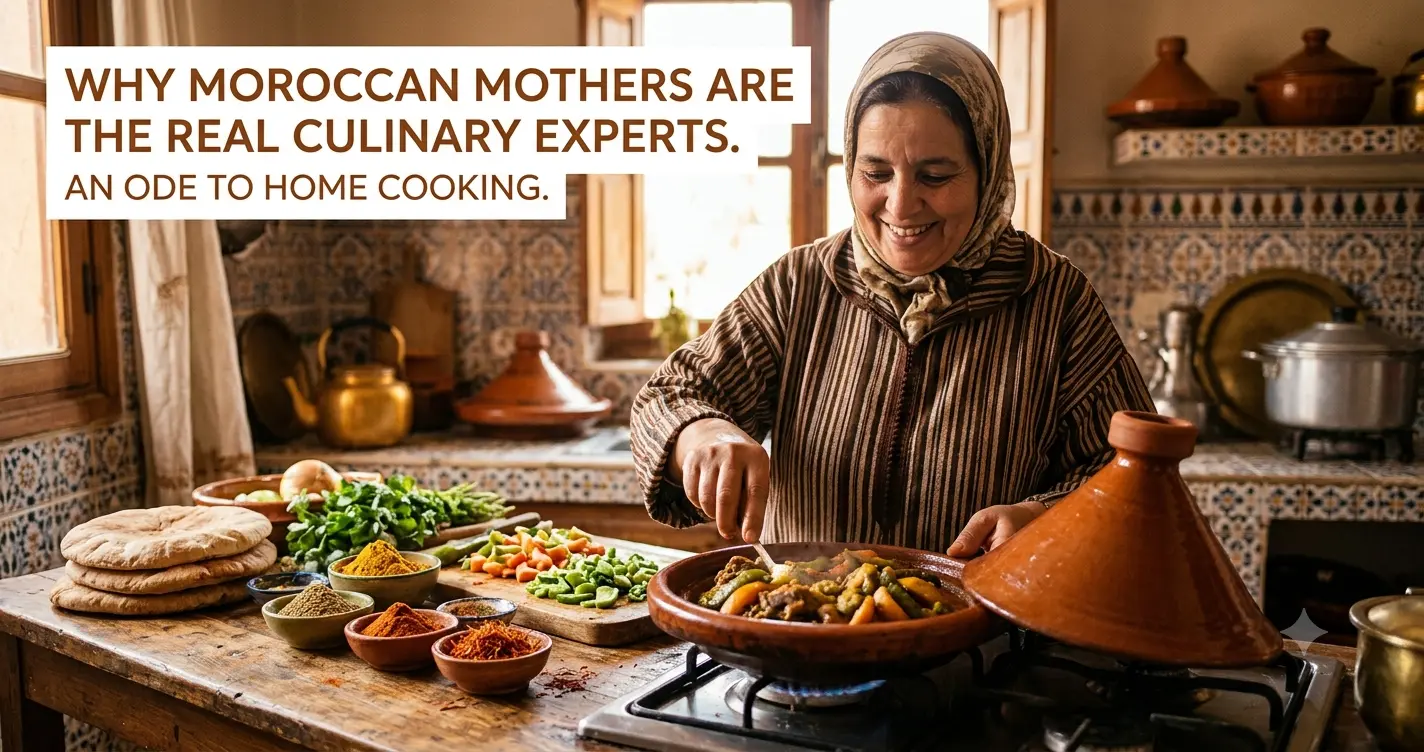
There is a moment — one that every Moroccan who has ever left home will recognize instantly — when you walk through the front door after a long absence and the smell hits you before anything else does. It is not one single scent but a layered, living thing: the ghost of cumin warming in a dry pan, the sweetness of caramelized onions that have been coaxing themselves into silk for the better part of an hour, the faint perfume of preserved lemon, the woody depth of aged argan oil. Before you have even set down your bag, your body already knows that you are home, because your mother is in the kitchen. That smell is not just dinner. It is memory, identity, and an unbroken chain of knowledge stretching back hundreds of years. And it has never once appeared on a restaurant menu quite the way it exists inside that kitchen. This is the central truth that professional chefs, food critics, and culinary tourists invariably discover when they dig deeply enough into Moroccan cuisine: the real experts were never wearing chef’s whites. They were wearing aprons in the medina, in the mountains of the Atlas, on the Atlantic coast, in the palm-grove villages of the Draa Valley. They were, and they remain, the mothers of Morocco.
Chapter One: The Living Library — What Moroccan Mothers Actually Know
Let us be precise about what we mean when we talk about culinary expertise, because the word is usually hijacked by the world of formal credentials. A culinary expert, in the Western imagination, has a certificate from a cooking school, a stage at a Michelin-starred restaurant, or at least a popular social media channel. By that definition, most Moroccan mothers would fail the test entirely. By any meaningful definition of the word, they pass with a distinction that no school could manufacture.
The knowledge that a Moroccan mother carries in her hands is encyclopedic. It covers botany — she knows which dried chickpeas from which region cook most evenly, which variety of olive produces the oil with the right bitterness for a given dish. It covers chemistry — she understands, without ever having used that word, exactly how the Maillard reaction works in a tagine clay pot over charcoal, and why the same recipe produces a flat result on a gas ring if you do not adjust the timing. It covers preservation science — she can cure lemons in salt and their own juice, ferment butter into smen, dry figs, and press olives in ways that have kept Moroccan households fed through harsh winters for generations. And it covers what we might call sensory calibration: the ability to taste a broth and understand in seconds what it needs, or to pinch a dough and know without a timer whether it has proofed correctly.
This knowledge is not written down. That is precisely what makes it precious and, in the modern world, endangered. At MaCooking, we have spent years working to document and translate this living library into formats that home cooks around the world can access without losing the soul of what makes these recipes extraordinary. But we are always aware that what we are capturing is an echo of something that can only be fully experienced in the original language, which is to say: standing beside a Moroccan grandmother as she adjusts the flame without looking at it.
The Taxonomy of Moroccan Home Cooking Knowledge
- Spice architecture: Not just knowing which spices go into a dish, but understanding the sequence, the heat required to bloom each one, and how the ratios shift across seasons and regions.
- Fire management: Traditional Moroccan cooking relies on charcoal, wood, or the kanoun (a clay brazier). Managing heat without thermometers is a lifelong skill.
- Fermentation and preservation: Smen, preserved lemons, fermented olives, dried herbs — a Moroccan pantry is built on transformation over time.
- Dough intuition: From msemen to harcha to meloui, Moroccan bread and pastry doughs are judged by touch, not recipes.
- Broth depth: The ability to build a marka (the sauce base of a tagine) that carries layers of flavor without any single element dominating.
- Seasonal fluency: Moroccan mothers cook with the market, not against it. The recipe changes when the season changes, and that adaptation is itself a form of expertise.
- Communal scaling: Cooking for a family of four and cooking for a wedding of three hundred require entirely different logic. Most Moroccan mothers can execute both.
Chapter Two: A History Written in Clay Pots
To understand why Moroccan home cooking is so extraordinarily rich, you have to understand the history that shaped it. Morocco sits at one of the great cultural crossroads of the ancient world. To the north, across a narrow strait, lies Andalusia — and for nearly eight centuries, a Muslim civilization flourished there that produced some of the most sophisticated cooking in the medieval world. When the Reconquista ended in 1492, the Moors and Jews expelled from Spain brought their recipes, their spice knowledge, and their agricultural practices directly into Morocco, particularly into cities like Fez, Tetouan, and Chefchaouen. You can taste this legacy today in dishes like bastilla — that extraordinary pigeon or chicken pie dusted with powdered sugar and cinnamon, which would not look out of place at a medieval Andalusian banquet.
To the south and east, the Saharan trade routes brought centuries of exchange with sub-Saharan Africa, bringing with them new spices, dried fruits, and cooking techniques that blended into what we now call the southern Moroccan kitchen. The cities of Marrakech and Taroudant carry this influence most visibly. Meanwhile, the indigenous Amazigh (Berber) population, who have farmed and herded in Morocco for at least four thousand years, contributed what might be the single most important element of Moroccan cooking: the tagine itself, both the cooking method and the vessel.
All of this history was transmitted not through cookbooks or culinary schools but through exactly the mechanism we are celebrating here: mothers teaching daughters. The Ottoman Empire, which spread its culinary influence across much of the Arab world, never fully colonized Morocco, which is one reason Moroccan cuisine retained a uniqueness and complexity that sets it apart from Levantine, Egyptian, or Gulf cooking. And the French Protectorate period (1912–1956), while it introduced baguettes and café culture to Moroccan cities, never penetrated the domestic kitchen in any meaningful way. The dar (traditional home) remained Moroccan. The kitchen remained in the hands of the women of the house.
Key Historical Influences on Moroccan Home Cooking
| Influence | Period / Origin | Contribution to Moroccan Kitchen | Example Dishes |
|---|---|---|---|
| Amazigh (Berber) | Pre-Islamic, ongoing | Tagine cooking, couscous, amlou, dried meat (khlii) | Lamb tagine with prunes, tafernout bread |
| Andalusian (Moorish & Jewish) | Post-1492 expulsion | Sweet-savory combinations, almond pastries, citrus use | Bastilla, sellou, briouats |
| Arab-Islamic | 7th century onward | Spice trade access, rose water, preserved lemons, smen | Harira, mrouzia, rfissa |
| Saharan & Sub-Saharan | Trans-Saharan trade routes | Dates, dried spices, saffron routes, millet | Saffron chicken tagine, date-stuffed pastries |
| French Protectorate | 1912–1956 | Bread-baking culture, café tradition, dairy integration | Moroccan-style baguette, café nos nos |
Chapter Three: The Spice Room — Understanding the Core of Moroccan Flavor
If you have ever tried to recreate a Moroccan dish from a Western recipe and felt that something was missing — that the result was technically correct but emotionally hollow — the answer almost certainly lives in the spices. Not in the list of spices, which many recipes get right, but in the spice philosophy, which almost none of them adequately explain.
A Moroccan mother does not think of spices as flavoring agents added to food. She thinks of them as the architecture of the dish — the structure upon which everything else is built. This is why the order and method of adding spices matters as much as the spices themselves. Ras el hanout, arguably the most famous Moroccan spice blend, can contain anywhere from twelve to thirty-five individual spices depending on who is blending it and for what purpose. The name translates literally as “head of the shop” — meaning the best the spice merchant has to offer. A good Moroccan mother will often have her own preferred blend from a specific vendor whose family she has trusted for decades. She will adjust the blend seasonally, adding more warming spices in winter, pulling back on heat in summer.
“My mother never measured spices in her life. She would open her palm, pour, smell, adjust, and pour again. I watched her do this ten thousand times before I understood that she was not being imprecise — she was being more precise than any measuring spoon could ever be. She was measuring with her whole body.”
The Essential Moroccan Spice Lexicon
- Cumin (kamoun): The backbone of savory Moroccan cooking. Used in almost every meat preparation and many vegetable dishes. Always best freshly toasted and ground.
- Saffron (zaafrane): Morocco produces some of the world’s finest saffron in the Taliouine region. Used in chicken dishes, fish tagines, and festive rice preparations. Always steeped in warm water first.
- Cinnamon (qarfa): Used in both sweet and savory contexts, which startles many Western cooks. It appears in lamb tagines, pigeon pie, and desserts equally.
- Ginger (skinjbir): Dried ginger, not fresh, is the default in most Moroccan home kitchens. It provides warmth without the sharp bite of fresh root.
- Turmeric (kharkoum): Primarily a coloring agent in Moroccan cooking, used more for the warm golden hue it lends to broths and rice than for flavor.
- Paprika (felfla hamra): Sweet paprika is used generously. Smoked paprika, which appears in some Western adaptations, is less traditional in Moroccan home cooking.
- Black pepper (ibzar): Ubiquitous and essential. Used more liberally than in many European traditions.
- Chermoula blend: Not a single spice but a wet marinade of fresh cilantro, parsley, cumin, paprika, preserved lemon, and olive oil. The foundation of Moroccan fish cooking.
Chapter Four: The Tagine as a Teaching Tool
The tagine is so synonymous with Moroccan cooking that it has become a cultural shorthand for the entire cuisine in the minds of international audiences. This is simultaneously accurate and reductive. It is accurate because the tagine — both the conical clay cooking vessel and the slow-braised dish it produces — does represent something fundamental about the Moroccan culinary philosophy: patience, layering, and the transformation of humble ingredients into something transcendent through time and care. It is reductive because it obscures the extraordinary breadth of Moroccan home cooking, which encompasses everything from the seven-vegetable couscous of Fridays to the thin, lacy baghrir pancakes of breakfast to the intricate almond-filled pastries of Eid celebrations.
But let us sit with the tagine for a moment, because it is a genuinely profound teaching tool. To cook a tagine properly — the way a Moroccan mother cooks it — you must learn how to build a foundation of aromatics (onion, garlic, fresh cilantro, parsley), how to layer proteins and vegetables so that each cooks at its ideal rate, how to manage moisture so that the sauce reduces to exactly the right consistency without burning, and how to read the signals the vessel gives you — the sound of the simmer, the color of steam escaping from the cone, the smell that shifts from raw to cooked to deeply caramelized over the course of two or three hours.
These are not skills you can learn from a recipe card. They are skills you develop by standing in a kitchen and watching, then doing, then failing, then adjusting. The tagine, in this sense, is a masterclass in cooking intuition — and the Moroccan mother is the master class instructor.
Home Tagine vs. Restaurant Tagine: What’s the Difference?
| Element | Home Tagine (Mother’s Kitchen) | Restaurant Tagine |
|---|---|---|
| Cooking vessel | Seasoned, well-used clay tagine or gsaa pot with character | Often decorative or stainless steel insert for speed |
| Heat source | Charcoal kanoun or wood fire for authentic smoke and even heat | Gas or electric range, often higher heat for table turnover |
| Cooking time | 2–4 hours of slow, patient braising | Often 45–90 minutes, sometimes pre-cooked and reheated |
| Spice sourcing | Personal spice merchant, seasonal blends, family recipes | Standardized commercial blends for consistency |
| Oil used | Local olive oil, sometimes smen (aged butter) for depth | Neutral oil or standard olive oil |
| Emotional dimension | Cooked for specific people, adjusted to family preferences | Cooked for anonymous customers, standardized portions |
| Vegetable sourcing | Market-fresh that morning, seasonal and local | Wholesale supply, not always seasonal |
Chapter Five: The Ritual Calendar — How Moroccan Mothers Cook Through the Year
One of the most striking things about Moroccan home cooking for outsiders is how deeply it is woven into the ritual calendar of the year. This is not cooking as a daily chore to get through; it is cooking as a form of participation in the life of the community and the turning of the seasons. Moroccan mothers are the custodians of this ritual calendar, and their expertise is expressed most fully in their ability to produce, on exactly the right day, the dish that the occasion demands — with everything made from scratch, at scale, with perfection.
The Ramadan Kitchen
No culinary event in Morocco approaches the intensity and complexity of Ramadan cooking. Every evening at iftar (the breaking of the fast), the table must hold harira — the rich tomato, lentil, and chickpea soup that is the spiritual center of Moroccan Ramadan. It must also hold chebakia (honey-soaked sesame cookies shaped into flowers), dates, fresh milk, soft-boiled eggs, sellou (a toasted flour and almond confection that provides sustained energy through the night), and an array of stuffed pastries and savory briouats. This production repeats every single day for thirty days. The sheer logistical and culinary intelligence required to execute this at home — with no professional kitchen, no team of sous chefs, often on a modest budget — is staggering.
Eid al-Adha: The Year’s Most Demanding Kitchen Day
Eid al-Adha, the Feast of Sacrifice, is perhaps the single most demanding cooking event in the Moroccan domestic calendar. On this day, a sheep is slaughtered, and over the following three days, every part of the animal must be cooked and consumed. The first morning alone involves grilling liver and heart in mrouzia spices over an open fire, preparing the head, roasting legs, and beginning the long slow process of preparing the liver and lung in a cumin-heavy sauce. None of this is done from a recipe. It is done from memory, from muscle, from the knowledge passed down through generations of women who learned this work at their own mothers’ sides.
Friday Couscous: The Weekly Sacred Meal
In Morocco, Friday is couscous day. This is not a preference; it is close to a religious obligation — the midday meal after Friday prayers is, for hundreds of thousands of Moroccan families, a large communal couscous. The seven-vegetable couscous of Fez is perhaps the most elaborate expression: hand-rolled semolina grains steamed three times over a broth fragrant with saffron, cinnamon, and ginger, topped with turnip, squash, carrot, cabbage, potato, courgette, and chickpeas, and finished with a sweet caramelized onion and raisin tfaya. The process takes most of the morning. The result is one of the great dishes of human civilization. It is made by mothers, in homes, every Friday, without fanfare or recognition.
Chapter Six: Transmission, Loss, and the Urgency of Documentation
There is a shadow over this celebration, and it would be dishonest to write about Moroccan home cooking without acknowledging it. The generation of mothers who carry the full depth of this culinary knowledge is ageing. Their daughters — educated, professional, urban, often living in Casablanca or Rabat or Paris or Montréal — frequently do not have the time or proximity to absorb this knowledge in the way it has always been transmitted: through years of daily presence in the kitchen. The oral tradition is fragile. When a grandmother dies, her specific version of rfissa, her personal ratio of spices in ras el hanout, her technique for achieving the perfect texture in briouats, goes with her unless someone thought to watch and record.
This is why platforms dedicated to authentic Moroccan culinary documentation matter more than they might appear to. At MaCooking, our mission has always been to serve as the digital extension of this oral tradition — to provide the kind of detailed, culturally grounded recipe documentation that bridges the gap between the grandmother’s kitchen and the diaspora home cook who wants to recreate those flavors in London or Los Angeles. We work with home cooks, not just professional chefs, because we understand that the knowledge lives in the home kitchen.
What Is Being Lost — And What Can Be Saved
The elements of Moroccan culinary knowledge most at risk of disappearing are precisely those that are hardest to write down:
- Sensory calibration: Knowing by smell alone when a tagine has reduced to the right point, or by touch when a dough is ready. This can be described but not transferred through text.
- Regional variation: The differences between a Fassi (Fez) lamb tagine and a Marrakchi version involve subtle distinctions in spice profile, sweetness level, and technique that vary family by family and neighborhood by neighborhood.
- Preservation techniques: Khlii (dried spiced beef preserved in fat), smen, fermented olives, home-pressed olive oil — these practices are declining as commercial alternatives become easier.
- Whole-animal cooking: The knowledge of how to cook every part of an animal, developed over centuries of zero-waste necessity, is being lost as younger generations gravitate toward boneless, pre-portioned cuts.
- Bread-making instinct: The ability to make khobz (the round Moroccan flatbread), msemen, harcha, and baghrir from memory, adjusting for humidity, flour type, and season.
Practical Ways to Honor and Preserve This Knowledge
- Cook with your mother or grandmother, not just beside her. Ask her to narrate her process. Record audio or video if she will allow it. The explanation of why she does something is more valuable than the recipe itself.
- Document variations, not just recipes. Ask what changes at Ramadan, what changes in summer, what she does differently for guests versus family. These variations reveal the underlying logic of the dish.
- Learn the pantry, not just the recipes. Understanding how to make smen, how to preserve lemons, how to blend ras el hanout, how to cure olives — these are the infrastructure of Moroccan cooking. Recipes built on this infrastructure work. Recipes that substitute commercial shortcuts rarely achieve the same depth.
- Trust authoritative digital resources. When you cannot be in the kitchen with a Moroccan mother, use platforms built on genuine expertise. MaCooking.com was built specifically to be that resource — a place where the recipes come with cultural context, technique explanations, and the kind of detail that bridges the gap between instruction and intuition.
- Cook the calendar. Do not wait for a special occasion to make harira. Cook it in Ramadan, but also cook it in January. Cook Friday couscous on a Sunday. The more you engage with the ritual context of these dishes, the more their logic reveals itself.
Chapter Seven: Lessons the World Should Learn from Moroccan Mothers
The Western food world has, over the past two decades, undergone a significant reckoning with its own assumptions about culinary expertise. The celebrity chef era — which celebrated individual genius and restaurant spectacle above all else — has given way to a broader appreciation for home cooking, fermentation traditions, peasant cuisines, and the knowledge systems of grandmothers across cultures. This is a genuine and welcome shift. But it is worth noting that Moroccan mothers never needed this reckoning because they never stopped being respected within their own cultural context.
What they offer the broader world, beyond the obvious gift of extraordinary food, is a model of culinary philosophy that the West is only beginning to rediscover:
Cook for People, Not for Performance
A Moroccan mother cooking for her family is thinking about the people who will eat the meal. She knows who is tired today, who has a cold, who is celebrating something, who needs feeding up and who is watching their weight. The food she makes is a response to human reality, not to a menu concept or a food trend. This is not naive; it is sophisticated. It requires a completely different kind of intelligence than restaurant cooking — one that integrates social, emotional, and culinary knowledge simultaneously.
Waste Nothing
Moroccan home cooking is built on a philosophy of zero waste that predates the current sustainability movement by centuries. Stale bread becomes rfissa. Leftover couscous becomes seffa. Overripe tomatoes become the base for a marka. The carcass of yesterday’s chicken becomes today’s broth. Every scrap of fat, every vegetable peel that has flavor, every dried herb at the back of the pantry has a use. This frugality is not a constraint on creativity; it is a generator of it.
Time Is an Ingredient
Perhaps the most radical lesson that Moroccan home cooking offers the modern world is this: some things cannot be rushed. The collagen in a lamb shank does not release its gelatin and transform the braising liquid into something extraordinary until it has been cooking at a gentle simmer for at least two hours. The preserved lemon does not develop its complex, fermented, floral bitterness in less than a month. The smen does not acquire its sheep’s milk pungency without at least six months of careful ageing. Moroccan mothers understand time as an ingredient with a precise function, not as a variable to be minimized. In a culture that valorizes speed above almost everything else, this is a profoundly countercultural position.
The Table Is the Destination
In Moroccan home culture, the meal is not a fuel stop between activities. It is the activity. The shared table — eating from communal dishes, breaking bread together, lingering over mint tea — is where family bonds are maintained, where stories are told, where decisions are made, where the young learn from the old. The Moroccan mother who spends four hours preparing a meal is not doing four hours of labor before the real event begins. She is already in the event. The cooking is itself a form of hospitality, a demonstration of love, a participation in the life of her household. This understanding changes everything about how you approach the kitchen.
Frequently Asked Questions About Moroccan Home Cooking and Culinary Tradition
Q1: Why does Moroccan home cooking taste so different from Moroccan restaurant food, even at good restaurants?
This is one of the most common observations made by people who have eaten in Moroccan homes after dining at Moroccan restaurants, and the answer has several layers. First, the ingredients: a Moroccan mother sources from her trusted market vendors, often buying specific regional products — saffron from Taliouine, argan oil from the Souss, olives from Meknes — that a restaurant may not prioritize due to cost. Second, the time investment: home cooking operates on a timeline that restaurants cannot replicate. A tagine made over three hours of gentle charcoal heat develops a depth of flavor that a restaurant version cooked in forty-five minutes on a gas range simply cannot match. Third, and perhaps most importantly, intention: a Moroccan mother cooks for the specific people at her table. She adjusts salt because her husband has high blood pressure. She adds extra saffron because her daughter loves it. She makes the sauce slightly sweeter because guests are visiting from Europe and she has learned they prefer it. This personalization creates food with a dimension that no standardized restaurant recipe can produce. You can explore how these differences manifest across specific dishes at MaCooking.com, where we document both home and restaurant versions of classic Moroccan recipes with detailed technique notes.
Q2: What are the most essential Moroccan pantry ingredients that a Western home cook should stock?
Building a Moroccan pantry is one of the most rewarding investments a home cook can make, because the same core ingredients appear across hundreds of dishes. Start with preserved lemons (you can make them yourself in about four weeks with lemons, salt, and a sterile jar — or buy good-quality ones online). Add a quality ras el hanout blend (seek one from a specialty spice merchant, not a supermarket version which is usually a pale shadow of the real thing). Stock whole cumin seeds that you toast and grind yourself, high-quality saffron (Moroccan or Iranian, not bargain-bin safflower “saffron”), good Spanish or Moroccan dried sweet paprika, cinnamon sticks, dried ginger, turmeric, and black pepper. For oils, a peppery extra-virgin olive oil is essential. Argan oil, if you can source it, opens up an entire world of Moroccan salads and dips. For liquids, rose water and orange blossom water are essential for desserts and tea culture. With these ingredients in your pantry, you can produce the flavor base of the vast majority of Moroccan home cooking.
Q3: Is it possible to authentically learn Moroccan cooking without going to Morocco or having a Moroccan family?
The honest answer is: you can learn a great deal, but there are dimensions of the experience that only direct transmission can provide. What you can absolutely achieve from outside Morocco, with the right resources and commitment, is technical competence in Moroccan cooking — you can learn to make a genuinely good tagine, an excellent couscous, a proper harira, beautiful pastilla. What is harder to acquire remotely is the intuition — the ability to taste a sauce and know instantly what it needs, or to read a tagine by its sound and smell. The best approach for Western home cooks is to combine rigorous use of authentic recipe resources (we recommend starting with the deeply researched recipe library at MaCooking) with deliberate practice and, whenever possible, direct contact with Moroccan home cooks. Many Moroccan women in diaspora communities offer cooking classes that provide exactly the kind of lived transmission that books and websites cannot fully replicate. Take every such opportunity you can find.
Q4: Why is couscous so central to Moroccan culture, and how does a Moroccan mother’s couscous differ from what you find in supermarket packets?
Couscous is not just a grain in Moroccan culture; it is a social institution. The Friday couscous meal is to Morocco what the Sunday roast is to Britain or Thanksgiving dinner is to the United States — a weekly ritual that assembles the family and reinforces its bonds. The Arabic name, ta’am (literally “food”), tells you everything about its status: it is so central that in many Moroccan dialects it simply means “the meal.” As for the difference between a Moroccan mother’s couscous and a supermarket packet: they share a name and almost nothing else. Traditional hand-rolled couscous, made from freshly milled semolina, hydrated and rolled by hand into tiny, even spheres, then steamed three times in a couscoussier over the braising broth, has a texture — light, separate, nutty — that no commercially pre-cooked instant product can approach. The three-steaming process is not optional; it is the mechanism by which the grains develop both their texture and their absorption of the broth’s flavor. Each steaming takes about twenty minutes. Most Western “couscous recipes” that call for pouring boiling water and waiting five minutes are producing something that Moroccan mothers would not recognize as couscous at all.
Q5: How are younger Moroccan women adapting these culinary traditions in modern life, and is the tradition at risk?
This is a question with a genuinely complex answer. The short version is: yes, there is risk, but there is also remarkable resilience. The urbanization and education of Moroccan women over the past thirty years has created a generation of women who, unlike their mothers and grandmothers, do not spend the majority of their days in the kitchen. This is, straightforwardly, a social good: education, professional opportunity, and reduced domestic labor are all positive developments. But the side effect is that the daily, immersive learning-by-doing through which culinary knowledge was always transmitted has been compressed or interrupted. At the same time, there is a powerful counter-movement. Many young Moroccan women — educated, professional, globally connected — are engaging with their culinary heritage with a deliberateness and enthusiasm that their grandmothers, for whom it was simply daily necessity, never needed to find. Social media has given Moroccan home cooks a platform that was previously unavailable, and the appetite for authentic Moroccan culinary content among both diaspora communities and international food lovers is stronger than it has ever been. Digital platforms dedicated to authentic documentation, rigorous recipe development, and cultural education play a crucial role in this preservation — which is exactly why the work done at MaCooking.com matters beyond just being a recipe website.
Conclusion: The Expert Who Never Called Herself One
We began with a smell. We end with a question: what would it mean for the world of food to genuinely recognize the expertise of Moroccan mothers?
It would mean understanding that culinary knowledge does not require a certificate. It would mean acknowledging that the most sophisticated cooking systems in the world have often been maintained not by chefs with television shows but by women cooking in homes, invisible to the food press, uninterested in recognition. It would mean paying attention — really paying attention — to the food that appears when you are welcomed into a Moroccan home, recognizing it not just as delicious hospitality but as the product of a knowledge system refined over centuries, expressed through hands that have made these dishes ten thousand times.
It would mean, practically speaking, choosing to learn. If you are a Western reader who has been drawn to Moroccan cuisine — who has fallen in love with a tagine at a restaurant, or been overwhelmed by the sensory experience of a Marrakech souq, or simply watched a cooking video and felt that pull toward something ancient and nourishing — then the next step is to go deeper. Not just to collect recipes, but to understand the culture and history from which they emerge. To learn not just what Moroccan mothers cook, but why, and when, and for whom, and with what intention.
That is the work that genuinely honors this tradition. And it is work you do not have to do alone. The entire culinary library at MaCooking.com has been built with exactly this purpose: to give you not just recipes but understanding, not just techniques but context, not just instructions but the kind of cultural depth that allows you to cook Moroccan food with respect and authenticity wherever you are in the world.
The Moroccan mothers who are the true heroes of this cuisine would probably wave off the praise with characteristic modesty. Mashi mushkil — it’s nothing, they would say. It is, of course, everything.