
90
Prep (min)
30
Cook (min)
4
Servings
Medium
Level
Introduction
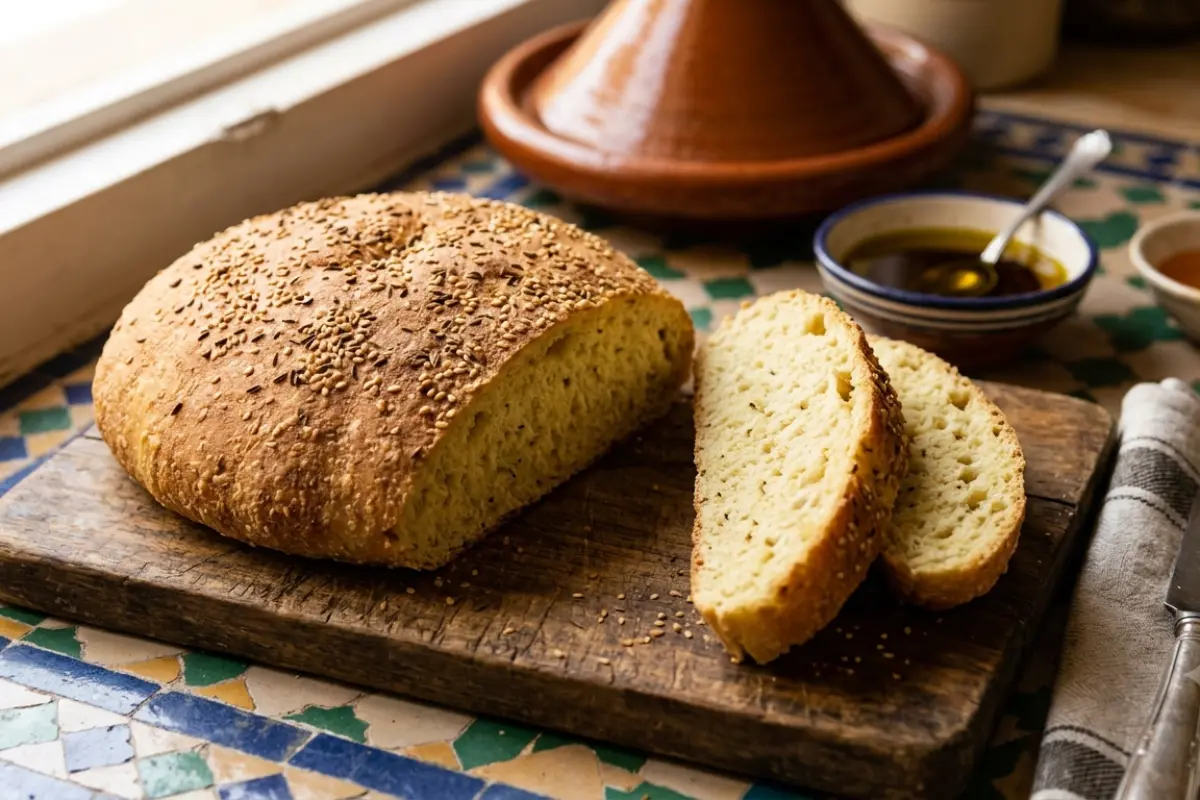
Moroccan bread, known locally as khobz, is far more than a simple side dish — it is the cornerstone of every Moroccan meal, used to scoop tagines, soak up rich sauces, and accompany mint tea during leisurely afternoon gatherings. The addition of cumin and sesame seeds to the classic khobz recipe elevates this humble staple into something truly aromatic and distinctive, reflecting the Moroccan tradition of weaving spices into every aspect of the culinary experience. This particular variation has been cherished in households across the country for generations, passed down through family kitchens where the smell of freshly baked bread mingled with warm spices announced the coming of a meal.
The city of Fez, one of Morocco's oldest imperial cities and a UNESCO World Heritage site, is especially renowned for its artisanal bread culture. The medina's narrow alleyways are dotted with communal wood-fired ovens called farran, where neighborhood families would bring their shaped dough on wooden boards to be baked by the local baker. The cumin and sesame combination is believed to have originated in the spice-rich kitchens of Fez, where Andalusian influences blended with Amazigh and Arab traditions to create a uniquely complex bread culture. Bakers in these ancient ovens developed a deep knowledge of fermentation, heat, and flavor that modern home bakers continue to honor.
Today, this bread is enjoyed not only in Morocco but by Moroccan diaspora communities around the world who seek to recreate the warmth and familiarity of home. The recipe is wonderfully forgiving and deeply satisfying to make by hand, as the kneading process itself becomes a meditative ritual. Cumin provides a smoky, slightly peppery depth while sesame seeds add a toasty, oil-rich crunch to the crust and crumb. Together, they transform a basic dough into a bread that carries centuries of tradition in every bite.
About This Recipe
Khobz, the Moroccan round flatbread, has been a daily essential in North African households for centuries, with roots tracing back to ancient Berber (Amazigh) bread-making traditions that predate Arab influence in the region. The addition of cumin to bread doughs is believed to have been popularized during the medieval Islamic Golden Age, when the spice trade along trans-Saharan caravan routes made cumin one of the most accessible and affordable spices in Moroccan cooking. Fez, Morocco's oldest imperial city founded in the 8th century, became a hub for spiced bread traditions as Andalusian refugees fleeing the Reconquista brought with them sophisticated baking techniques and a culture of layering spices into everyday foods. Sesame seeds, which were already widely cultivated in North Africa since antiquity, were a natural pairing with cumin, offering complementary flavors and nutritional richness. The farran, or community oven, became a social institution in Moroccan medinas, where women would bring their prepared dough in the morning and collect their baked loaves before noon, creating a rhythm of communal life centered around bread. Today, while modern home ovens have largely replaced the farran for everyday baking, the tradition of making cumin and sesame khobz by hand remains a deeply embedded cultural practice, connecting Moroccan families to a culinary heritage that spans more than a thousand years.
Nutrition / serving
Recipe Tags
Understanding the Ingredients
All-Purpose Flour
The base of the bread, all-purpose flour provides the gluten structure necessary for a chewy yet soft interior. In Morocco, a combination of white flour and semolina is common, but all-purpose flour alone yields excellent results for home bakers. Sifting it before use ensures a lighter, more even dough.
Fine Semolina
Semolina adds a slightly grainy texture and a golden color to the crumb. It is a traditional ingredient in Moroccan khobz that gives the bread its characteristic density and chew. Using fine semolina rather than coarse ensures it integrates smoothly into the dough without creating gritty pockets.
Active Dry Yeast
Yeast is the leavening agent that makes the bread rise and develops its complex flavor through fermentation. Active dry yeast must be dissolved in warm water before use to activate it. A good foam after proofing indicates the yeast is alive and ready to leaven the dough properly.
Ground Cumin
Cumin is one of Morocco's most beloved spices, used in everything from tagines to marinades and breads. In this recipe, ground cumin is kneaded directly into the dough, infusing every part of the bread with its warm, slightly smoky, and distinctly earthy flavor. It pairs beautifully with the nuttiness of sesame.
Sesame Seeds
Toasted sesame seeds are sprinkled on top of the loaves before baking, providing a nutty crunch and visual appeal to the finished bread. They can also be incorporated into the dough itself for a more uniform distribution of flavor. White sesame seeds are traditional, though black sesame seeds can be used for a more dramatic presentation.
Salt
Salt is essential not only for flavor but also for strengthening gluten bonds and regulating yeast activity. Using the right amount ensures the bread has a balanced taste and a proper rise. Fine sea salt dissolves evenly throughout the dough and is preferred over coarse salt in bread making.
Warm Water
Water hydrates the flour and activates the yeast, bringing the dough together. The temperature is critical — it should be between 38°C and 43°C (100°F to 110°F), warm enough to activate the yeast without killing it. The exact amount may vary slightly depending on the flour's absorption capacity.
Olive Oil
A small amount of olive oil enriches the dough, making it softer, more flavorful, and easier to handle. It also extends the shelf life of the bread by keeping the crumb moist. Moroccan extra virgin olive oil, with its fruity and slightly peppery profile, adds an authentic regional character to the loaf.
Step-by-Step Cooking Guide
Activate the Yeast
10 minIn a small bowl, combine the active dry yeast with 1/4 cup of warm water (about 40°C) and a pinch of sugar. Stir gently and let it sit for 8 to 10 minutes until the mixture becomes foamy and fragrant. This confirms the yeast is alive and active. If no foam forms after 10 minutes, discard the mixture and start again with fresh yeast, as dead yeast will result in a flat, dense loaf.
Tip: Use a thermometer to check water temperature if you are unsure. Water that is too hot will kill the yeast, while water that is too cold will not activate it.
Mix the Dry Ingredients
5 minIn a large mixing bowl, whisk together the all-purpose flour, fine semolina, ground cumin, and salt until evenly combined. Create a well in the center of the dry ingredients. This ensures the cumin and salt are uniformly distributed throughout the dough before any liquids are added, preventing uneven seasoning in the finished bread.
Tip: Sift the flour for a lighter texture. Make sure the salt does not come into direct contact with the yeast during this stage, as it can inhibit yeast activity.
Form and Knead the Dough
15 minPour the activated yeast mixture and olive oil into the well of the dry ingredients. Gradually add the remaining warm water while mixing with your hands until a rough dough forms. Turn the dough out onto a lightly floured surface and knead vigorously for 10 to 12 minutes until the dough is smooth, elastic, and slightly tacky but not sticky. It should spring back when poked with a finger. This develops the gluten structure essential for a good rise and soft crumb.
Tip: If the dough is too sticky, add flour one tablespoon at a time. Avoid adding too much flour, as this will make the bread dense and dry.
First Rise
75 minShape the kneaded dough into a ball and place it in a lightly oiled bowl, turning once to coat all sides. Cover the bowl with a clean kitchen towel or plastic wrap and place it in a warm, draft-free location. Allow the dough to rise for 60 to 90 minutes, or until it has doubled in size. A good spot is inside an oven with only the light on, or near a warm stovetop.
Tip: Do not rush the rise by placing the dough in a too-hot environment. A slow, steady rise develops more complex flavor and better texture in the finished bread.
Shape the Loaves
10 minPunch down the risen dough gently to release the gas. Divide it into 4 equal portions. On a lightly floured surface, shape each portion into a smooth round disc about 15 cm in diameter and 2 cm thick, typical of traditional Moroccan khobz. Place the shaped loaves on a baking sheet lined with parchment paper. Brush the tops lightly with water and sprinkle generously with sesame seeds. Use your fingertips or a fork to gently press the seeds into the surface so they adhere during baking.
Tip: Keep the thickness even across the disc so the bread bakes uniformly. Uneven discs may result in parts that are undercooked or overcooked.
Second Rise
30 minCover the shaped loaves loosely with a clean kitchen towel and allow them to rest and rise again for 20 to 30 minutes. This second proof relaxes the gluten and gives the bread a lighter, more open crumb. Meanwhile, preheat your oven to 220°C (425°F), ensuring it is fully hot before the loaves go in. You can place a baking stone or heavy baking sheet in the oven during preheating to mimic the effect of a traditional farran oven.
Tip: Do not skip the second rise, as it is crucial for achieving the soft yet structured interior characteristic of good Moroccan bread.
Bake to Golden Perfection
30 minUsing a sharp knife or bread lame, score a shallow cross or several small slits on the surface of each loaf to allow steam to escape during baking and to give the bread its traditional appearance. Slide the loaves onto the hot baking surface and bake at 220°C (425°F) for 25 to 30 minutes, until the tops are deep golden brown and the loaves sound hollow when tapped on the bottom. If they are browning too quickly, tent loosely with aluminum foil for the last 10 minutes.
Tip: For a crispier crust, place a small oven-safe dish with hot water on the bottom rack of the oven during the first 10 minutes of baking. The steam helps develop a beautiful golden crust.
Common Mistakes to Avoid
✗ Using water that is too hot when activating the yeast
Fix: Always use water between 38°C and 43°C. Water above 50°C will kill the yeast, resulting in dough that does not rise. Use a kitchen thermometer to be precise, especially if you are new to bread making.
✗ Not kneading the dough long enough
Fix: Under-kneaded dough lacks sufficient gluten development, leading to a dense, crumbly bread. Knead for a full 10 to 12 minutes by hand, or until the dough passes the windowpane test — stretch a small piece thin enough to see light through without tearing.
✗ Skipping the second rise
Fix: The second proof after shaping is essential for relaxing the gluten and achieving a light, airy crumb. Skipping it results in a tough, compact texture. Always allow at least 20 minutes of rest after shaping before baking.
✗ Adding too much flour during kneading
Fix: Adding excessive flour to prevent sticking will make the bread dry and hard. The dough should be slightly tacky. Instead of flouring heavily, oil your hands lightly or use just enough flour on the surface to keep the dough manageable.
✗ Opening the oven door during the first 15 minutes of baking
Fix: Opening the oven early causes a sudden drop in temperature, preventing the bread from rising properly and resulting in a pale, dense crust. Resist the urge to check until at least 20 minutes have passed.
Ingredient Substitutions
Instead of: Active Dry Yeast
Use: Instant yeast can be used in the same quantity without needing to be proofed separately — simply mix it directly into the dry ingredients. Sourdough starter can also be used for a more tangy, traditional flavor, though fermentation time will be significantly longer.
Instead of: Fine Semolina
Use: If semolina is unavailable, use an equal amount of additional all-purpose flour. The texture will be slightly softer and less rustic, but the flavor will remain excellent. Whole wheat flour is another option that adds a nutty depth and extra fiber.
Instead of: Olive Oil
Use: Argan oil, Morocco's prized culinary oil, can replace olive oil for a more distinctly Moroccan flavor profile. Neutral vegetable oil or melted butter also work well and produce a slightly richer crumb.
Instead of: Ground Cumin
Use: Caraway seeds can substitute for cumin and offer a similar earthy warmth with a slightly anise-like note. Fennel seeds are another aromatic alternative. Reduce the quantity slightly as caraway and fennel have a more pronounced flavor than cumin.
Serving Suggestions
Serve warm alongside a classic Moroccan harira soup, tearing pieces of bread to dip into the rich tomato and lentil broth for a nourishing and complete meal.
Slice and serve with a generous drizzle of local olive oil and a small dish of amlou, the traditional Moroccan almond and argan oil dipping paste, for an authentic breakfast or afternoon snack.
Use as a base for a simple open-faced spread with fresh kefta, grilled vegetables, and chermoula sauce for a satisfying light lunch.
Pair with a selection of Moroccan salads such as zaalouk (roasted eggplant), taktouka (pepper and tomato), and carrot salad with cumin and lemon for a beautiful mezze-style spread.
Storage & Reheating
Storage
Once fully cooled, wrap the bread tightly in a clean kitchen towel or store in a paper bag at room temperature for up to 2 days. For longer storage, place cooled loaves in a zip-lock freezer bag and freeze for up to 2 months. Avoid storing in plastic at room temperature, as it traps moisture and makes the crust soggy.
Reheating
To reheat, sprinkle the bread lightly with water and warm it in a preheated oven at 180°C (350°F) for 8 to 10 minutes. This revives the crust and makes the interior soft and warm again. For frozen bread, thaw at room temperature for 1 to 2 hours before reheating, or reheat directly from frozen at 180°C for 15 to 18 minutes.
For the best results, never microwave Moroccan bread to reheat, as it makes the crust rubbery and the crumb tough. The oven method or a dry skillet over medium heat for 2 to 3 minutes per side both yield far superior results.
Frequently Asked Questions
Recipe by

Abdrahman Idrissi
عبد الرحمن الإدريسي
Pastry & Bread Chef
View all recipes by Abdrahman →
You May Also Like
Our Ebooks
The Moroccan Vegan
$12.56

Tables of Fez: A Royal Palace Legacy
$22.99

The Soul of Morocco
$20.00
YouTube
Watch step-by-step cooking videos and learn traditional Moroccan techniques.
450+
Subscribers
150+
Videos