
90
Prep (min)
45
Cook (min)
30
Servings
Hard
Level
Introduction
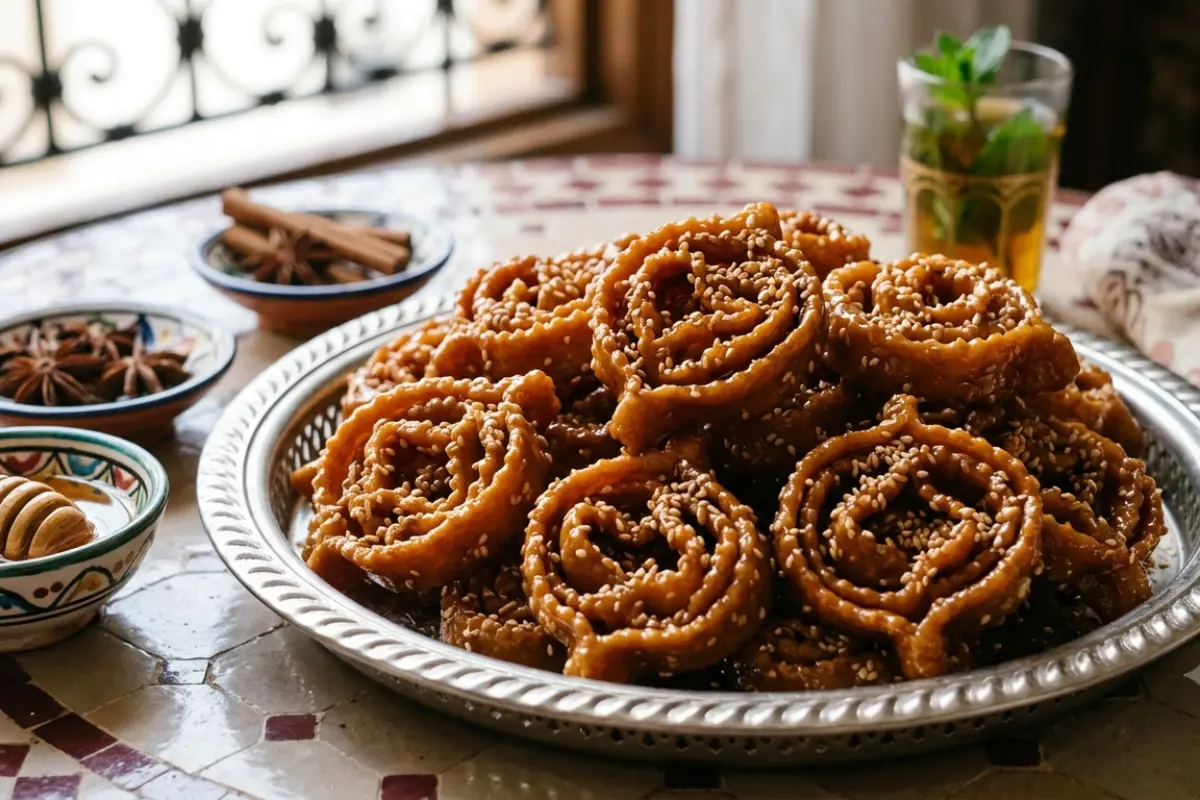
Chebakia, known in Arabic as شباكية, is one of the most iconic and treasured sweets in Moroccan gastronomy. Originating from the imperial city of Fez, this elaborate pastry has been crafted by Moroccan families for centuries, passed down through generations of skilled home cooks and professional pastry chefs alike. The name itself is derived from the Arabic word for 'window' or 'lattice,' a reference to the intricate interlocking shape that defines this cookie's distinctive appearance. During the holy month of Ramadan, chebakia is virtually omnipresent on Moroccan tables, served alongside harira soup to break the daily fast — a pairing that is both culturally symbolic and nutritionally complementary.
The preparation of chebakia is considered a true culinary art form in Morocco, requiring patience, practiced hands, and a deep familiarity with the dough's texture and behavior. The dough itself is a complex blend of toasted sesame seeds, flour, warm spices, fragrant orange blossom water, and a small amount of vinegar that helps achieve the perfect crispiness after frying. Each piece must be hand-shaped into a precise flower or lattice form, a skill that Moroccan women traditionally learn from their mothers and grandmothers starting in childhood. In many households, the making of chebakia before Ramadan is a communal event, with extended family members gathering together to shape, fry, and coat hundreds of cookies in preparation for the month ahead.
Beyond Ramadan, chebakia holds a cherished place at weddings, birth celebrations, and religious holidays such as Eid al-Fitr and Eid al-Adha. The cookies are often presented as gifts, arranged in elaborate trays and decorated with additional sesame seeds and colored sugar. The finishing touch — a generous coating in warm honey infused with orange blossom water — gives chebakia its characteristic glossy sheen and intensely sweet flavor. Modern Moroccan pastry shops across cities like Fez, Casablanca, and Marrakech sell chebakia year-round, but most Moroccans agree that nothing compares to the homemade version crafted with love and tradition.
About This Recipe
Chebakia traces its origins to the kitchens of Fez, the ancient imperial city that has long been considered the cultural and culinary heart of Morocco. Historical accounts suggest that this elaborate pastry dates back to at least the medieval period, when Moorish culinary traditions from Andalusia blended with Berber and Arab cooking practices to create the sophisticated pastry culture that Morocco is celebrated for today. The cookie's intricate lattice shape, which requires considerable skill and practice to execute, reflects the high value placed on culinary artistry in Fez's aristocratic households. Over centuries, the recipe spread from Fez to all corners of Morocco, with each region developing subtle variations in spice blends and shaping techniques. Today, chebakia is most strongly associated with the month of Ramadan, where it appears on nearly every Moroccan table alongside harira soup as part of the traditional iftar meal that breaks the daily fast. This pairing — savory soup followed by sweet, honey-drenched cookies — is one of the most beloved rituals in Moroccan domestic life. The cookies' long shelf life, made possible by the natural preservative properties of honey and the low moisture content of the fried dough, made them practical for the extended fasting month when large quantities of food are prepared in advance. Chebakia also holds a honored place at weddings and circumcision celebrations, where trays of the golden, sesame-encrusted cookies are presented to guests as a symbol of abundance and hospitality. In 2024, the tradition of making harira and chebakia for Ramadan was inscribed on UNESCO's list of intangible cultural heritage elements, cementing the global recognition of this deeply beloved Moroccan culinary tradition.
Nutrition / serving
Recipe Tags
Understanding the Ingredients
All-purpose flour
The base of the chebakia dough, flour provides structure and body to the cookies. It is important to use unbleached all-purpose flour for the best texture. The dough should be firm enough to hold its shape when molded but pliable enough to fold and pinch without cracking.
Toasted sesame seeds
Sesame seeds are ground and incorporated directly into the dough, giving chebakia its signature nutty flavor and slightly dense, crumbly texture. They must be toasted until golden before grinding to release their full aroma and prevent a raw, bitter taste. Sesame seeds are also sprinkled on top of the finished cookies for decoration.
Pure honey
High-quality Moroccan honey, ideally wild thyme or wildflower honey, is used to coat the fried cookies while they are still hot. The honey bath is typically warmed gently and infused with orange blossom water. It is essential to use real, pure honey rather than artificial sweeteners, as it provides the glossy coating and preserves the cookies for longer shelf life.
Orange blossom water
This delicate floral water, distilled from orange blossoms, is a cornerstone of Moroccan pastry making. It is added both to the dough and to the honey bath, lending a distinctive perfumed quality that is instantly recognizable in chebakia. Use authentic Moroccan orange blossom water for the most authentic result.
Ground cinnamon
Cinnamon is one of the primary warming spices in chebakia, contributing a sweet, woody depth to the overall flavor profile. Moroccan cinnamon, which tends to be lighter and more delicate than Vietnamese or Chinese varieties, is preferred. It pairs beautifully with the honey and sesame to create the complex, layered taste that defines this cookie.
Anise seeds
Whole or ground anise seeds impart a subtly licorice-like, herbal note that balances the sweetness of honey and the richness of sesame. This spice is traditional in Moroccan baking and is an essential component of authentic chebakia. It should not be omitted, as it is one of the defining flavor elements of this pastry.
Saffron
A small pinch of Moroccan saffron dissolved in warm water gives the dough a beautiful golden hue and adds a subtle floral, earthy complexity. Moroccan saffron from the Taliouine region is among the finest in the world and lends an unmistakable authenticity to the finished cookies.
Vegetable oil
Neutral vegetable oil or sunflower oil is used both in the dough and for deep-frying. In the dough, oil contributes tenderness and helps bind the ingredients. For frying, the oil must be maintained at a consistent medium temperature — too hot and the outside burns before the inside cooks; too cool and the cookies absorb excess oil and become greasy.
White vinegar
A small amount of vinegar in the dough is a traditional Moroccan technique that reacts with the other ingredients to create a particularly crisp, light texture after frying. It also helps the dough hold together during shaping. Do not skip this ingredient, as it plays a subtle but important functional role.
Ground ginger
Dried ground ginger adds a gentle warmth and slight peppery note that complements the cinnamon and anise. Along with other spices, it contributes to the complex, multi-layered spice profile that distinguishes Moroccan chebakia from simpler fried honey cookies found in other cuisines.
Step-by-Step Cooking Guide
Toast and Grind the Sesame Seeds
15 minPlace the sesame seeds in a dry skillet over medium heat and toast them, stirring constantly, until they turn a light golden color and release a nutty aroma, approximately 5 to 7 minutes. Be careful not to let them burn, as this will make the dough bitter. Remove from heat immediately and allow them to cool completely. Once cooled, transfer the sesame seeds to a food processor or blender and grind them into a coarse, slightly oily meal. The texture should resemble coarse flour with some visible pieces remaining. Set aside.
Tip: Toasting the sesame seeds in small batches ensures even coloring. Allow them to cool fully before grinding to prevent the heat from causing clumping.
Prepare the Saffron Water and Combine Dry Ingredients
10 minDissolve a pinch of saffron in two tablespoons of warm water and allow it to steep for at least 10 minutes until the water turns a deep golden orange. In a large mixing bowl, combine the flour, ground sesame seeds, ground cinnamon, ground ginger, anise seeds, and a pinch of salt. Whisk the dry ingredients together thoroughly to ensure an even distribution of spices throughout the dough. Create a well in the center of the dry mixture to receive the wet ingredients.
Tip: Saffron should be crumbled between your fingers before adding to the water to release its full color and flavor. Steeping for longer gives a richer golden color.
Form and Rest the Dough
30 minAdd the vegetable oil, white vinegar, orange blossom water, saffron water, and a small amount of warm water gradually to the dry ingredients. Mix with your hands, incorporating the wet ingredients into the flour mixture until a cohesive dough forms. Knead the dough firmly for 8 to 10 minutes until it is smooth, slightly firm, and not sticky. The dough should hold its shape when pressed. If too dry, add water one teaspoon at a time. Cover the dough with a clean kitchen towel and allow it to rest at room temperature for 20 minutes to relax the gluten.
Tip: The dough should feel similar to shortcrust pastry — firm and slightly crumbly but holding together when pressed. Avoid over-kneading, which can make the dough tough.
Shape the Chebakia
40 minDivide the rested dough into manageable portions. On a lightly floured surface, roll each portion out to a thickness of approximately 3 to 4 millimeters using a rolling pin. Using a pastry cutter or sharp knife, cut the dough into rectangles approximately 8 centimeters long and 5 centimeters wide. On each rectangle, make four or five parallel cuts lengthwise, leaving the edges intact. Thread alternating strips through to create a lattice or flower effect, then fold and pinch the ends together to form the traditional chebakia shape. Alternatively, use a dedicated chebakia mold for more uniform results. Place shaped cookies on a tray as you work.
Tip: Keep your hands lightly oiled to prevent sticking during shaping. Practice the folding technique with a few pieces before working through all the dough. Watching a video tutorial can be very helpful for first-timers.
Deep Fry the Chebakia
25 minHeat vegetable oil in a deep heavy-bottomed pot to approximately 170 degrees Celsius (340 degrees Fahrenheit). Carefully lower the shaped cookies into the hot oil in batches of four to six pieces, depending on the size of your pot. Fry for 4 to 6 minutes, turning them gently halfway through, until they are deep golden brown and perfectly crisp. The color should be uniform and rich without being dark or burnt. Remove with a slotted spoon and drain briefly on paper towels. Fry all the chebakia before proceeding to the honey bath.
Tip: Maintain consistent oil temperature throughout frying. If the oil is too hot, the outside will color before the inside is cooked through. Use a thermometer for accuracy.
Prepare the Honey Bath and Coat the Cookies
15 minIn a wide, deep saucepan, gently warm the honey over low heat until it becomes liquid and runny but not boiling. Stir in a generous splash of orange blossom water and, if desired, a small pinch of cinnamon. Working while the fried chebakia are still warm, lower them into the honey bath in batches and allow them to soak for 2 to 3 minutes, turning them gently to ensure complete, even coating. The honey will seep into the lattice crevices, coating every surface. Remove with a slotted spoon and transfer to a wire rack set over a tray to allow excess honey to drip off.
Tip: Dipping the cookies while they are still warm from the fryer allows the honey to penetrate more deeply and adhere more evenly. Do not rush this step — thorough coating is essential for authentic flavor and preservation.
Garnish and Allow to Set
10 minWhile the honey is still wet and tacky, sprinkle the chebakia generously with toasted sesame seeds. Some families also add colored nonpareils or a light dusting of additional cinnamon for festive presentation. Arrange the finished cookies on a large tray or plate in a single layer or stacked pyramid style, which is the traditional Moroccan presentation. Allow them to cool and set at room temperature for at least one hour before serving, during which time the honey coating will firm up and become beautifully glossy.
Tip: For a more decorative finish, use a mix of white and black sesame seeds. The cookies will continue to absorb honey as they cool, becoming even more flavorful after resting overnight.
Common Mistakes to Avoid
✗ Frying the chebakia at too high a temperature
Fix: Maintain the oil temperature at around 170°C (340°F). Use a kitchen thermometer to monitor the heat carefully. Oil that is too hot will burn the outside while leaving the inside doughy and undercooked, ruining the characteristic crispiness.
✗ Making the dough too soft or sticky
Fix: The dough for chebakia must be firm enough to hold its intricate shape during frying. If the dough is too soft, the shapes will collapse or puff unevenly in the oil. Add flour gradually until the dough is smooth and holds its form when pressed.
✗ Skipping the honey bath or dipping cold cookies
Fix: The honey must be warm and the cookies should be dipped while still warm from the fryer. Dipping cold cookies in cold honey results in a thin, uneven coating that slides off. Warm honey penetrates the lattice structure for a deeply sweet, well-coated result.
✗ Under-toasting or skipping the sesame seed toasting step
Fix: Raw sesame seeds have a bitter, flat flavor that will negatively impact the entire dough. Always toast them thoroughly until golden before grinding. The toasting step is non-negotiable for authentic flavor.
✗ Cutting the dough strips unevenly or too thick
Fix: Roll the dough to a consistent thickness of 3 to 4 millimeters and use a ruler or guide to cut uniform strips. Uneven strips will cook at different rates and the shapes will not hold their intricate lattice pattern after frying.
Ingredient Substitutions
Instead of: Orange blossom water
Use: Rose water can be used in a smaller quantity (about half the amount), though it will give a slightly different floral note. A small amount of finely grated orange zest in the dough can also approximate some of the orange blossom flavor.
Instead of: Pure honey
Use: Light corn syrup or golden syrup can be used as a coating substitute, though the flavor will be significantly less complex and the preservation benefit of real honey will be lost. For the most authentic result, always use real honey.
Instead of: Saffron
Use: A small pinch of turmeric dissolved in warm water can mimic the golden color of saffron, though it cannot replicate the distinctive floral aroma. If saffron is unavailable, the recipe will still work without it, just with a paler dough.
Instead of: White vinegar
Use: Apple cider vinegar or fresh lemon juice can be used in equal amounts. Both provide the necessary acidity to help create a crisp texture after frying.
Serving Suggestions
Serve chebakia alongside a steaming bowl of harira soup as is traditional during Ramadan — the contrast of the savory, tomato-based soup with the sweet, honey-soaked cookies is a classic Moroccan flavor pairing that has endured for centuries.
Arrange chebakia on a large decorative platter garnished with extra sesame seeds and mint leaves, accompanied by a pot of Moroccan mint tea, for an impressive presentation at festive gatherings, Eid celebrations, or as part of a traditional Moroccan dessert spread.
Chebakia can be offered as part of a Moroccan sweets assortment alongside sellou, kaab el ghzal, and briouats with almond paste for a complete and festive dessert table.
For a modern serving idea, crumble a few pieces of chebakia over vanilla ice cream or Greek yogurt drizzled with extra honey for a fusion dessert that bridges traditional Moroccan flavors with contemporary presentation.
Storage & Reheating
Storage
Chebakia stores exceptionally well thanks to the preservative properties of honey. Once completely cooled and set, store in an airtight container or tin at room temperature. They will keep for up to 3 to 4 weeks without refrigeration. Do not store in the refrigerator, as the cold will cause the honey to crystallize and the texture to become unpleasantly hard. Keep in a cool, dry place away from direct sunlight.
Reheating
Chebakia is best enjoyed at room temperature and does not require reheating. If the honey coating has crystallized slightly after storage, allow the cookies to sit at room temperature for an hour or gently warm the container in a very low oven (50°C / 120°F) for 5 to 10 minutes to soften the honey.
If stacking chebakia in a storage container, place a sheet of parchment paper between layers to prevent sticking. For gifting, arrange in decorative tins lined with parchment and tie with ribbon for a beautiful traditional Moroccan gift presentation during Ramadan or Eid.
Frequently Asked Questions
Recipe by

Abdrahman Idrissi
عبد الرحمن الإدريسي
Pastry & Bread Chef
View all recipes by Abdrahman →
You May Also Like
Our Ebooks

The Moroccan Vegan
$12.56

Tables of Fez: A Royal Palace Legacy
$22.99

The Soul of Morocco
$20.00
YouTube
Watch step-by-step cooking videos and learn traditional Moroccan techniques.
450+
Subscribers
150+
Videos