
30
Prep (min)
90
Cook (min)
6
Servings
Medium
Level
Introduction
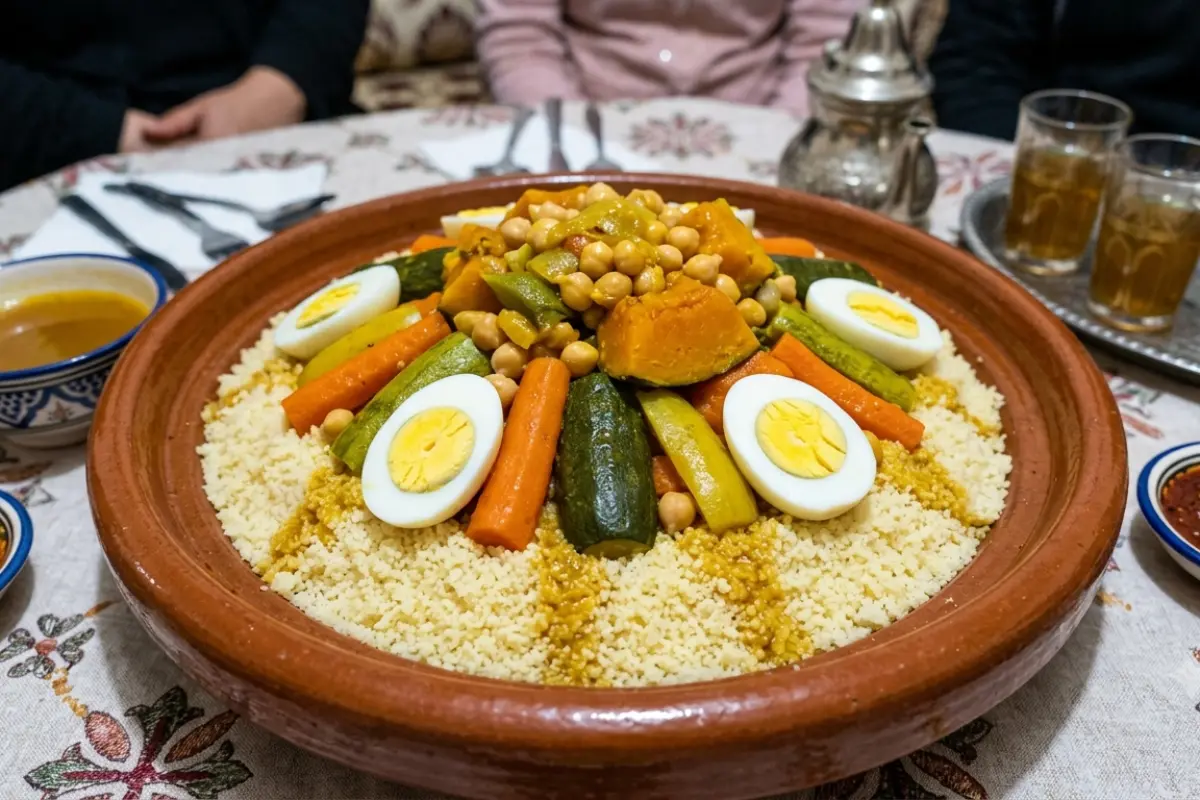
Couscous is the crown jewel of Moroccan cuisine, a dish so deeply woven into the cultural fabric of the country that it was inscribed on UNESCO's Intangible Cultural Heritage list in 2020. Originating among the Berber communities of North Africa, couscous has been prepared for over a thousand years, evolving from a simple peasant staple into a celebrated centerpiece of Moroccan hospitality. The version featuring hard-boiled eggs and seasonal vegetables is one of the most traditional and nourishing preparations, reflecting the resourcefulness and warmth of Moroccan home cooking.
In Moroccan households, couscous is traditionally served on Fridays after the midday prayer, bringing families together around a large communal platter. The dish is as much about ritual and togetherness as it is about flavor. Hard-boiled eggs, placed atop the mound of steamed couscous, symbolize abundance and new beginnings in many Moroccan traditions, and their mild, creamy texture provides a beautiful contrast to the spiced broth and tender vegetables. Each region of Morocco puts its own stamp on the recipe, with Fez being particularly celebrated for its refined and aromatic interpretation.
The beauty of this dish lies in its layered cooking process, using a couscoussier — a traditional two-tiered steamer — that allows the couscous grains to absorb the fragrant steam rising from the vegetable broth below. This slow, careful method yields grains that are impossibly light and fluffy, each one separate and perfectly cooked. The vegetables, cooked until tender in a spiced golden broth, are arranged artfully over the couscous, and the whole dish is finished with a generous ladle of broth poured tableside, making every bite deeply satisfying and aromatic.
About This Recipe
Couscous is one of the oldest and most revered dishes in North African and Moroccan culinary history, with origins tracing back to the Berber populations of the Maghreb region as far back as the 9th or 10th century. Ancient clay couscoussiers have been discovered at archaeological sites in Algeria dating to the era of Berber king Massinissa, confirming the dish's ancient roots. The preparation traveled along trade routes through the Mediterranean, eventually becoming a beloved staple across Morocco, Algeria, Tunisia, and beyond. In Morocco specifically, couscous became synonymous with Friday — the holy day of the Islamic week — when families would gather after prayers for a communal meal centered on this dish. The version with hard-boiled eggs and vegetables is among the most traditional preparations, reflecting the Berber philosophy of using seasonal produce and wholesome, affordable ingredients to create deeply nourishing meals. The city of Fez, with its ancient medina and refined culinary traditions, became particularly celebrated for its artful and aromatic interpretations of couscous, elevating the humble grain into a dish of extraordinary sophistication. In 2020, couscous was added to UNESCO's Representative List of the Intangible Cultural Heritage of Humanity, recognizing its profound cultural, social, and culinary significance across North Africa.
Nutrition / serving
Recipe Tags
Understanding the Ingredients
Medium-grain couscous
Medium-grain semolina couscous is the traditional choice for Moroccan cooking. Its size allows it to steam beautifully, absorbing the aromatic broth flavors while maintaining a light, fluffy texture. Avoid instant couscous for the most authentic result, as the traditional steaming method yields far superior texture.
Eggs
Fresh large eggs are hard-boiled and halved to crown the finished dish. In Moroccan tradition, eggs represent abundance and nourishment. They add a creamy, protein-rich element that balances the spiced vegetables and absorbs the flavorful broth beautifully.
Carrots
Carrots add natural sweetness and a vibrant orange color to the vegetable medley. They are cut into large chunks to withstand the long cooking time without falling apart, and their natural sugars caramelize slightly in the spiced broth, deepening the overall flavor profile.
Zucchini
Zucchini is a quintessential couscous vegetable in Moroccan cooking. It absorbs the spiced broth deeply and becomes wonderfully tender. It is typically added later in the cooking process to prevent it from becoming too soft, preserving its shape and subtle flavor.
Turnips
Turnips are a traditional and slightly underappreciated ingredient in Moroccan couscous. They add a mild, earthy bitterness that balances the sweetness of carrots and the richness of the broth. They are cut into wedges and cooked until perfectly tender and golden.
Chickpeas
Canned or pre-soaked dried chickpeas add heartiness and protein to the dish. They soak up the spiced broth and add a satisfying, creamy texture. In traditional Moroccan cooking, dried chickpeas soaked overnight are preferred for their superior flavor and firmer texture.
Onion
A large yellow onion forms the aromatic base of the broth. It is roughly chopped and sautéed in olive oil until softened and golden, building the savory foundation upon which all the spices and vegetables develop their depth of flavor.
Ras el hanout
This complex Moroccan spice blend, whose name translates to 'top of the shop,' typically contains up to thirty different spices including cardamom, cumin, coriander, cinnamon, and rose petals. It is the signature seasoning of Moroccan couscous, lending warmth, depth, and an unmistakably North African character to the dish.
Olive oil
Extra-virgin olive oil is used to sauté the aromatics and is also worked into the dry couscous before steaming to prevent clumping and to enrich the flavor. Moroccan olive oil, produced primarily in the Fez-Meknes region, is among the finest in the world and adds a fruity, peppery note.
Fresh cilantro and parsley
A mixed bunch of fresh cilantro and flat-leaf parsley is a non-negotiable aromatic element in Moroccan couscous broth. Tied together and added to the pot, they release a bright, herbaceous fragrance that lifts the entire dish and provides a fresh counterpoint to the warm spices.
Step-by-Step Cooking Guide
Prepare and season the couscous
15 minPlace the couscous in a large bowl and add a generous pinch of salt, 2 tablespoons of olive oil, and about half a cup of cold water. Use your hands to work the oil and water evenly into the grains, rubbing them between your palms to ensure no clumps form. Let the couscous rest for 10 minutes to absorb the moisture before the first steaming.
Tip: Working the oil in by hand is essential — it coats each grain individually and is the secret to achieving the signature fluffy, non-sticky texture of authentic Moroccan couscous.
Build the vegetable broth
15 minIn the bottom pot of a couscoussier or a large stockpot, heat 3 tablespoons of olive oil over medium-high heat. Add the chopped onion and sauté for 5 to 7 minutes until softened and golden. Add the ras el hanout, turmeric, ginger, salt, and pepper, stirring to toast the spices for 1 minute. Add the carrots and turnips, stir to coat, then pour in 2 liters of water. Add the tied bunch of cilantro and parsley and the drained chickpeas. Bring to a boil.
Tip: Toasting the spices briefly in the oil before adding liquid unlocks their aromatic compounds and creates a much deeper, more complex broth flavor.
First steam of the couscous
25 minOnce the broth is boiling, place the steamer basket on top, ensuring a tight seal — wrap a damp kitchen towel around the joint if needed to prevent steam from escaping. Add the prepared couscous to the steamer basket, spreading it in an even layer. Steam uncovered for 20 minutes, letting the steam from the broth cook the grains gently.
Tip: Never cover the couscous while it steams — the open top allows moisture to escape evenly, preventing the grains from becoming gummy or waterlogged.
Aerate the couscous and add zucchini
25 minRemove the steamer basket and tip the couscous back into the large bowl. Break up any clumps with a fork or your hands, add another splash of cold water and a small drizzle of olive oil, and work through the grains again. Return the couscous to the steamer. Add the zucchini chunks to the broth below, stir, and return the steamer to the pot for a second 20-minute steam.
Tip: This aeration step is the key difference between restaurant-quality and truly exceptional couscous. Do not skip it — the twice-steamed grains will be noticeably lighter and more separate.
Hard boil the eggs
15 minWhile the couscous undergoes its second steaming, place the eggs in a small saucepan and cover with cold water. Bring to a boil over medium-high heat, then reduce to a gentle simmer and cook for exactly 10 minutes. Transfer immediately to a bowl of ice-cold water and let them cool for 5 minutes before peeling. Halve the eggs lengthwise and set aside.
Tip: The ice bath stops the cooking process immediately, preventing the formation of the grey-green ring around the yolk that indicates overcooked eggs, and making the shells much easier to peel.
Final assembly and plating
10 minRemove the steamer basket and tip the finished couscous into a large, wide serving bowl or a traditional Moroccan gsaa platter. Drizzle with a ladleful of hot broth and toss gently to distribute the moisture. Mound the couscous into a dome shape. Arrange the cooked vegetables artfully over and around the mound. Place the halved hard-boiled eggs around the top of the dome. Ladle additional warm broth over the entire platter and serve the remaining broth in a pitcher alongside.
Tip: Serving the extra broth on the side is a Moroccan tradition — diners can pour it over their individual portions to their preferred level of sauciness, ensuring everyone enjoys it exactly as they like.
Common Mistakes to Avoid
✗ Using instant couscous and just pouring boiling water over it
Fix: While quick, this method produces gummy, clumped couscous. Take the time to steam the couscous at least twice in a couscoussier for the authentic light, fluffy texture that defines great Moroccan couscous.
✗ Adding all the vegetables to the broth at the same time
Fix: Different vegetables have different cooking times. Hard vegetables like carrots and turnips go in early, while tender zucchini should only be added during the second steaming phase to prevent it from dissolving into the broth.
✗ Skipping the aeration step between steamings
Fix: Always remove the couscous between steamings, break up the grains by hand, and work in a little water and oil. This is the fundamental technique that separates perfectly textured couscous from a dense, clumped mass.
✗ Not sealing the couscoussier properly
Fix: If steam escapes from the sides of the steamer, the couscous will cook unevenly. Wrap a damp kitchen towel or a rope of dough around the joint between the pot and steamer basket to create a proper seal and direct all steam upward through the grains.
Ingredient Substitutions
Instead of: Ras el hanout
Use: A blend of equal parts ground cumin, coriander, cinnamon, and a pinch of allspice can approximate the warmth of ras el hanout, though the complex floral notes will be less pronounced.
Instead of: Turnips
Use: Parsnips or kohlrabi make excellent substitutes for turnips, offering a similar earthy sweetness and the ability to hold their shape during the long braising process.
Instead of: Fresh cilantro
Use: If cilantro is unavailable or disliked, flat-leaf parsley alone can be used in greater quantity, or a small amount of fresh mint can be added to bring a different but complementary freshness.
Instead of: Couscoussier
Use: A large stockpot fitted with a metal steamer basket or a colander lined with cheesecloth makes a perfectly adequate substitute. Ensure the basket sits above the broth level and seal the edges with a damp towel.
Serving Suggestions
Serve on a large communal platter placed at the center of the table in the traditional Moroccan style, with everyone eating from their section of the shared dish using a spoon or their right hand.
Accompany with a small bowl of harissa paste on the side for guests who enjoy a spicy kick, as well as a pitcher of the warm vegetable broth for pouring over individual portions.
Offer a simple Moroccan chopped salad of tomatoes, cucumbers, and onions dressed with cumin and lemon juice as a fresh side to balance the richness of the couscous.
A glass of hot sweet Moroccan mint tea served after the meal is the traditional and perfect way to complete this dining experience.
Storage & Reheating
Storage
Store the couscous and vegetable broth separately in airtight containers in the refrigerator for up to 3 days. Keep the hard-boiled eggs in their shells in a separate container submerged in cold water, changing the water daily, for up to 2 days.
Reheating
To reheat the couscous, sprinkle it with a few tablespoons of water and steam it in a couscoussier or microwave it covered with a damp paper towel on medium power for 2 to 3 minutes, fluffing with a fork halfway through. Reheat the broth and vegetables in a saucepan over medium heat until piping hot.
Avoid reheating the eggs in the broth as they will become rubbery. Instead, halve fresh or pre-peeled cold eggs and place them on the warm couscous just before serving — the residual heat will warm them gently without overcooking.
Frequently Asked Questions
Recipe by

Fatima El Amrani
فاطمة العمراني
Master Chef
View all recipes by Fatima →
You May Also Like
Our Ebooks

The Moroccan Vegan
$12.56

Tables of Fez: A Royal Palace Legacy
$22.99

The Soul of Morocco
$20.00
YouTube
Watch step-by-step cooking videos and learn traditional Moroccan techniques.
450+
Subscribers
150+
Videos