
40
Prep (min)
90
Cook (min)
6
Servings
Medium
Level
Introduction
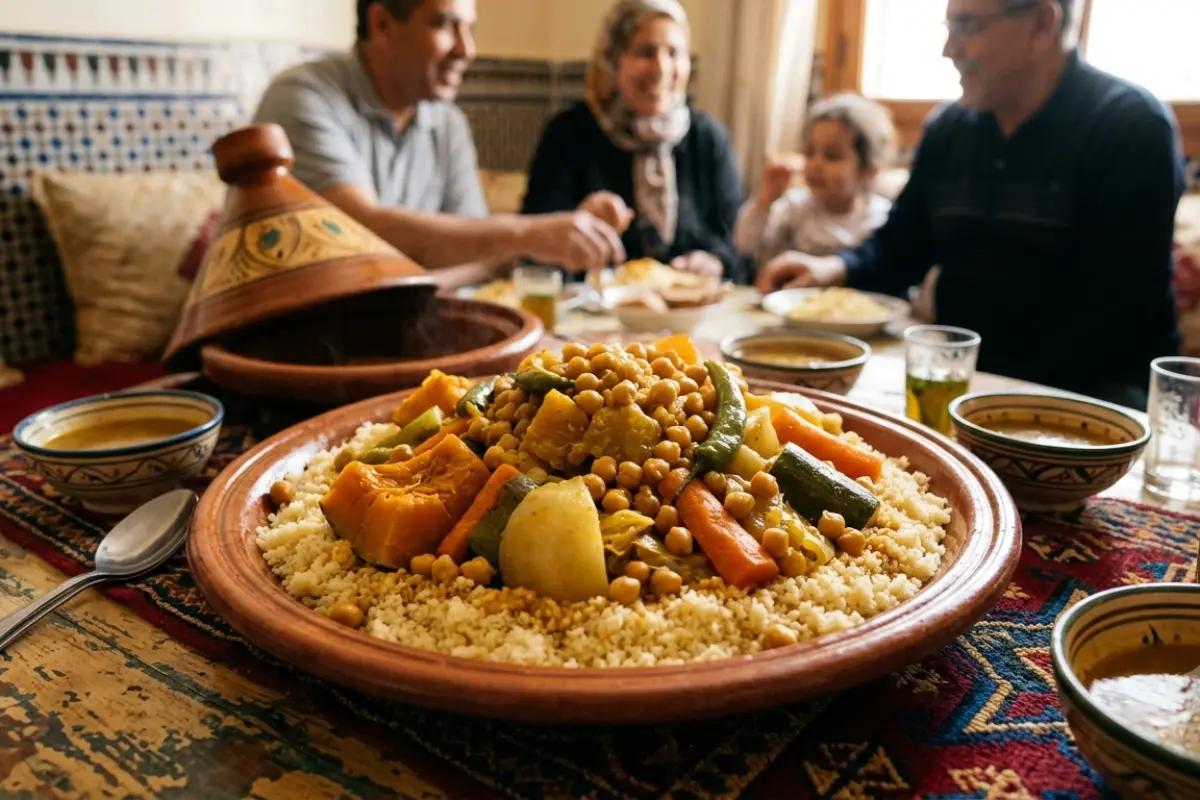
Couscous with Seven Vegetables holds a place of supreme honor in Moroccan culinary heritage, served almost universally every Friday after the midday prayer as a sacred family ritual. The number seven is deeply symbolic in Moroccan and Islamic culture, representing completeness, blessing, and abundance, which is why the selection of exactly seven vegetables is considered essential rather than merely traditional. Each family across Morocco has its own cherished combination of vegetables, passed down through generations, yet all versions share the same soul: a fragrant, saffron-kissed broth, perfectly steamed couscous, and the comforting sweetness of slow-cooked root vegetables.
The dish traces its origins to the Berber (Amazigh) people of North Africa, who are credited with inventing couscous itself thousands of years ago. The method of hand-rolling semolina grains and steaming them multiple times over a flavorful broth is an ancient technique that has been refined over millennia. As Moroccan civilization flourished through Arab, Andalusian, and sub-Saharan influences, the couscous dish absorbed new spices, legumes, and vegetables, evolving into the magnificent preparation known today. Fes, long considered the cultural and culinary capital of Morocco, is particularly renowned for its refined and aromatic version of this dish.
Beyond its role as a Friday meal, Couscous with Seven Vegetables is the centerpiece of major celebrations including weddings, naming ceremonies, and religious holidays such as Eid. It is traditionally served on a large communal platter called a gsaa, eaten together by the family, which reinforces its meaning as food of togetherness. UNESCO recognized Moroccan couscous as an Intangible Cultural Heritage of Humanity in 2020, a testament to its profound cultural significance not just in Morocco but across North Africa. Preparing this dish with care and patience is an act of love and cultural preservation.
About This Recipe
Couscous is believed to have originated with the Berber (Amazigh) people of North Africa, with evidence of couscous vessels dating back to the 9th century. The practice of steaming rolled semolina grains over a spiced broth is a distinctly Amazigh culinary invention that spread throughout the Maghreb and beyond. As Morocco developed one of the most sophisticated culinary cultures in the medieval world, couscous evolved from a simple peasant staple into a refined celebratory dish, absorbing influences from Arab, Andalusian, sub-Saharan, and later Ottoman culinary traditions. The preparation of couscous with seven vegetables became codified as the quintessential Friday dish, likely by the 12th or 13th century during the height of Moroccan dynastic civilization. The city of Fes, as Morocco's intellectual and culinary capital, is credited with refining the dish to its most elevated form, emphasizing quality spices including precious Moroccan saffron from Taliouine, carefully balanced seasoning, and the meticulous triple-steaming technique. For centuries, the art of making couscous was transmitted from mother to daughter in Moroccan households, representing not just a culinary technique but a cultural identity. The UNESCO inscription of Moroccan couscous as an Intangible Cultural Heritage of Humanity in 2020, a designation shared with Algeria, Tunisia, and Mauritania, acknowledged what every Moroccan family has always known: that couscous is far more than food. It is a living expression of community, generosity, and the enduring bonds of family.
Nutrition / serving
Recipe Tags
Understanding the Ingredients
Medium-grain couscous
The foundation of the dish. Medium-grain couscous is preferred in Morocco as it absorbs the broth beautifully while maintaining a light, fluffy texture after multiple steamings. It is important to use traditional couscous, not the instant variety, to achieve the authentic airy texture through the steaming process.
Bone-in lamb shoulder
Lamb is the most traditional protein for this dish, adding deep richness and flavor to the broth. The bone contributes collagen and body to the sauce. Choose bone-in pieces as they release more flavor during the long cooking process. Chicken can be substituted but lamb is the authentic choice.
Dried chickpeas
Chickpeas soaked overnight and cooked in the broth provide substantial protein and a creamy, nutty flavor that complements the spiced broth. Canned chickpeas can be used in a pinch but dried chickpeas soaked and cooked from scratch yield a far superior texture and flavor.
Ras el hanout
This signature Moroccan spice blend, whose name means 'top of the shop,' typically contains over a dozen spices including cumin, coriander, cinnamon, ginger, turmeric, and black pepper. It is the soul of the broth, lending warmth, complexity, and a distinctly Moroccan character to the entire dish.
Saffron
Moroccan saffron, particularly from the Taliouine region of southern Morocco, is among the finest in the world. A small pinch dissolved in warm water imparts a golden hue and a delicately floral, honey-like aroma to the broth that is unmistakably characteristic of fine Moroccan cooking.
Seven vegetables (turnip, carrot, zucchini, pumpkin, cabbage, onion, tomato)
The classic seven-vegetable combination varies by family but this selection is the most traditional. Turnips and carrots provide sweetness and body, zucchini adds tenderness, pumpkin lends earthy sweetness, cabbage contributes depth, onions form the aromatic base, and tomatoes add acidity and color to the broth. Each vegetable is added at a different stage to ensure none are overcooked.
Unsalted butter
Butter is worked into the steamed couscous grains between steamings and at the final stage. It enriches the grains, helps separate them, and adds a luxurious silkiness to the finished couscous. Some Moroccan cooks use smen, a preserved clarified butter with a pungent aged flavor, for an even more traditional result.
Fresh cilantro and flat-leaf parsley
These herbs are bundled together and added to the broth, infusing it with bright, fresh herbaceous notes throughout the cooking process. They are typically removed before serving or finely chopped and used as a garnish, adding a fresh contrast to the rich, spiced broth.
Step-by-Step Cooking Guide
Prepare the chickpeas and marinate the lamb
15 minIf using dried chickpeas, drain the soaked chickpeas and set aside. Place the lamb pieces in the bottom of a couscoussier or large pot. Add the chopped onions, grated tomatoes, olive oil, ras el hanout, ground ginger, turmeric, black pepper, cinnamon stick, the saffron dissolved in two tablespoons of warm water, half the cilantro-parsley bundle, and a generous pinch of salt. Pour in enough water to cover the meat by about 5 cm. Add the soaked chickpeas. Bring to a boil over high heat, then reduce to a steady simmer, cover, and cook for 30 minutes while you prepare the couscous and vegetables.
Tip: Browning the lamb briefly in olive oil before adding the liquids adds an additional layer of flavor to the broth through the Maillard reaction.
First steaming of the couscous
25 minPlace the dry couscous in a large shallow bowl. Sprinkle lightly with cold salted water and toss well with your hands to moisten evenly. Transfer the couscous to the perforated top of the couscoussier. Place it over the simmering broth and steam, uncovered, for 20 minutes, allowing the steam to rise through and cook the grains. Do not press the couscous down during steaming; allow the steam to circulate freely.
Tip: Seal the joint between the two parts of the couscoussier with a strip of damp flour-and-water paste or a damp kitchen towel to ensure all the steam passes through the couscous and none escapes from the sides.
Aerate the couscous and add harder vegetables to the broth
30 minTurn the steamed couscous out into the large bowl. Break up any clumps with your hands or a fork, working from the outside in. Add a tablespoon of butter and a drizzle of cold water, tossing and rubbing the grains between your palms to separate them and help them absorb the moisture evenly. Meanwhile, add the carrots, turnips, and cabbage wedges to the broth. Return the couscous to the couscoussier for a second 20-minute steaming.
Tip: Be careful when handling the hot couscous grains. If necessary, let them cool for a few minutes before rubbing them with your hands. This aeration step is critical for achieving a light, non-clumpy texture.
Second aeration and addition of tender vegetables
30 minTurn the couscous out again and repeat the aeration process, adding another tablespoon of butter and a small amount of cold water, working the grains thoroughly with your hands. Add the zucchini, pumpkin chunks, and the remaining cilantro-parsley bundle to the broth. Taste the broth and adjust salt and spices as needed. Return the couscous to steam for a final 20 minutes. The broth should be flavorful, slightly reduced, and aromatic.
Tip: The pumpkin will soften relatively quickly, so keep an eye on the vegetables. You want them tender but not completely falling apart, as they need to hold their shape on the final platter.
Final preparation of couscous and plating
15 minTurn the fully steamed couscous into the large serving bowl for the final time. Add two tablespoons of cold butter and ladle two to three large spoonfuls of hot broth over the couscous. Toss and work the grains vigorously with your hands, incorporating the butter and broth until the grains are separate, glistening, and perfectly seasoned. Mound the couscous into a large round platter. Create a well in the center and arrange the lamb pieces and all seven vegetables artistically over and around the couscous. Ladle enough broth over everything to moisten generously. Serve the remaining broth in a separate bowl on the side for guests to add as they wish.
Tip: Serve immediately on a large communal platter. Traditionally the most honored guest or eldest family member is invited to begin eating first. The remaining broth served alongside is essential as guests typically add more to their portion throughout the meal.
Common Mistakes to Avoid
✗ Using instant couscous and not steaming it properly
Fix: While instant couscous is convenient, it cannot replicate the texture of traditionally steamed couscous. Invest in medium-grain traditional couscous and follow the triple-steaming process for an authentic, light, and fluffy result that absorbs the broth beautifully.
✗ Adding all vegetables to the broth at the same time
Fix: Different vegetables have very different cooking times. Hard root vegetables like turnips and carrots need significantly longer than tender zucchini or pumpkin. Add vegetables in stages corresponding to their cooking times to ensure all are perfectly cooked rather than some being mushy and others undercooked.
✗ Not aerating the couscous between steamings
Fix: The aeration step between each steaming, where you break up clumps, add butter, and sprinkle with water while rubbing grains between your palms, is what creates the signature light, separate texture. Skipping this step results in dense, clumped couscous.
✗ Making the broth too thin and watery
Fix: The broth should be flavorful and slightly reduced by the end of cooking. If it is too thin, remove the lid for the last 15 minutes of cooking to allow some evaporation and concentration of flavors. A rich, well-seasoned broth is what elevates the entire dish.
Ingredient Substitutions
Instead of: Bone-in lamb shoulder
Use: Bone-in chicken thighs or beef short ribs work well. For a vegetarian version, omit the meat entirely and increase the chickpeas and add extra vegetables; the vegetarian version is also a traditional preparation.
Instead of: Dried chickpeas
Use: Two cans of drained and rinsed canned chickpeas can be used. Add them in the last 30 minutes of cooking rather than the beginning to prevent them from becoming too soft.
Instead of: Ras el hanout
Use: A blend of equal parts cumin, coriander, and turmeric with a pinch each of cinnamon, ginger, and black pepper approximates the warming complexity of ras el hanout, though the original blend is always preferred.
Instead of: Couscoussier
Use: A large pot with a tight-fitting steamer basket or metal colander lined with cheesecloth set over the pot works as a substitute. Seal any gaps between the pot and steamer with a damp kitchen towel to direct all steam upward through the couscous.
Instead of: Pumpkin
Use: Butternut squash is an excellent substitute, providing a similar sweetness and texture. Sweet potato can also be used but will cook more quickly, so add it with the tender vegetables rather than the harder ones.
Serving Suggestions
Serve on a large round communal platter with the couscous mounded in the center, the meat nestled on top, and the colorful vegetables arranged decoratively around it. Bring a bowl of the extra broth to the table so guests can moisten their portions throughout the meal.
Pair with a glass of cold buttermilk (lben) or fresh mint tea, both of which are traditional accompaniments that help balance the richness of the dish.
A side of harissa paste on the table allows guests who prefer spice to add heat to their individual portions without altering the dish for those who prefer the traditional mild preparation.
Follow with fresh seasonal fruit or a light pastry such as briouats filled with almond paste for a complete traditional Moroccan Friday lunch experience.
Storage & Reheating
Storage
Store the couscous grains and the broth with vegetables and meat separately in airtight containers in the refrigerator for up to 3 days. Keeping them separate prevents the couscous from absorbing all the broth and becoming soggy.
Reheating
Reheat the broth and meat gently in a pot over medium-low heat, adding a splash of water if needed to loosen. For the couscous, place it in the couscoussier or a steamer over simmering water and steam for 10 to 15 minutes until heated through and fluffy, or microwave with a damp paper towel covering it and a small cup of water in the microwave to create steam.
Couscous can be frozen successfully for up to one month. Spread it in a single layer on a baking sheet to freeze, then transfer to a freezer bag. The broth and meat also freeze well for up to 2 months. Thaw overnight in the refrigerator before reheating.
Frequently Asked Questions
Recipe by

Fatima El Amrani
فاطمة العمراني
Master Chef
View all recipes by Fatima →
You May Also Like
Our Ebooks

The Moroccan Vegan
$12.56

Tables of Fez: A Royal Palace Legacy
$22.99

The Soul of Morocco
$20.00
YouTube
Watch step-by-step cooking videos and learn traditional Moroccan techniques.
450+
Subscribers
150+
Videos