
40
Prep (min)
90
Cook (min)
6
Servings
Medium
Level
Introduction
Couscous is the crown jewel of Moroccan cuisine, a dish so deeply embedded in the culture that UNESCO recognized it as an Intangible Cultural Heritage of Humanity in 2020. Traditionally prepared every Friday after midday prayers, couscous has been a symbol of hospitality, family unity, and spiritual nourishment for centuries. The version featuring turkey — known locally as 'Diik Roumi' or the Roman rooster — is a festive variation that gained popularity during special occasions such as weddings, Eid celebrations, and large family gatherings, particularly in the imperial city of Fes.
The city of Fes, one of Morocco's oldest and most culturally rich cities, is renowned for its sophisticated culinary tradition. Fassi cuisine, as it is called, is characterized by its careful layering of spices, its balance of sweet and savory elements, and its meticulous cooking techniques passed down through generations of families. The Couscous with Turkey and Spices reflects this culinary philosophy perfectly, combining the warming notes of cinnamon, turmeric, and ginger with the natural richness of turkey, slow-cooked until the meat falls effortlessly off the bone.
What sets this dish apart from other couscous preparations is the unique steaming method used for the couscous grains. True Moroccan couscous is never simply soaked — it is steamed multiple times in a couscoussier, a traditional double-boiler pot, and hand-rolled with butter between each steaming to achieve its signature light, fluffy, and separate texture. The turkey broth that develops during cooking infuses every grain with incredible depth of flavor, making this dish a complete and magnificent expression of Moroccan culinary artistry.
About This Recipe
Couscous has been the cornerstone of North African cuisine for over a thousand years, with its origins traced to the Berber peoples of the Maghreb who first developed the technique of rolling semolina into tiny grains and steaming them over fragrant broths. The dish spread across Morocco, Algeria, Tunisia, and Libya, evolving into distinct regional variations that reflect local ingredients, trade routes, and cultural influences. The version featuring turkey emerged as a festive adaptation particularly popular in the cities of Fes and Meknes, where the culinary traditions of Andalusian Muslims who fled the Spanish Reconquista in the 15th century blended magnificently with existing Moroccan and Berber cooking to create the sophisticated Fassi cuisine we know today. Turkey, introduced to Morocco through trade routes with the Ottoman Empire, became a prized alternative to the traditional lamb or chicken used in everyday couscous, reserved for celebrations and honored guests. The elaborate spicing of this dish — featuring ras el hanout, saffron, preserved lemon, and dried fruit — reflects the historical importance of Morocco as a crossroads of the ancient spice trade, where merchants traveling the trans-Saharan and Mediterranean routes brought precious ingredients that became permanently woven into the fabric of Moroccan cooking. Today, Couscous with Turkey and Spices remains a beloved preparation for special occasions, a dish that carries within every grain of steamed semolina the centuries of culinary wisdom, cultural exchange, and family tradition that define Moroccan food culture.
Nutrition / serving
Recipe Tags
Understanding the Ingredients
Turkey pieces (bone-in)
Bone-in turkey thighs and drumsticks are preferred for this dish as they remain moist and tender during the long braising process. The bones enrich the broth with gelatin and deep flavor. Choose pieces weighing around 300-400g each for even cooking.
Medium-grain couscous
Medium-grain couscous is the classic choice for Moroccan couscous dishes. It absorbs broth beautifully without becoming mushy and achieves the ideal fluffy texture when properly steamed. Avoid instant couscous for this traditional preparation as the texture will differ significantly.
Ras el Hanout
This iconic Moroccan spice blend, whose name translates to 'head of the shop,' contains up to 30 different spices including cardamom, cumin, clove, cinnamon, nutmeg, mace, allspice, dry ginger, chili peppers, coriander seed, peppercorn, sweet and hot paprika, fenugreek, and turmeric. It is the soul of this dish and provides its complex, warming flavor profile.
Saffron
Moroccan saffron from the Taliouine region in the Anti-Atlas mountains is among the finest in the world. It imparts a golden color and a uniquely floral, slightly honey-like aroma to the broth. Always bloom saffron in warm water before adding it to the dish to maximize its color and flavor release.
Preserved lemon
A cornerstone of Moroccan cooking, preserved lemons are whole lemons cured in salt and their own juice for weeks to months. They add a distinctive briny, intensely citrusy, and slightly fermented flavor that cuts through the richness of the turkey and spices. Only the rind is typically used in cooking.
Golden raisins
Golden raisins, known as zbib in Darija, add a gentle sweetness that is characteristic of Fassi cuisine and creates a beautiful contrast with the savory spiced broth. They are typically plumped in warm water or orange blossom water before being added to the dish, often as a garnish on top of the finished couscous.
Chickpeas
Chickpeas add substance, protein, and a creamy, nutty texture to the couscous topping. Using dried chickpeas soaked overnight yields the best texture, but high-quality canned chickpeas are an acceptable shortcut. They absorb the spiced broth and complement the turkey beautifully.
Zucchini, carrots, and turnips
These traditional Moroccan couscous vegetables provide varied textures, natural sweetness, and essential nutrition. They are added in stages based on their cooking time so that each vegetable retains its individual texture and flavor while being deeply infused with the aromatic broth.
Unsalted butter
Butter is essential for working into the couscous grains between steamings, giving the finished couscous its characteristic richness, sheen, and perfectly separated texture. Use high-quality unsalted butter to control the salt level of the dish.
Onion and fresh ginger
Grated onion and fresh ginger form the aromatic base of the broth alongside the dry spices. The grated onion melts into the sauce, providing sweetness and body, while fresh ginger adds a bright, warming heat that complements the turkey's natural flavor.
Step-by-Step Cooking Guide
Marinate the Turkey
30 minIn a large bowl, combine the turkey pieces with ras el hanout, turmeric, ground ginger, cinnamon, a generous pinch of salt and pepper, half of the grated onion, and 3 tablespoons of olive oil. Mix thoroughly, ensuring every piece of turkey is well coated with the spice mixture. Cover and allow to marinate in the refrigerator for at least 30 minutes, or ideally overnight for deeper flavor penetration.
Tip: Marinating overnight dramatically improves the depth of flavor. Score the turkey skin with a knife to allow the spices to penetrate more deeply.
Brown the Turkey and Build the Broth
20 minHeat olive oil in the bottom pot of a couscoussier or a large heavy-bottomed pot over medium-high heat. Add the marinated turkey pieces skin-side down and sear until golden brown, about 4-5 minutes per side. Remove the turkey and set aside. In the same pot, add the remaining grated onion and cook until softened. Add the bloomed saffron water, 1.5 liters of warm water or chicken stock, the preserved lemon rind quarters, chickpeas, and the browned turkey. Bring to a boil, then reduce to a gentle simmer, cover, and cook for 30 minutes.
Tip: Do not rush the browning of the turkey — this step creates the Maillard reaction compounds that give the broth its deep, complex flavor. Deglaze the pot with a splash of water to capture all the caramelized bits.
Prepare and First Steam the Couscous
25 minWhile the turkey simmers, place the couscous in a large shallow bowl. Sprinkle with 1 cup of cold salted water and toss well with your hands to moisten all the grains. Allow the couscous to rest for 10 minutes, then rake through it with your fingers to break up any clumps. Line the top of the couscoussier steamer basket with a damp muslin cloth, add the couscous, and steam over the simmering broth for 15 minutes. Transfer the steamed couscous back to the bowl, sprinkle with another cup of salted water, and work in 2 tablespoons of butter with your hands, breaking up all lumps.
Tip: Ensure no steam escapes from around the couscoussier joint — seal it with a damp cloth or aluminum foil if necessary to keep all steam directed upward through the couscous.
Add Vegetables to the Broth
30 minAfter the turkey has cooked for 30 minutes, add the carrots and turnips cut into large chunks to the broth. Continue simmering for 15 minutes. Then add the zucchini cut into thick rounds and the golden raisins that have been plumped in warm orange blossom water. Taste the broth and adjust salt, pepper, and spices as needed. Continue cooking for another 15 minutes until all vegetables are tender but not falling apart.
Tip: Add vegetables in stages from hardest to softest to ensure each one is cooked to the perfect texture. The zucchini should be tender but still hold its shape.
Second and Third Steaming of Couscous
35 minReturn the couscous to the steamer basket and steam for a second 15 minutes. Transfer back to the bowl, work in another 2 tablespoons of butter and a ladle of the hot broth, and rake through to separate all grains. Allow to rest for 5 minutes, then return to the steamer for a final 10-minute steaming. The finished couscous should be perfectly light, fluffy, and fully separated with each grain distinct.
Tip: The three-steam method is the authentic Moroccan technique that produces incomparably light and perfectly textured couscous. Do not skip steamings — each one is essential to the final result.
Plate and Serve
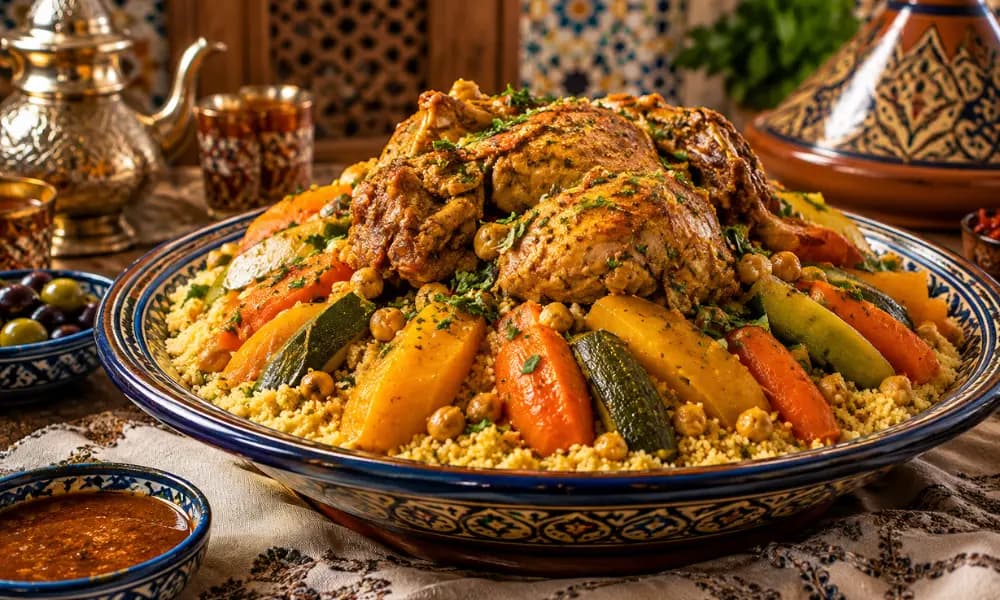
10 minMound the finished couscous in a large, deep serving platter, creating a well in the center. Arrange the turkey pieces in the center, then carefully place the cooked vegetables around and on top of the turkey. Spoon over several generous ladles of the fragrant broth to moisten the couscous. Scatter the plumped golden raisins over the top and garnish with toasted almonds and fresh flat-leaf parsley or cilantro. Serve the remaining broth in a separate bowl alongside so guests can add more as desired.
Tip: Presentation matters in Moroccan cuisine — take time to arrange the dish beautifully. The traditional Moroccan table setting places the communal platter at the center, with guests eating from their side of the dish.
Common Mistakes to Avoid
✗ Using instant couscous and simply pouring hot water over it
Fix: Always steam couscous the traditional way in multiple stages. Instant couscous lacks the texture and flavor absorption of properly steamed couscous and will result in a gummy, inferior dish.
✗ Overcrowding the pot when browning the turkey
Fix: Brown the turkey in batches if necessary. Overcrowding causes the turkey to steam rather than sear, preventing the development of the caramelized flavors essential to a rich broth.
✗ Adding all vegetables at the same time
Fix: Add vegetables in stages from hardest to softest. Root vegetables need significantly more cooking time than zucchini. Adding everything together results in mushy vegetables or undercooked root vegetables.
✗ Not breaking up the couscous lumps between steamings
Fix: After each steaming, work through the couscous with your hands (using a light touch when hot) or a fork to break up every single lump before returning it to steam. Lumps will set and become hard if not addressed between each steaming cycle.
✗ Making the broth too thin or under-seasoned
Fix: The broth should be richly flavored and well-seasoned as it does double duty as both a cooking liquid and a sauce. Taste and adjust throughout cooking, and if the broth is too thin, simmer it uncovered for a few minutes to concentrate the flavors.
Ingredient Substitutions
Instead of: Turkey pieces
Use: Bone-in chicken pieces (thighs and drumsticks) work beautifully and reduce total cooking time by about 20 minutes. Lamb shoulder cut into large chunks is another traditional and very flavorful alternative.
Instead of: Preserved lemon
Use: A combination of fresh lemon zest and a small amount of lemon juice can approximate the citrus note, though the unique fermented complexity of preserved lemon cannot be fully replicated. You can make quick preserved lemons by salting lemon quarters and letting them rest for a few hours.
Instead of: Ras el Hanout
Use: A blend of equal parts cumin, coriander, cinnamon, turmeric, and paprika with a pinch each of cardamom, ginger, and black pepper creates a reasonable approximation of ras el hanout's warming complexity.
Instead of: Couscoussier
Use: A large pot fitted with a steamer basket lined with cheesecloth or a fine mesh sieve works effectively. Seal any gaps between the pot and steamer with a damp kitchen towel twisted into a rope to ensure all steam passes through the couscous.
Instead of: Golden raisins
Use: Dried apricots cut into small pieces, dried cranberries, or regular dark raisins can all provide the sweet contrasting element. Medjool dates cut into pieces are an excellent and authentically Moroccan alternative.
Serving Suggestions
Serve in a large communal platter placed at the center of the table, accompanied by a separate bowl of extra hot broth for guests to add as desired — this is the traditional Moroccan way of enjoying couscous together as a family.
Accompany with a simple Moroccan salad of grated carrots dressed with cumin, lemon, and cilantro, or a classic zaalouk (smoked eggplant and tomato salad) to balance the richness of the main dish.
Offer a side of Moroccan harissa or chermoula sauce for guests who enjoy extra heat or brightness, and serve traditional Moroccan mint tea after the meal as a digestif.
For a festive presentation, garnish the finished platter with toasted blanched almonds, additional golden raisins, and a light dusting of cinnamon powder around the edge of the mound of couscous.
Storage & Reheating
Storage
Store the couscous and turkey broth with vegetables separately in airtight containers in the refrigerator for up to 3 days. Keeping them separate prevents the couscous from absorbing all the broth and becoming too soft. The turkey can be stored directly in the broth to keep it moist.
Reheating
Reheat the broth and turkey in a covered pot over medium-low heat until fully warmed through, about 10-15 minutes. For the couscous, place it in a steamer basket over simmering water and steam for 5-8 minutes, then fluff with a fork and work in a small knob of butter. Alternatively, microwave the couscous with a splash of water and a dab of butter covered with a damp paper towel for 2-3 minutes.
Never reheat couscous in the microwave without adding moisture — it will dry out and become hard. Always add a small amount of water or broth before reheating and fluff thoroughly afterward. The dish actually tastes even better the next day as the spices continue to develop and meld overnight.
Frequently Asked Questions
Recipe by

Fatima El Amrani
فاطمة العمراني
Master Chef
View all recipes by Fatima →
You May Also Like
Our Ebooks

The Moroccan Vegan
$12.56

Tables of Fez: A Royal Palace Legacy
$22.99

The Soul of Morocco
$20.00
YouTube
Watch step-by-step cooking videos and learn traditional Moroccan techniques.
450+
Subscribers
150+
Videos