
45
Prep (min)
30
Cook (min)
8
Servings
Medium
Level
Introduction
Msemen, also spelled m'smen or mesmen, is one of Morocco's most treasured breakfast and teatime breads. Its origins trace back centuries through Berber and Andalusian culinary traditions, where nomadic communities perfected the art of producing thin, layered flatbreads on portable griddles using nothing more than flour, semolina, water, and fat. The technique of folding and flattening dough multiple times to create distinct flaky layers is a skill passed down from grandmother to granddaughter in virtually every Moroccan household, making msemen as much a cultural inheritance as it is a recipe.
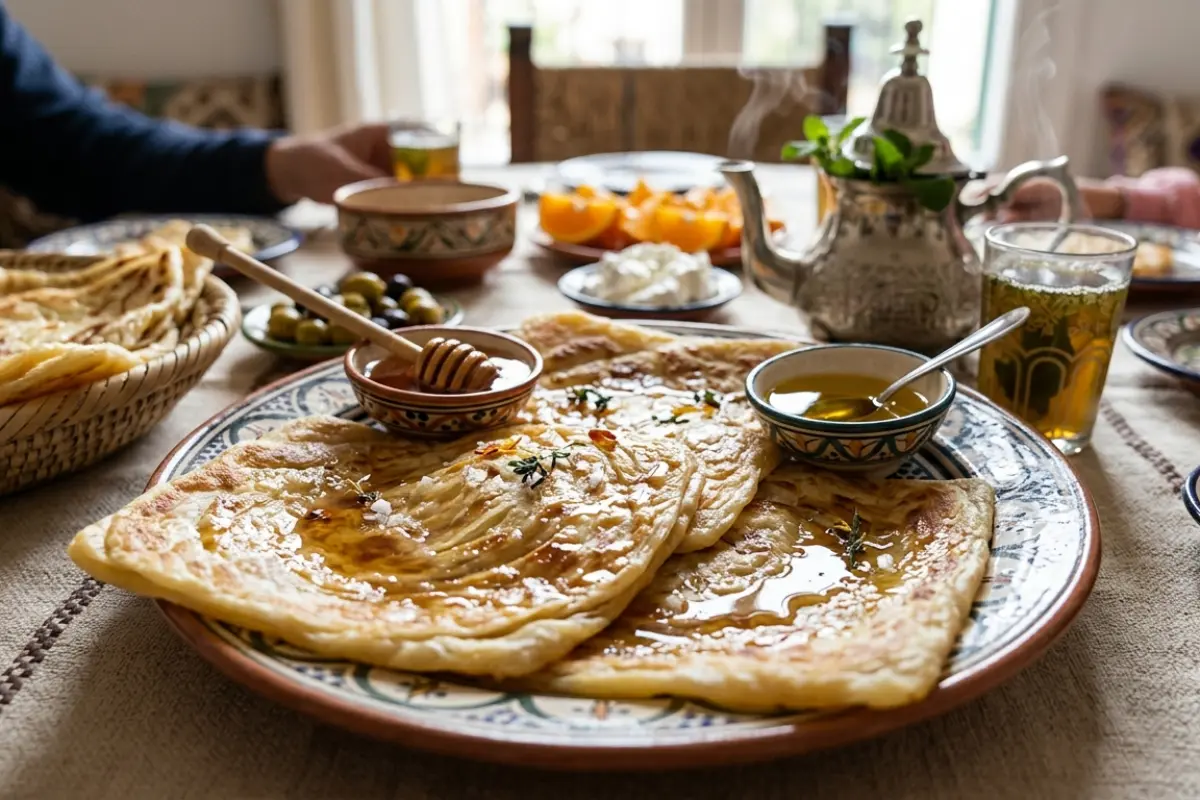
The pairing of msemen with honey and argan oil is considered one of the most luxurious and authentic ways to serve this flatbread. Culinary-grade argan oil, pressed from the kernels of the Argania spinosa tree native to southwestern Morocco, carries a distinctive nutty, toasted aroma that complements the neutral richness of the bread. Morocco is the only country in the world where argan trees grow in the wild at commercial scale, and the oil has been UNESCO-recognized as part of the intangible cultural heritage of the region. When raw wildflower honey is added alongside the argan oil, the combination creates a harmonious balance of sweetness, nuttiness, and buttery layered bread that is profoundly satisfying.
In cities like Marrakech, Fes, and Casablanca, msemen vendors begin their work before dawn, shaping and cooking hundreds of squares that are sold warm to passersby along with glasses of steaming mint tea. At home, the bread is invariably the centerpiece of the Moroccan breakfast table, accompanied by olives, fresh cheese, jam, and of course honey and argan oil. Preparing msemen with care and patience rewards the cook with a bread whose textures and flavors are impossible to replicate with any shortcut method, making the process itself a meditative and deeply Moroccan experience.
About This Recipe
Msemen belongs to a family of layered flatbreads that have been central to North African and Andalusian culinary culture for at least a thousand years. Food historians link its origins to the Berber communities of the Atlas Mountains and the Saharan oases, where nomadic peoples developed efficient ways to prepare nourishing, portable bread using minimal equipment. The technique of working fat into stretched dough to create distinct flaky layers appears across a broad swath of the Mediterranean and Middle Eastern world, from Moroccan msemen to Tunisian malsouka and Yemeni lahoh, suggesting a shared ancient heritage of layered bread-making that predates the modern borders of nations. The specific pairing of msemen with argan oil is particular to the Souss-Massa region of southwestern Morocco, where the argan tree has grown wild for millions of years and where Amazigh Berber women have processed argan kernels into oil using traditional stone mills for generations. The addition of honey to this pairing reflects Morocco's long tradition of apiculture, with hives maintained in the Middle Atlas cedar forests, the Rif mountains, and the valleys of the High Atlas producing honeys of exceptional diversity and quality. By the medieval period, Moroccan cookbooks and traveler accounts describe layered flatbreads served with fats and sweeteners as a sign of hospitality and abundance. Today, msemen with argan oil and honey is served at significant occasions including wedding mornings, the breaking of Ramadan fast, and the welcoming of honored guests, cementing its place not merely as a recipe but as an emblem of Moroccan generosity and cultural identity.
Nutrition / serving
Recipe Tags
Understanding the Ingredients
All-purpose flour
The primary structure of msemen comes from all-purpose flour, which provides enough gluten development to create a pliable, smooth dough that can be stretched thin without tearing. A moderate protein content flour, around 10 to 12 percent, gives the ideal balance between elasticity and tenderness.
Fine semolina
Fine durum wheat semolina is the traditional secret ingredient that gives msemen its characteristic slightly grainy texture and golden color. It also prevents the layers from sticking together during folding, helping to create the bread's defining flakiness.
Salt
Salt seasons the dough throughout and also strengthens the gluten network, contributing to a dough that holds its shape during the repeated folding and flattening process. Using the correct amount ensures the bread is well seasoned without being overpowering.
Warm water
Warm water, between 35 and 40 degrees Celsius, is used to hydrate the dough to the correct consistency. The temperature helps the salt dissolve fully and encourages a supple, workable dough. The exact quantity may vary slightly depending on flour absorption.
Unsalted butter, softened
Softened unsalted butter is smeared over each piece of dough during the folding process. It is the fat that separates the layers and creates the bread's signature flakiness when cooked on a dry griddle. Using unsalted butter allows you to control the total salt content of the recipe.
Vegetable oil
A neutral vegetable oil, such as sunflower or grapeseed, is used both to oil the work surface and to coat the dough balls during resting. This prevents sticking without adding competing flavors, keeping the preparation clean and the dough manageable.
Culinary argan oil
Culinary argan oil is distinct from cosmetic argan oil. It is made from roasted kernels and has a pronounced nutty, toasty flavor. It is served as a finishing condiment drizzled over the hot msemen at the table. Only a small amount is needed because the flavor is rich and concentrated.
Raw wildflower honey
Moroccan wildflower honey, ideally sourced from the Middle Atlas or Souss regions, has a complex floral sweetness that pairs beautifully with argan oil. Raw honey retains all its natural enzymes and aromatic compounds. It should be drizzled generously over the bread just before eating.
Step-by-Step Cooking Guide
Prepare the dough
15 minIn a large mixing bowl, combine 400 grams of all-purpose flour, 100 grams of fine semolina, and one teaspoon of salt. Mix the dry ingredients together thoroughly. Gradually pour in approximately 250 to 280 milliliters of warm water while mixing with your hands until a shaggy dough forms. Knead the dough vigorously on a clean work surface for 10 to 12 minutes until it is smooth, soft, and slightly tacky but not sticky. The dough should feel elastic and spring back when lightly pressed.
Tip: Do not add all the water at once. Moroccan flour and semolina absorb water differently depending on humidity and brand, so adjust the water gradually to achieve the correct soft consistency.
Rest and portion the dough
25 minLightly oil the surface of the dough and cover the bowl with a clean kitchen towel or plastic wrap. Allow the dough to rest at room temperature for 15 minutes to relax the gluten. After resting, divide the dough into 8 equal portions, each approximately 90 grams. Roll each portion into a smooth ball. Place the dough balls on an oiled tray and brush each lightly with vegetable oil. Cover and allow them to rest for another 10 minutes.
Tip: Oiling the dough balls generously prevents a dry crust from forming during the second rest period. This rest is essential and should not be skipped, as relaxed gluten is far easier to stretch thin.
Stretch and fold the msemen
15 minOil your work surface lightly with vegetable oil. Working with one dough ball at a time, use your fingertips to gently press and stretch the dough outward into a very thin, almost translucent square or rectangle, roughly 30 by 30 centimeters. Spread approximately one teaspoon of softened butter evenly over the surface of the stretched dough. Sprinkle a pinch of fine semolina over the butter. Fold the left third of the dough toward the center, then fold the right third over the top to create a long rectangle. Now fold the top third down and the bottom third up to form a compact square. Press gently with your palms to flatten slightly.
Tip: Work quickly once the dough is stretched, as it will begin to dry at the edges. If the dough resists stretching, allow it to rest for two additional minutes before continuing.
Second fold and flatten
10 minAfter forming the square packet, use your palms or a rolling pin to gently flatten each msemen to approximately one centimeter thickness. Some cooks prefer to perform a second round of folding: open the square, spread a small additional amount of butter and semolina, and refold. This creates even more defined layers. Place the completed squares on an oiled tray. Repeat the stretching, buttering, and folding process with all remaining dough balls. Cover the formed msemen and allow them to rest for 5 minutes before cooking.
Tip: The thickness after flattening should be uniform across the entire square. Uneven thickness will result in some parts cooking faster than others. Aim for a consistent one-centimeter depth.
Cook on a dry griddle
30 minHeat a large cast-iron skillet or traditional Moroccan griddle over medium heat. The pan should be hot enough that a drop of water evaporates within two seconds of contact. Do not add any oil or butter to the pan. Place one or two msemen squares onto the dry griddle and cook for approximately 3 to 4 minutes per side, pressing gently with a spatula, until each side develops deep golden-brown patches and the bread feels cooked through with no raw doughy sections. The bread should puff slightly in areas and feel light when lifted.
Tip: Adjust the heat as needed. If the msemen browns too quickly before cooking through, reduce the heat. A cast-iron pan maintains even heat better than a thin non-stick pan and produces superior results.
Serve with honey and argan oil
5 minTransfer the freshly cooked msemen to a serving plate immediately. Serve them hot. At the table, generously drizzle culinary argan oil over the top of each msemen, followed by a lavish drizzle of raw wildflower honey. Some families tear the msemen open slightly so the honey and argan oil seep into the warm layers. Serve alongside a pot of freshly brewed Moroccan mint tea for the complete traditional breakfast experience.
Tip: The quality of the argan oil and honey will make a dramatic difference to the final result. Invest in authentic culinary argan oil from a reputable Moroccan cooperative and raw unfiltered honey for the best flavor.
Common Mistakes to Avoid
✗ Not kneading the dough long enough
Fix: Msemen dough needs a minimum of 10 to 12 minutes of vigorous kneading to develop sufficient gluten structure. Under-kneaded dough will tear when stretched and produce a dense, tough bread instead of light, flaky layers.
✗ Skipping the resting periods
Fix: Both resting periods are essential. The first rest allows the gluten to relax after kneading so the dough can be stretched thin, and the second rest after shaping allows the butter layers to firm slightly before cooking. Rushing these steps results in dough that snaps back and layers that merge together.
✗ Cooking on too high a heat
Fix: Excessive heat causes the outside to brown rapidly while the inside remains raw and doughy. Use medium heat and be patient, allowing each side to cook fully before flipping. The total cooking time per msemen should be 6 to 8 minutes.
✗ Using too little butter during folding
Fix: The butter is what creates the layers. Using too little results in a bread that is more like a dense flatbread than a flaky msemen. Be generous when spreading the butter over the stretched dough at each folding stage.
✗ Stretching the dough without oiling the surface
Fix: Without a lightly oiled work surface the dough will stick, tear, and become impossible to stretch to the required thinness. Always ensure the surface and your hands are lightly coated with vegetable oil before beginning to work with the dough.
Ingredient Substitutions
Instead of: Unsalted butter
Use: Smen (Moroccan aged fermented butter) can be used for an even more traditional and pungent flavor, or clarified butter (ghee) works well as a dairy option with a high smoke point.
Instead of: Culinary argan oil
Use: High-quality extra virgin olive oil with a fruity, grassy profile can be used as a substitute, though the distinctive nutty argan flavor will be absent. Toasted walnut oil is another alternative that approximates the nuttiness.
Instead of: Raw wildflower honey
Use: Thyme honey, orange blossom honey, or any single-origin raw honey can be used. Avoid processed supermarket honey as it lacks the complexity needed to complement the argan oil properly.
Instead of: Fine semolina
Use: If fine semolina is unavailable, use coarse semolina ground briefly in a food processor, or substitute up to half the quantity with fine cornmeal for a slightly different but acceptable texture.
Serving Suggestions
Serve msemen hot off the griddle with a generous drizzle of culinary argan oil and raw wildflower honey alongside a large pot of traditional Moroccan mint tea sweetened with sugar cubes for the quintessential Moroccan breakfast.
Offer msemen as part of a full Moroccan breakfast spread including amlou (argan oil, honey, and almond paste), fresh sheep's milk cheese, black olives marinated in preserved lemon, and a bowl of warm harira soup for a festive weekend morning.
Tear msemen into pieces and use them to scoop up a savory egg and tomato tagine, transforming the flatbread into an edible utensil for a simple and satisfying lunch.
Stack leftover msemen with thin slices of kefta (spiced lamb patties) and a drizzle of harissa for a satisfying street-food inspired sandwich that works well as a midday snack or light dinner.
Storage & Reheating
Storage
Allow cooked msemen to cool completely to room temperature before storing. Stack them with sheets of parchment paper between each piece to prevent sticking. Store in an airtight container or zip-lock bag at room temperature for up to two days, or refrigerate for up to five days. Uncooked shaped msemen can be frozen in a single layer on a tray, then transferred to a freezer bag and stored frozen for up to two months.
Reheating
Reheat cooked msemen on a dry skillet or griddle over medium-low heat for approximately 2 minutes per side until warmed through and slightly crisped. Alternatively, wrap in foil and heat in an oven at 180 degrees Celsius for 8 to 10 minutes. Avoid microwaving as it makes the bread soft and rubbery, destroying the flaky texture.
For frozen uncooked msemen, thaw overnight in the refrigerator and bring to room temperature for 20 minutes before cooking on the griddle as normal. Do not attempt to cook frozen msemen directly from frozen as they will not cook evenly and the layers will not separate properly.
Frequently Asked Questions
Recipe by

Abdrahman Idrissi
عبد الرحمن الإدريسي
Pastry & Bread Chef
View all recipes by Abdrahman →
You May Also Like
Our Ebooks

The Moroccan Vegan
$12.56

Tables of Fez: A Royal Palace Legacy
$22.99

The Soul of Morocco
$20.00
YouTube
Watch step-by-step cooking videos and learn traditional Moroccan techniques.
450+
Subscribers
150+
Videos