
90
Prep (min)
40
Cook (min)
8
Servings
Medium
Level
Introduction
Bread holds a sacred and deeply symbolic place in Moroccan culture, where it is treated not merely as food but as a divine blessing. In Moroccan households, bread is present at every meal, placed at the center of the table and used to scoop up stews, salads, and dips. The tradition of baking bread at home — or sending dough to the communal oven, known as the ferran — is a practice that has been carried down through generations, particularly in ancient cities like Fez, where artisanal baking remains a living art form.
Barley flour, known locally as dqiq cha'ir, has been a staple grain in North Africa for thousands of years, predating wheat cultivation in the region. Berber communities across the Atlas Mountains and the pre-Saharan plains relied heavily on barley bread, or aghroum in Tamazight, for its nourishment and resilience in harsh climates. Oats were historically less common but have been embraced in modern Moroccan kitchens for their fiber content and mild, nutty flavor, blending seamlessly with the earthier profile of barley. Together, these two grains create a bread that is both ancient in spirit and nourishing in nature.
Rosemary, or iklil al-jabal in Arabic, grows abundantly in the hills of northern Morocco, particularly around the Rif Mountains and the outskirts of Chefchaouen and Fez. While it is more often used in herbal teas and medicinal preparations in traditional Moroccan culture, rosemary has found its way into contemporary Moroccan baking, where its piney, floral aroma elevates simple grain breads to something truly memorable. This recipe honors that evolving tradition, marrying the ancient grains of the Maghreb with an aromatic herb that has graced Moroccan hillsides for centuries.
About This Recipe
Barley has been cultivated in the Maghreb region for over 6,000 years, making it one of the oldest food crops in North African history. Ancient Berber and Amazigh communities depended on barley bread as their primary source of sustenance, particularly in the semi-arid regions of the Atlas Mountains and the pre-Saharan territories where wheat cultivation was less reliable. In Fez, one of Morocco's most historically significant imperial cities and a center of Islamic scholarship and artisan culture, communal bread baking at neighborhood ovens called ferrans has been a cornerstone of daily life since the city's founding in the 9th century. Citizens would prepare their dough at home, often using inherited grain mixtures passed down through families, and carry it to the communal oven to be baked by skilled bakers who managed the wood-fired ovens with great expertise. The incorporation of oats into Moroccan grain breads reflects the broader agricultural diversity of the region, as well as contemporary Moroccan home cooks' embrace of nutritious ancient grains. Rosemary, which grows wild across the limestone hills of northern Morocco, has long been used in Berber herbal medicine and tea traditions; its use in bread represents a beautiful convergence of the Amazigh, Arab, and Mediterranean culinary threads that together form the rich tapestry of Moroccan food culture.
Nutrition / serving
Recipe Tags
Understanding the Ingredients
Rolled oats
Rolled oats are processed oat groats that have been steamed and flattened. They add a chewy, slightly sweet texture to the bread and are rich in beta-glucan fiber, which supports heart health. When soaked briefly in water before mixing, they soften and integrate smoothly into the dough.
Barley flour
Stone-ground barley flour has a distinctly earthy, slightly sweet, and nutty flavor that forms the backbone of this bread. It is lower in gluten than wheat flour, which means the bread will be denser — a characteristic prized in traditional Moroccan grain breads. It also adds a beautiful golden hue to the crumb.
Whole wheat flour
Whole wheat flour provides structural gluten that helps the dough hold together and rise properly, compensating for barley flour's lower gluten content. It adds a mild nuttiness and complements the oats and barley without overpowering them.
Fresh rosemary
Fresh rosemary leaves, finely chopped, deliver an aromatic, piney fragrance and a slightly resinous flavor that pairs beautifully with whole grains. Finely chopping the leaves ensures they distribute evenly through the dough without creating overpowering pockets of flavor.
Active dry yeast
Yeast is the leavening agent that causes the bread to rise through fermentation. It must be activated in warm water before adding to the flour mixture. Using water that is too hot will kill the yeast; too cold will prevent activation. The ideal temperature is between 100°F and 110°F (38°C to 43°C).
Olive oil
Extra virgin olive oil is a cornerstone of Moroccan cooking and adds richness, flavor, and moisture to the bread. It helps create a tender crumb and a slightly crisp crust. Moroccan olive oil, particularly from the Meknes region, is fruity and mild, making it ideal for baking.
Honey
A small amount of natural honey is added to feed the yeast and add a subtle sweetness that balances the earthy grain flavors. Moroccan thyme honey or wildflower honey is ideal, but any good-quality natural honey will work beautifully.
Salt
Sea salt enhances all the flavors in the bread and controls yeast activity during fermentation, ensuring a controlled, even rise. Fine sea salt from Morocco's Atlantic coast is traditionally preferred in Moroccan cooking for its clean, mineral taste.
Step-by-Step Cooking Guide
Activate the Yeast
10 minIn a small bowl, combine the active dry yeast with 1/4 cup of warm water (between 100°F and 110°F) and the honey. Stir gently and let it sit for 8 to 10 minutes until the mixture becomes frothy and bubbly. This confirms the yeast is alive and ready to work. If the mixture does not foam, discard it and start again with fresh yeast.
Tip: Use a thermometer to check water temperature if unsure. Water that is too hot will kill the yeast completely.
Soak the Oats
10 minIn a separate small bowl, combine the rolled oats with 1/3 cup of warm water and let them soak for 10 minutes. This softens the oats so they incorporate evenly into the dough and prevents them from drawing too much moisture from the bread during baking, which could result in dry pockets in the finished loaf.
Tip: Do not skip this step — unsoaked oats can create a crumbly, unevenly textured crumb.
Mix the Dough
15 minIn a large mixing bowl, whisk together the barley flour, whole wheat flour, and salt. Make a well in the center and pour in the activated yeast mixture, soaked oats, olive oil, chopped rosemary, and remaining warm water. Stir with a wooden spoon until a shaggy dough forms, then turn it out onto a lightly floured surface and knead by hand for 10 to 12 minutes until the dough is smooth, slightly tacky, and elastic.
Tip: Because barley flour is low in gluten, the dough will feel stickier than a standard wheat bread dough. Resist the urge to add too much flour — a slightly sticky dough yields a more tender crumb.
First Rise
75 minShape the dough into a smooth ball and place it in a lightly oiled bowl, turning it once to coat all sides. Cover the bowl with a clean damp kitchen towel or plastic wrap and set it in a warm, draft-free place. Allow the dough to rise for 60 to 75 minutes, or until it has roughly doubled in size. In Moroccan homes, the dough is often left near the kitchen hearth or in a warm corner of the room to rise slowly.
Tip: In cooler weather, place the covered bowl in an oven with only the oven light on to create a gentle warmth.
Shape the Loaf
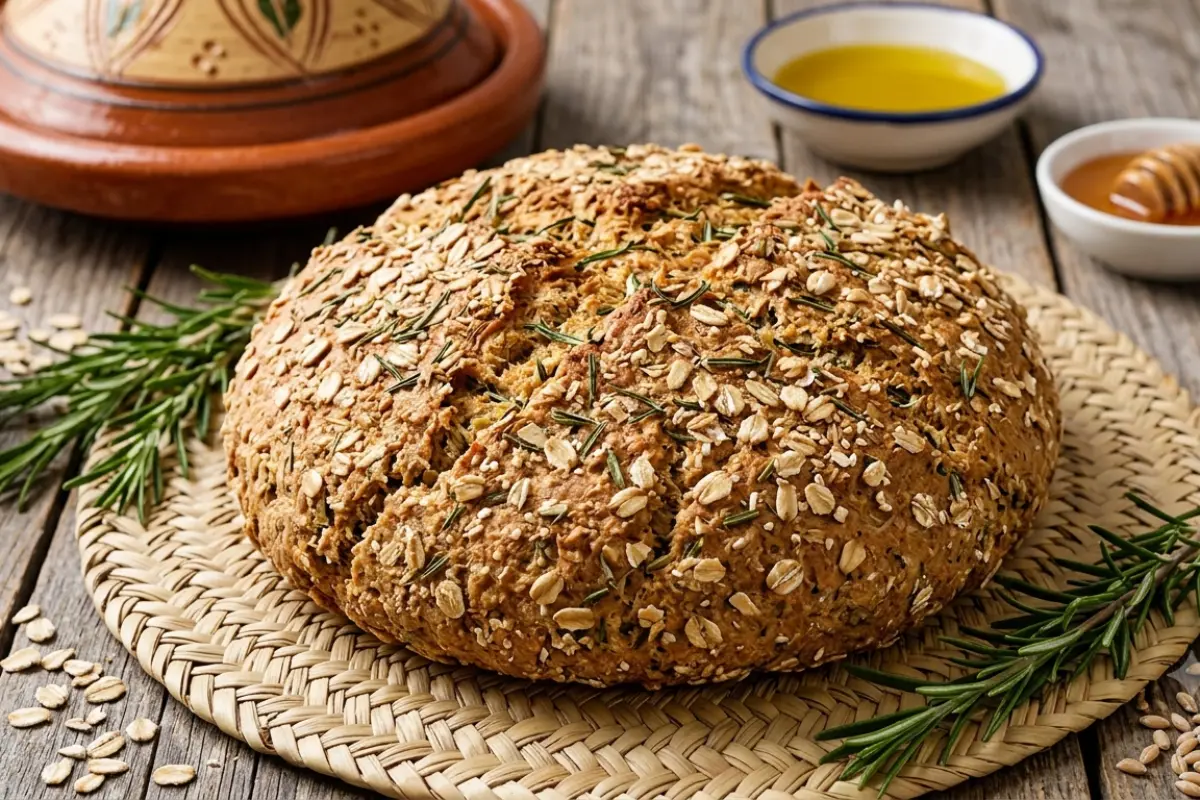
10 minPunch down the risen dough gently to release air bubbles. Turn it out onto a lightly floured surface and shape it into a round, flat disc approximately 9 to 10 inches in diameter and about 1.5 inches thick — the traditional Moroccan bread shape known as khobz. Place the shaped loaf on a baking sheet lined with parchment paper or lightly dusted with semolina. Using a fork or skewer, poke several small holes across the surface of the loaf in a decorative pattern, then dust the top lightly with oat flakes or barley flour.
Tip: The decorative fork marks are a traditional Moroccan touch that also help the bread bake evenly by allowing steam to escape.
Second Rise
30 minCover the shaped loaf loosely with a clean kitchen towel and allow it to rest and rise again for 20 to 30 minutes. During this second proof, the dough relaxes and expands slightly, ensuring a lighter texture in the final bake. Preheat your oven to 400°F (200°C) during this time so it is fully hot and ready when the bread goes in.
Tip: Do not let the second rise go too long, or the bread may over-proof and collapse slightly in the oven.
Bake the Bread
40 minPlace the loaf in the fully preheated oven and bake for 35 to 40 minutes until the crust is deep golden brown and the bread sounds hollow when tapped on the bottom. For a crispier crust, place a small oven-safe dish of water on the bottom rack of the oven during the first 15 minutes of baking to create steam. Remove the bread from the oven and let it cool on a wire rack for at least 20 minutes before slicing to allow the crumb to set properly.
Tip: Cutting into the bread too soon will result in a gummy crumb. Patience during cooling is essential for the best texture.
Common Mistakes to Avoid
✗ Using water that is too hot when activating the yeast
Fix: Always use a kitchen thermometer to ensure the water is between 100°F and 110°F. Water above 120°F will kill the yeast, resulting in a flat, dense loaf that will not rise.
✗ Adding too much flour because the dough feels sticky
Fix: The combination of barley flour and oats creates a naturally stickier dough than pure wheat bread. Add flour in very small increments only if the dough is completely unworkable. A slightly tacky dough produces the best final texture.
✗ Skipping the second rise
Fix: The second proof after shaping is essential for developing structure and a lighter texture. Skipping it results in a very dense, heavy loaf. Always allow the shaped bread to rest for at least 20 minutes before baking.
✗ Slicing the bread immediately after baking
Fix: The interior of the bread continues to cook and set as it cools. Cutting into it while still hot releases steam too quickly and leaves the crumb gummy and underbaked in texture. Allow the loaf to cool for a minimum of 20 minutes on a wire rack.
Ingredient Substitutions
Instead of: Barley flour
Use: Spelt flour or whole wheat flour can be used in the same quantity. Spelt will produce a slightly lighter loaf, while additional whole wheat will maintain the earthy character of the original bread.
Instead of: Fresh rosemary
Use: Dried rosemary can be used in half the quantity — about 1.5 teaspoons instead of 1 tablespoon of fresh. Alternatively, fresh thyme or a combination of thyme and za'atar blends well with these grains.
Instead of: Honey
Use: Date molasses (dibs tamr), which is widely used in Morocco, makes an excellent substitute and adds a deeper, more complex sweetness. Maple syrup or agave nectar also work well.
Instead of: Active dry yeast
Use: Instant yeast can be used in the same quantity and does not need to be pre-activated in water — it can be added directly to the dry ingredients. Reduce rise times slightly as instant yeast works faster.
Serving Suggestions
Serve warm alongside a traditional Moroccan harira soup, tearing the bread into pieces for dipping into the rich tomato and lentil broth.
Accompany with a drizzle of Moroccan extra virgin olive oil and a small dish of amlou — the traditional Moroccan almond, argan oil, and honey spread — for a simple and satisfying breakfast.
Use as a base for an open-faced spread of kefta spiced ground meat and roasted peppers for a hearty lunch.
Serve at the center of a mechoui feast alongside slow-roasted lamb, preserved lemons, and a medley of Moroccan salads.
Storage & Reheating
Storage
Wrap the fully cooled bread tightly in a clean kitchen towel or beeswax wrap and store at room temperature for up to 2 days. For longer storage, wrap tightly in plastic wrap and then aluminum foil and freeze for up to 1 month.
Reheating
To reheat, sprinkle the bread lightly with water and warm it in a 350°F (175°C) oven for 8 to 10 minutes. This restores the crust's crispness and warms the crumb without drying it out. Frozen bread should be thawed at room temperature before reheating.
Avoid storing bread in the refrigerator, as this accelerates staling. The refrigerator environment causes the starch molecules to recrystallize faster, making the bread go stale more quickly than leaving it at room temperature.
Frequently Asked Questions
Recipe by

Abdrahman Idrissi
عبد الرحمن الإدريسي
Pastry & Bread Chef
View all recipes by Abdrahman →
You May Also Like
Our Ebooks

The Moroccan Vegan
$12.56

Tables of Fez: A Royal Palace Legacy
$22.99

The Soul of Morocco
$20.00
YouTube
Watch step-by-step cooking videos and learn traditional Moroccan techniques.
450+
Subscribers
150+
Videos