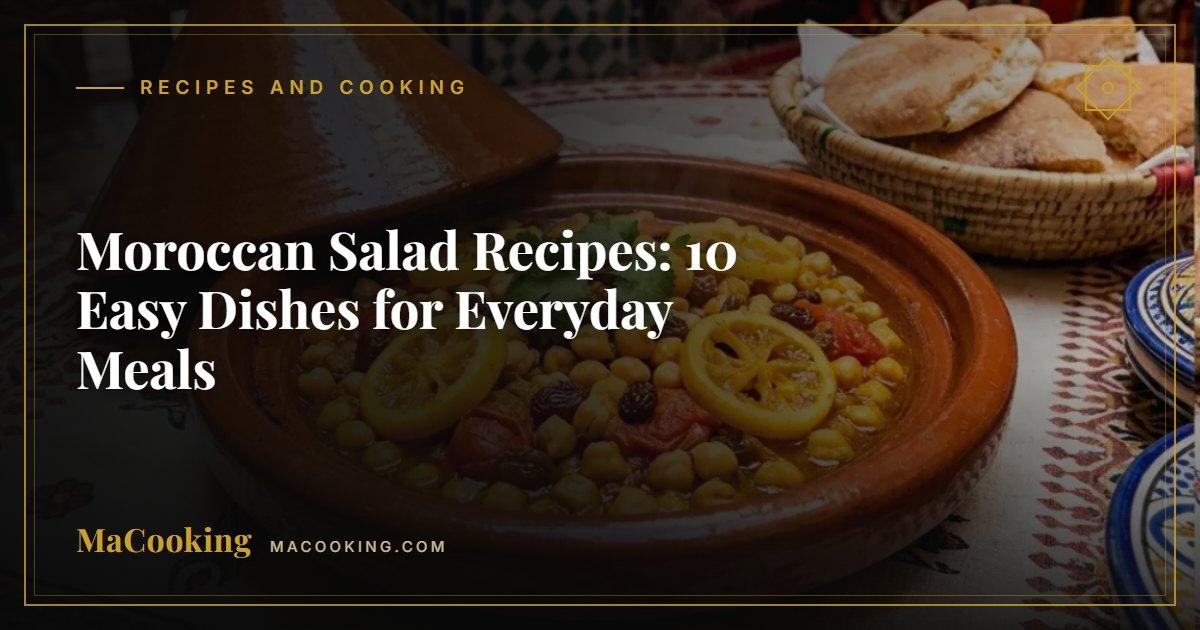
Moroccan salad recipes range from fresh tomato-cucumber chops to slow-cooked, spiced vegetable dishes like zaalouk and taktouka. Most rely on olive oil, lemon, cumin, paprika, garlic and fresh herbs, take under 40 minutes, and are served as small plates at the start of a meal. Below are ten easy versions for everyday cooking.
Key Takeaways
- A Moroccan "salad" is often a cooked, spiced vegetable dish served at room temperature, not just raw greens.
- A pantry of olive oil, lemons, cumin, sweet paprika, garlic, parsley and cilantro covers most recipes.
- Meals usually open with several small salads, so you can make two or three simple ones instead of one large dish.
- Most cooked salads improve after resting, which makes them good for meal prep.
- Chickpeas, beans and lentils turn these salads into a light main course.
In Moroccan homes the opening of the meal is rarely a single bowl of lettuce. It is a spread of small dishes, each with its own colour and spice, scooped up with fresh bread. Some are raw and bright, others are cooked down until jammy. The ten recipes below are the ones that work best on a weeknight, with quantities, timings and Western-pantry substitutions. For more of the same, browse our full Salads & Appetizers recipes.
What Are the Key Moroccan Salad Ingredients?
Moroccan salad ingredients are simple and mostly pantry-friendly. The character comes from how a few of them are combined: acid from lemon or vinegar, warmth from cumin and paprika, and freshness from herbs. For a wider look at the cuisine's background, see the overview of Moroccan cuisine on Wikipedia.
| Ingredient | Role in the salad | Easy substitute |
|---|---|---|
| Extra-virgin olive oil | Base of the dressing and for cooking vegetables | Mild vegetable oil for cooking; keep olive oil for finishing |
| Lemons | Brightness; used in almost every dressing | White wine or apple cider vinegar |
| Ground cumin | Earthy warmth, especially with carrots, beets and chickpeas | Toast and grind whole seeds for stronger flavour |
| Sweet paprika | Colour and mild sweetness | Mild smoked paprika, used sparingly |
| Garlic | Sharpness in cooked salads and dressings | None needed; grate it for raw salads |
| Flat-leaf parsley and cilantro | Fresh finish, used generously | Use all parsley if cilantro is unavailable |
| Preserved lemon | Salty, floral depth in olive and tomato salads | Fresh lemon zest plus a pinch of salt |
| Orange blossom water | Perfume for sweet fruit salads | A tiny splash of rose water, or leave out |
If you cook Moroccan food regularly, it is worth learning to make your own preserved lemons. Our step-by-step preserved lemon guide walks through it.
How Do You Make Moroccan Salad Dressing?
Moroccan salad dressing is less a fixed recipe than a balance. Most versions are an oil-and-acid mix seasoned with cumin, paprika, garlic and herbs. Start with this all-purpose base, then adjust.
All-purpose dressing (serves 4)
- 3 tablespoons extra-virgin olive oil
- 1 tablespoon fresh lemon juice (or 2 teaspoons vinegar)
- 1 small garlic clove, grated
- ¼ teaspoon salt, plus a pinch of black pepper
- 1 tablespoon finely chopped parsley or cilantro
Whisk everything in a small bowl or shake in a jar for 20 seconds. Taste it on a piece of tomato or cucumber, not from the spoon, because the vegetable will soften the salt and acid. For carrots and beets, add a pinch of sugar or a teaspoon of orange juice. For a spicier version, add a small pinch of cayenne or a few drops of harissa.
10 Easy Moroccan Salad Recipes for Everyday Meals
Here are the ten dishes most useful for everyday cooking. Quantities serve four as a starter or two to three as a light lunch.
| Salad | Main ingredients | Style | Total time |
|---|---|---|---|
| Tomato & cucumber chop | Tomato, cucumber, onion, herbs | Raw | 10 min |
| Zaalouk | Eggplant, tomato, garlic, spices | Cooked | 40 min |
| Taktouka | Green peppers, tomato, garlic | Cooked | 40 min |
| Carrot salad | Carrots, cumin, lemon | Cooked | 20 min |
| Chickpea salad | Chickpeas, cilantro, lemon | Raw/assembled | 10 min |
| Beet salad | Beets, cumin, parsley | Cooked | 15 min + cooking |
| Orange & cinnamon salad | Oranges, cinnamon, orange blossom water | Raw, sweet | 10 min |
| White bean salad | White beans, tomato, paprika | Cooked | Depends on beans |
| Courgette (zucchini) salad | Zucchini, garlic, cumin | Cooked | 25 min |
| Olive & preserved lemon salad | Olives, preserved lemon, herbs | Raw | 10 min |
1. Tomato and cucumber chopped salad
This is the answer to how to make Moroccan salad when you have ten minutes. Finely dice 4 ripe tomatoes, 1 cucumber and ½ small red onion into pieces about the size of a pea. Add a handful of chopped parsley and dress with the all-purpose dressing above. Salt just before serving, since the tomatoes release water quickly. Fine dicing is the point: it lets every spoonful carry all the flavours.
2. Zaalouk (smoky eggplant and tomato)
Peel 2 medium eggplants (aubergines) in stripes, cube them, salt lightly, and steam or simmer for 10 to 15 minutes until very soft. Meanwhile, cook 4 grated or chopped tomatoes with 3 crushed garlic cloves, 2 tablespoons olive oil, 1 teaspoon paprika and ½ teaspoon cumin until thick. Add the drained eggplant and mash it into the tomato with a fork over medium-low heat for 10 to 15 minutes. Finish with cilantro and lemon. It should be spreadable, not watery.
3. Taktouka (roasted pepper and tomato)
Char 3 green bell peppers under the grill or over a gas flame until blistered, rest them in a covered bowl, then peel, seed and chop. Cook 4 chopped tomatoes with 3 garlic cloves, 2 tablespoons olive oil, 1 teaspoon paprika and ½ teaspoon cumin for 15 minutes until jammy. Fold in the peppers and cook 10 minutes more. Serve at room temperature. If you want heat, add a small chopped chilli with the tomatoes.
4. Cumin and lemon carrot salad
Slice 500 g (1 lb) carrots into thin coins and simmer in salted water for 8 to 10 minutes until just tender, not mushy. Drain, then toss while warm with 2 tablespoons olive oil, 1 tablespoon lemon juice, 1 grated garlic clove, ½ teaspoon cumin, ½ teaspoon paprika and plenty of parsley. Warm carrots absorb the dressing much better than cold ones. A pinch of sugar softens the lemon if you like a gentler finish.
5. Moroccan salad with chickpeas
For a Moroccan salad with chickpeas, drain two 400 g (14 oz) cans (or about 3 cups cooked), rinse well, and toss with ½ cup chopped cilantro, 3 tablespoons olive oil, the juice of 1 lemon, ½ teaspoon cumin and a diced tomato or red onion. Let it sit 15 minutes. Our chickpea salad with cilantro and lemon gives the full method. If you prefer chickpeas hot and saucy, try the Moroccan chickpea tagine another night.
6. Beet salad with cumin
Boil or roast 4 medium beets until a knife slides in easily (about 40 to 60 minutes boiled), then peel and dice. Dress with 2 tablespoons olive oil, 1 tablespoon lemon juice or vinegar, ½ teaspoon cumin, a pinch of salt and chopped parsley. Pre-cooked vacuum-packed beets work perfectly well on a busy day, as long as they are unseasoned.
7. Orange and cinnamon salad
Peel 4 oranges, removing all pith, and slice into rounds. Arrange on a plate, dust with ½ teaspoon cinnamon, and sprinkle with 1 teaspoon orange blossom water and a little sugar if the fruit is tart. Some cooks add a few black olives or thin red onion for contrast. It works as a palate cleanser between richer dishes or as a light dessert.
8. White bean salad
White beans are a very common starter in Moroccan homes, often served warm or at room temperature. Our Loubia (Moroccan white beans) recipe is a good base. For a cooler, salad-style version, let the beans cool, drain off most of the sauce, and add fresh chopped tomato, parsley and a squeeze of lemon.
9. Courgette (zucchini) salad
Cut 3 zucchini into small cubes. Fry in 2 tablespoons olive oil over medium heat with 2 garlic cloves for 8 to 10 minutes until golden at the edges, then add ½ teaspoon cumin, ½ teaspoon paprika and 2 tablespoons water, and cover for 5 minutes. Finish with lemon juice and cilantro. Cook it until soft and slightly melting; undercooked zucchini tastes grassy here.
10. Olive and preserved lemon salad
Combine 1½ cups green or mixed olives (rinsed if very salty) with the finely chopped rind of ¼ preserved lemon (flesh discarded), 1 sliced garlic clove, 2 tablespoons chopped cilantro, 2 tablespoons olive oil and a pinch of paprika. Rest for 30 minutes. This salad is intensely savoury, so serve it in small quantities beside milder dishes.
How Do You Build a Moroccan Salad Table?
The Moroccan way is to serve several salads at once, mixing textures and temperatures. Pick one raw, one cooked-smooth (like zaalouk), one bean or chickpea dish and one sweet or acidic accent. Put out warm bread, and let everyone scoop from the shared plates.
- Quick weeknight spread: tomato-cucumber chop, carrot salad, and olives with preserved lemon.
- Weekend lunch: zaalouk, taktouka, beet salad and chickpea salad.
- Beside a main dish: a simple chopped salad and orange salad alongside Moroccan-style roasted chicken (Djej Mhammar).
- Holiday table: see our guide to Moroccan salad recipes for a Ramadan iftar table for larger spreads.
For readers who want to go deeper into the tradition of the opening course, the full ebook Tables of Fez: A Royal Palace Legacy includes a chapter titled "The Salad Table: Cold Dishes and the Fassi Art of Beginning".
How Do You Store and Prep Moroccan Salads Ahead?
Cooked salads are some of the most make-ahead-friendly dishes in the cuisine. Flavours deepen as spices settle into the vegetables. Raw salads need more care.
- Zaalouk, taktouka, carrot, beet and zucchini salads: keep in airtight containers in the fridge for up to 3 days. Bring to room temperature, or warm gently, and refresh with lemon and herbs.
- Chickpea and bean salads: best within 2 to 3 days. Add fresh herbs on the day.
- Tomato-cucumber chop: chop ahead and keep the vegetables undressed; salt and dress within 10 minutes of serving.
- Orange salad: slice up to a few hours ahead, adding orange blossom water at the last minute.
If you are planning a whole week of cooking, our Moroccan meal prep guide shows how to fit these salads around other make-ahead dishes.
Frequently Asked Questions
What is the most popular Moroccan salad?
There is no single winner, but zaalouk (smoky eggplant and tomato) and the finely chopped tomato, cucumber and onion salad appear on many Moroccan tables. Cumin-spiced carrot salad and beet salad are also everyday staples. Most meals offer several small salads together rather than one.
Are Moroccan salads served hot or cold?
Both, and often in between. Cooked salads such as zaalouk and taktouka are usually served at room temperature or chilled, while chopped raw salads are served cold and dressed shortly before eating. Moroccan salads are rarely piping hot.
What spices are used in Moroccan salad dressing?
Cumin and sweet paprika are most common, sometimes with a pinch of cayenne or ras el hanout, plus garlic, lemon juice or vinegar, olive oil and fresh parsley or cilantro. Sweet salads, such as orange salad, use cinnamon and orange blossom water instead.
Can I make Moroccan salads ahead of time?
Yes. Cooked salads like zaalouk, taktouka, carrot, beet and chickpea often taste better after a few hours or a day in the fridge. Keep raw tomato and cucumber salads undressed and combine them just before serving so they stay crisp.
Is there a good Moroccan salad with chickpeas?
Yes. A simple version combines cooked chickpeas with cilantro, lemon juice, olive oil, cumin and a little red onion or tomato. It is filling enough for lunch, keeps well for a couple of days, and works as a base for adding grilled chicken or feta.
Conclusion
Once you see Moroccan salads as small, flavourful plates rather than a single bowl of greens, they become easy to fit into any week. Start with two: a quick tomato-cucumber chop and a cumin carrot salad. Then add zaalouk or taktouka when you have time. With olive oil, lemon, cumin, paprika and fresh herbs in the kitchen, you are never far from a good Moroccan starter. For more ideas, explore all our salad spreads for special occasions and the wider recipe collection.