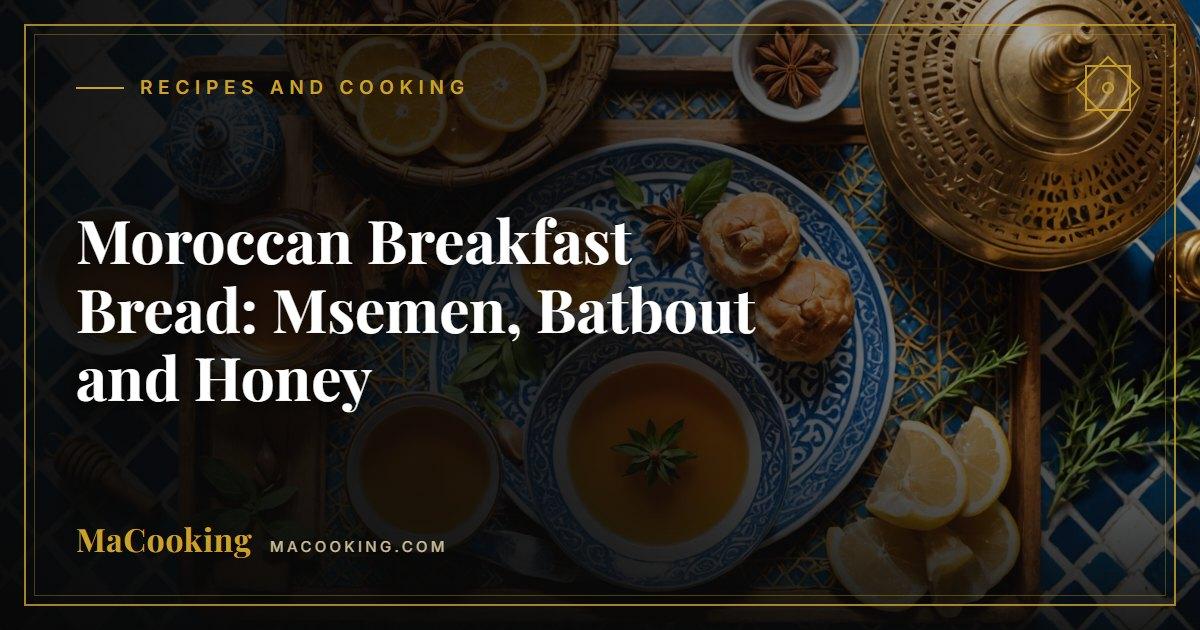
The easiest Moroccan breakfast bread to make at home is batbout, a soft yeasted pan bread, or msemen, a no-yeast layered square. Both cook in a dry skillet in minutes and are best eaten warm with honey, butter or olive oil alongside a glass of mint tea.
Key Takeaways
- Msemen needs no yeast and no rising time, only a short rest, so it suits mornings when you are short on time.
- Batbout is a soft, puffed, pocket-style bread that you can split and fill with cheese, eggs or honey.
- Fine semolina is the key to the texture of both breads and is easy to find in Western supermarkets.
- Both breads freeze well, so you can make a batch on the weekend and reheat them on a weekday.
- Honey, butter and olive oil are the simplest toppings, and a pot of mint tea completes the table.
Which easy Moroccan breakfast bread should you start with?
Morocco has a whole family of breakfast breads, and the right one depends on how much time and patience you have. If you want an easy Moroccan breakfast bread with the least fuss, there are really two beginner-friendly answers: batbout for softness and msemen for flaky layers. The table below compares the main options you will meet on a Moroccan breakfast table.
| Bread | Texture | Leavening | Effort | Best with |
|---|---|---|---|---|
| Batbout | Soft, puffy, pocket-like | Yeast | Easy; needs about 1.5 hours of resting | Cheese, eggs, honey, jam |
| Msemen | Layered, crisp edges, tender centre | None | Medium; folding takes practice | Honey, butter, olive oil |
| Harcha | Crumbly, semolina-rich | Baking powder | Easy; no resting needed | Butter, cheese, jam |
| Baghrir | Spongy, thousand-holed pancake | Yeast and baking powder | Easy; pourable batter | Warm butter and honey |
| Khobz | Round, chewy, crusty loaf | Yeast | Medium; needs a full rise | Olive oil, olives, eggs |
This article focuses on msemen and batbout because they give you two very different results from the same basic pantry. If you want to explore the wider world of Moroccan loaves and griddle breads, browse our Breads & Pastries recipes.
What does a traditional Moroccan breakfast table look like?
Moroccan breakfast is usually built around bread and something to dip, spread or pour over it. A typical spread might include warm msemen or khobz, a small dish of olive oil, a pot of honey, butter, olives, soft cheese, jam and perhaps eggs. Mint tea or coffee with milk completes the picture. What you find depends on the region, the season and the household, so treat any list of Moroccan breakfast foods as a set of possibilities rather than a fixed menu.
In the Amazigh mountain regions, breakfast leans on local grains, olive oil, and in some areas argan oil and almonds. If that world interests you, read The Amazigh Breakfast Table for more on its traditions and nutrition. For a broader look at what people across the country eat in the morning, see our guide to Moroccan breakfast traditions.
How do you make msemen at home?
Msemen is a square, layered flatbread made from a simple dough of wheat flour and fine semolina. The dough is rolled very thin, brushed with fat, folded, and cooked on a griddle until golden and crisp at the edges. There is nothing hard about it, but your first few will probably look uneven. That is normal, and they will still taste excellent.
Ingredients (makes 8 msemen)
- 2 ½ cups (320 g) all-purpose flour, plus extra for dusting
- ½ cup (80 g) fine semolina, plus extra for dusting
- 1 teaspoon fine salt
- 1 teaspoon sugar
- About 1 cup (240 ml) warm water, adding a little more if needed
- For brushing: ¼ cup (60 g) soft butter mixed with ¼ cup (60 ml) neutral oil
Method
- Make the dough. Mix the flour, semolina, salt and sugar in a large bowl. Add the water gradually and mix until a shaggy dough forms.
- Knead. Knead for 8 to 10 minutes on a clean counter until smooth and elastic. The dough should be soft and slightly tacky but not sticking to your hands.
- Divide and rest. Divide into 8 balls, oil them lightly, cover and rest for 15 to 20 minutes.
- Stretch. On an oiled surface, flatten one ball and spread it with your fingertips into a very thin, almost translucent rectangle. Rolling with a pin works too if you oil the pin.
- Brush and sprinkle. Brush generously with the butter and oil mixture and sprinkle with a pinch of semolina.
- Fold. Fold the rectangle into thirds like a letter, brush the top again, then fold into thirds the other way to make a small square.
- Flatten and cook. Gently press the square out to about 12 cm (5 in). Cook on a lightly oiled skillet over medium heat for 2 to 3 minutes per side, until golden with darker spots.
- Fluff. Serve hot. Some cooks lightly crush the edges with their hands to open up the layers.
For a fully detailed walk-through with extra technique notes, see our msemen recipe and the guide How to Make Moroccan Msemen.
Common msemen mistakes
- Dough too dry. It will tear when you stretch it. Add water a teaspoon at a time.
- Skipping the rest. The gluten needs time to relax, or the dough springs back.
- Heat too high. The outside burns before the layers cook through. Keep the heat at medium.
- Too little fat between layers. The fat is what separates the layers, so be generous.
How do you make batbout, the soft Moroccan pan bread?
Batbout is often called Moroccan pita because it puffs on the pan and can be split open like a pocket. It is traditionally cooked on a griddle rather than baked, which makes it practical for small kitchens. The dough is yeasted, so you need to plan about an hour and a half of resting, but almost none of that is active work.
Ingredients (makes 8 batbout)
- 2 cups (250 g) all-purpose flour
- 1 cup (150 g) fine semolina or whole wheat flour
- 2 teaspoons (7 g) instant yeast
- 1 teaspoon salt
- 1 teaspoon sugar
- 1 tablespoon olive or neutral oil
- About 1 cup plus 2 tablespoons (270 ml) warm water
Method
- Combine the flour, semolina, yeast, salt and sugar. Add the oil and most of the water and mix to a soft dough.
- Knead for 8 to 10 minutes. The dough should be soft, smooth and slightly sticky. Add the remaining water only if it feels stiff.
- Cover and let it rise for about 1 hour, until nearly doubled.
- Divide into 8 pieces and shape each into a smooth ball.
- Flatten each ball into a disc about 10 cm (4 in) across and 1 cm (½ in) thick. Dust with semolina, cover with a towel, and rest for 30 to 40 minutes.
- Heat a non-stick skillet over medium-low heat. Cook the discs dry, 3 to 4 minutes per side, until puffed and lightly golden, with a pale ring around the edge.
- Wrap the cooked breads in a clean towel for 10 minutes to keep them soft.
Our full batbout recipe covers shaping and filling in more depth.
Tips for puffy batbout
- Do not press the discs once they are on the pan. Pressure knocks out the air that creates the pocket.
- Keep the heat moderate. If the surface browns before the bread puffs, turn the heat down.
- Flip only once the underside has set and has light colour.
What is the best way to serve Moroccan bread with honey?
Honey is the classic sweet partner for msemen, and the simplest way to serve it is also the best. Take a hot msemen straight from the pan, spread it with a little butter so it melts into the layers, and drizzle with honey. For a more local touch, add a few drops of argan oil, which has a nutty, toasty flavour. Our msemen with honey and argan oil recipe shows exactly how to do this.
Batbout is more flexible. Split it open and fill it with soft cheese, a fried egg, olives and herbs, or keep it sweet with honey and butter. The following table gives you easy ideas and Western-pantry substitutions.
| Topping or filling | Works best with | Western pantry substitution |
|---|---|---|
| Honey and butter | Msemen, baghrir, harcha | Any mild runny honey; salted butter is fine |
| Olive oil and olives | Batbout, khobz | Good extra virgin olive oil |
| Amlou (almond, argan oil and honey paste) | Msemen, batbout | Almond butter loosened with a little toasted nut oil and honey |
| Soft cheese and herbs | Batbout | Labneh, cream cheese or fresh goat cheese |
| Jam or fruit preserves | Msemen, harcha | Apricot, fig or orange preserves |
| Fried or soft-boiled eggs | Batbout, khobz | Add cumin and flaky salt |
If you cannot find argan oil, use a small amount of toasted almond or hazelnut oil for a similar nutty note, or simply leave it out. The bread and honey are already delicious on their own.
What else can you serve for a Moroccan breakfast?
Once you have the bread, building a full spread is easy. Here are some Moroccan breakfast ideas that pair well with both msemen and batbout:
- Mint tea or coffee with milk in small glasses or cups. The sweet, fragrant tea balances buttery bread well.
- Fresh orange juice or seasonal fruit such as oranges, dates or figs.
- A dish of olive oil for dipping, with olives and a little salt.
- Eggs cooked with cumin, or a simple omelette with tomato and herbs.
- Something savoury and filling for weekends. Msemen is also used in more elaborate dishes. See stuffed msemen with onions and herbs for a savoury version.
If you want to learn how to prepare and pour the tea properly, the free chapter on the Moroccan tea ceremony is a good place to start, and it costs nothing to read online.
Can you make Moroccan breakfast bread ahead of time?
Yes, and both breads are good candidates for batch cooking. Here is how to handle timing and storage:
- Msemen dough: shape the folded squares, stack them with baking paper between each, and refrigerate overnight or freeze them uncooked. Cook straight from the fridge, or from frozen with an extra minute per side.
- Cooked msemen: keeps for a day at room temperature, wrapped. Freeze for up to two months and reheat in a dry skillet for about a minute per side.
- Batbout dough: after the first rise, you can shape the discs, cover them and chill for a few hours before cooking.
- Cooked batbout: store in a sealed bag once completely cool. Warm briefly in a pan or toaster before serving.
The following table summarises the timings so you can plan your morning.
| Stage | Msemen | Batbout |
|---|---|---|
| Kneading | 8 to 10 minutes | 8 to 10 minutes |
| Resting or rising | 15 to 20 minutes | About 1 hour plus 30 to 40 minutes |
| Shaping | 15 to 20 minutes | 10 minutes |
| Cooking per bread | 4 to 6 minutes total | 6 to 8 minutes total |
| Freezer life | Up to 2 months | Up to 2 months |
Msemen also appears in dishes beyond breakfast. For example, it is torn and layered in rfissa with chicken and lentils, so a batch in the freezer is useful for more than one meal. For more background on the dish itself, Wikipedia's overview of Moroccan cuisine is a helpful starting point.
Why does a simple Moroccan breakfast feel so satisfying?
Part of the appeal is contrast. Crisp edges against a tender centre, salty butter against sweet honey, the warmth of fresh bread against a cool glass of juice. Another part is the rhythm. Bread is cooked in batches and eaten as it comes off the pan, shared at the table, torn by hand. You do not need special equipment, just a decent skillet, a rolling surface, and a few minutes of attention.
Frequently Asked Questions
What is the easiest Moroccan bread to make for breakfast?
Batbout is the easiest if you want a soft, pocket-style bread with little handwork: mix, rest, flatten and cook in a dry pan. Msemen takes more practice because of the folding, but it needs no yeast and no rising time, so it can be faster on a busy morning.
What do Moroccans eat with bread for breakfast?
Common partners include honey, butter, olive oil, jam, soft cheese, olives, eggs and amlou, a paste of almonds, argan oil and honey. Mint tea or coffee with milk usually sits alongside. What appears on the table varies by region and household.
Can I make msemen without semolina?
Yes. Use all-purpose flour alone, though the result will be slightly softer and less crisp at the edges. Fine semolina adds a gentle crunch and a little structure. If you can only find coarse semolina, grind it briefly in a blender or spice grinder first.
How do I keep batbout soft?
Cook it on moderate heat so it puffs without drying out, then wrap the warm breads in a clean kitchen towel for ten minutes. Store them in a bag once fully cool. Too much heat or too long in the pan is the usual cause of stiff batbout.
Can I freeze Moroccan breakfast bread?
Both freeze well. Separate cooked msemen or batbout with baking paper, seal in a freezer bag and freeze for up to two months. Reheat msemen in a dry pan for a minute per side, and batbout in a warm pan or toaster until soft and hot.
Is msemen the same as paratha?
They are related in spirit, since both are folded, fat-brushed flatbreads cooked on a griddle, but they are not the same. Msemen is made with a wheat and semolina dough, folded into a square and cooked until crisp outside and layered inside.
Conclusion: start with one bread and build from there
You do not need to master every Moroccan bread at once. Choose batbout if you like soft, fillable bread, or msemen if you enjoy flaky layers and a drizzle of honey. Either one will turn an ordinary morning into something more special, and both are forgiving enough for first-time cooks. When you are ready for more, explore our Breads & Pastries recipes and build your own Moroccan breakfast table one bread at a time.