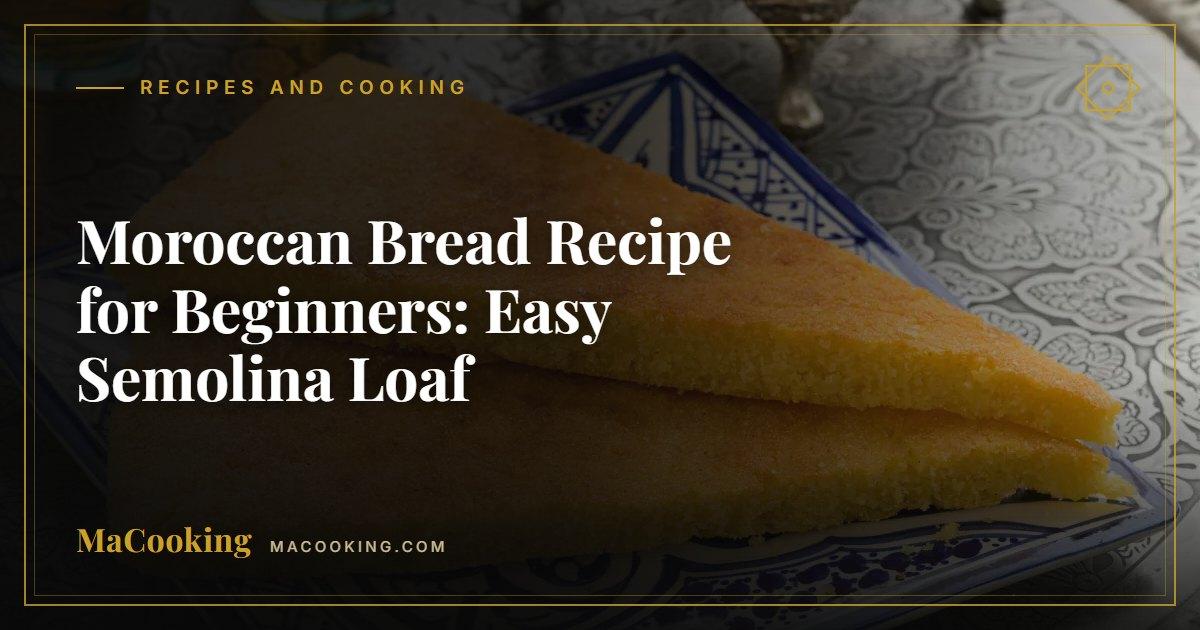
This Moroccan bread recipe makes two round semolina loaves with a golden crust and a soft, slightly nutty crumb. Mix flour, fine semolina, yeast, salt and warm water, knead for ten minutes, let the dough rise twice, then bake at 230°C (450°F) for about 25 minutes. No special equipment needed.
Key Takeaways
- Fine semolina plus bread or all-purpose flour gives the soft, golden crumb that is typical of Moroccan home bread.
- Semolina absorbs water slowly, so aim for a soft, slightly tacky dough and let it rest before you judge it.
- Two rises (about 1 hour, then 45 minutes) and a hot, steamy oven are what give you an open crumb and a crisp crust.
- The loaves keep for two days at room temperature and freeze well, so they suit weekly batch baking.
- Serve the bread warm with olive oil and honey for breakfast, or use it to scoop up tagine sauce at dinner.
What Makes Moroccan Bread with Semolina Different?
Bread in Morocco is called khobz, and it is much more than a side dish. It sits on the table at nearly every meal, and it is often used as the utensil itself. You tear off a piece, fold it around a bite of food and use it to mop up the sauce.
Moroccan bread comes in many forms, and the semolina loaf in this article is one of the most approachable. Semolina is milled from durum wheat. It gives a warm yellow tint, a faintly sweet, nutty flavour and a slightly tender, sandy bite. If you want to read more about the ingredient itself, Wikipedia's semolina entry is a good starting point.
Compared with a typical Western sandwich loaf, this dough has several distinguishing features:
- Little or no fat. Many home versions use only a spoonful of oil, so the crumb is clean and bread-like rather than enriched.
- A fairly wet dough. The semolina soaks up the water, so the dough starts out sticky but becomes manageable.
- A round, slightly flattened shape. The loaf is meant for tearing and scooping, not slicing into neat sandwich squares.
- Seed toppings. Sesame, anise or nigella seeds are common finishing touches, though they are optional.
In many Moroccan neighbourhoods, households have traditionally prepared dough at home and sent it to the local communal oven (ferran) to be baked. Your home oven will not replicate a wood-fired ferran, but with a hot baking surface and some steam you can get surprisingly close.
Moroccan Bread Ingredients: What Do You Need?
The moroccan bread ingredients list is short, so quality and measurement matter. This recipe makes two loaves of roughly 430 g (15 oz) each.
| Ingredient | Amount | Why it matters | Western pantry substitute |
|---|---|---|---|
| Bread flour or all-purpose flour | 300 g (about 2⅓ cups) | Supplies the gluten that holds the loaf together | Either works; bread flour gives a chewier crumb |
| Fine semolina | 200 g (about 1⅓ cups) | Colour, flavour and a tender, slightly sandy bite | Semola rimacinata or fine durum flour; avoid coarse semolina |
| Instant (fast-action) yeast | 7 g (2¼ tsp, one standard packet) | Raises the dough | Active dry yeast: use 8 g and dissolve it in the warm water first |
| Fine salt | 10 g (about 1¾ tsp) | Flavour and dough strength | Fine sea salt; use slightly more if using flaky salt |
| Sugar | 1 tsp | Feeds the yeast and helps browning | Honey, or leave it out |
| Warm water | 340-370 ml (1⅓-1½ cups), about 35°C (95°F) | Hydrates the semolina and flour | Add the lower amount first, then adjust |
| Olive oil | 1 tbsp | Softens the crumb | Any neutral oil |
| Sesame, anise or nigella seeds | 1-2 tbsp, optional | Topping for aroma and crunch | Poppy seeds, or leave plain |
Where to Find Fine Semolina
In the US, look for "semolina flour" in the baking aisle or in the Italian section. In the UK and Europe, ask for fine semolina, or for Italian semola rimacinata (re-milled durum), which is the closest to a flour-like texture. Check that the packet does not say "coarse", since that is better suited to porridge or couscous-style dishes. If you are curious about couscous, our guide to authentic Moroccan couscous explains how semolina is used in that tradition.
Easy Moroccan Bread Recipe: Step by Step
This is the full method for how to make Moroccan bread at home. Allow about three hours from start to finish, most of which is hands-off waiting.
Equipment
- A large mixing bowl
- A kitchen scale (strongly recommended for semolina doughs)
- A baking tray or baking stone
- A second small tray for steam
- A clean cloth or lightly oiled cling film
Method
- Mix the dry ingredients. In the bowl, whisk together the flour, semolina, yeast, salt and sugar so the salt and yeast are evenly spread.
- Add the water and oil. Pour in 340 ml of the warm water and the olive oil. Mix with your hand or a wooden spoon until no dry patches remain. The dough will look rough and sticky.
- Rest for 10 minutes. Cover the bowl. This short pause gives the semolina time to absorb water, so you can judge the dough properly.
- Adjust the hydration. If the dough feels stiff or crumbly, add water 1 tablespoon at a time. You want a soft, slightly tacky dough that holds together but still sticks a little to your fingers.
- Knead for about 10 minutes. Use a lightly oiled surface, not extra flour. Push the dough away with the heel of your hand, fold it back, turn it and repeat. It is ready when it feels smooth and elastic and springs back slowly when poked. With a stand mixer and dough hook, 6-7 minutes on medium-low is enough.
- First rise: 60-75 minutes. Shape the dough into a ball, place it in a lightly oiled bowl, cover it and leave it somewhere warm until it has roughly doubled.
- Divide and shape. Turn the dough onto a lightly floured surface, deflate it gently and cut it into two equal pieces. Fold each piece's edges into the centre, flip it seam-side down and cup your hands around it, rotating, until you have a tight round.
- Flatten slightly. Press each ball into a disc about 18-20 cm (7-8 in) wide and 3 cm (just over 1 in) thick. Place them on a tray lined with baking paper, with room to spread.
- Second rise: 40-45 minutes. Cover loosely and leave until puffy. Meanwhile, put a baking stone or a second tray on the middle rack, a small empty tray on the lowest rack, and preheat the oven to 230°C (450°F), or 210°C fan.
- Top and dock. Brush the loaves lightly with water, sprinkle with seeds if you like, and prick them in several places with a fork. Pricking helps prevent large bubbles and gives the loaf its rustic look.
- Bake with steam. Slide the loaves into the oven and carefully pour about 150 ml of hot water into the lower tray. Close the door quickly. Bake for 22-28 minutes, until deep golden and hollow-sounding when tapped underneath.
- Cool. Rest on a wire rack for at least 20 minutes. If you cut in too soon, the steam inside is still setting the crumb and it can feel gummy.
Timeline at a Glance
| Stage | Time | What to look for |
|---|---|---|
| Mix and rest | 15 minutes | Sticky dough; semolina starts to hydrate |
| Knead | 10 minutes | Smooth, elastic, slightly tacky |
| First rise | 60-75 minutes | Roughly doubled in size |
| Shape | 10 minutes | Tight, smooth rounds |
| Second rise | 40-45 minutes | Puffy; a gentle fingertip press springs back slowly |
| Bake | 22-28 minutes | Deep golden crust; hollow sound when tapped |
| Cool | 20+ minutes | Crumb sets and slices cleanly |
For a fully baked loaf, an instant-read thermometer should show about 96-99°C (205-210°F) in the centre.
Why Did My Moroccan Bread Turn Out Dense or Dry?
Most problems with semolina bread come down to hydration and patience. Here are the common mistakes and how to fix them.
- The dough was too stiff. Semolina keeps absorbing water as it sits. If your dough felt fine right after mixing but firm after the rest, add a splash of water during kneading. A slightly sticky dough gives a softer loaf.
- Too much flour on the counter. Adding handfuls of flour while kneading dries the dough out. Use a little oil on your hands and surface instead.
- Under-kneading. Without enough kneading the gluten is weak and the loaf bakes up squat and dense. Knead until the dough passes the windowpane test: stretch a small piece and it should thin out without tearing immediately.
- Cutting the rise short. Kitchen temperature varies a lot. Judge by the dough, not the clock. In a cool kitchen the first rise may take 90 minutes or more.
- A cool oven or no steam. A hot oven and a burst of steam let the loaf expand before the crust sets. Without them, the crust forms early and the bread stays tight.
- Over-baking. If the crust is very dark and the crumb is dry, reduce the time by 3-5 minutes next time or lower the temperature by 10°C.
A good rule for any Moroccan dough: trust your hands and eyes over the written number. Flours and semolinas absorb water differently, so adjust the water until the dough feels right.
What Do You Eat with Moroccan Bread?
This loaf works as an easy Moroccan breakfast bread, and it is just as useful at dinner.
For Breakfast
Tear the warm bread and serve it with good olive oil, butter, honey, jam, soft cheese or olives, with a glass of sweet mint tea alongside. For a deeper look at the traditions behind morning meals in the Atlas and beyond, read The Amazigh Breakfast Table.
For Lunch and Dinner
Use it for scooping. It is excellent with saucy dishes such as a Moroccan fish tagine, where the bread soaks up the tomato, pepper and spice sauce. Moroccan salads and dips also pair well with it.
Which Moroccan Bread Should You Try Next?
Once you are comfortable with this semolina loaf, these breads each teach a new skill:
- Harcha, a quick pan-cooked semolina bread with no yeast and a crisp, crumbly outside.
- Batbout, a soft, pocket-style pan bread that puffs up on the stovetop.
- Msemen, the layered, folded flatbread that is a staple of Moroccan breakfasts.
- Cumin bread with sesame, a savoury loaf that is a natural next step if you enjoy seed toppings.
You can also browse the full Breads & Pastries recipes collection to see how they compare.
How Do You Store and Reheat Moroccan Bread?
Fresh khobz is best on the day it's baked, but it keeps reasonably well with a little care.
- Room temperature: Once fully cool, store in a paper bag or wrapped in a clean cloth for up to 2 days. Plastic bags soften the crust.
- Freezing: Slice or tear the loaf into portions, place in a freezer bag, and freeze for up to a month. Thaw at room temperature or toast directly from frozen.
- Reheating: Warm a whole loaf in a 180°C (350°F) oven for about 8 minutes. Sprinkle the crust lightly with water first to refresh it.
- Using up leftovers: Day-old bread makes excellent croutons, breadcrumbs or dippers for olive oil and spiced dips.
Variations and Tips for Beginners
- Add wholemeal flour. Swap up to 100 g of the white flour for wholemeal, and add 2-3 tablespoons of extra water.
- Infuse the flavour. Add 1 teaspoon of anise seeds or a pinch of ground cumin to the dough for a more aromatic loaf.
- Bake on a hot surface. A preheated baking stone or an upturned heavy tray gives a better base crust than a cold tray.
- Weigh your ingredients. Cup measures for semolina vary widely, and a scale takes the guesswork out.
- Learn the wider context. If you are building a Moroccan kitchen from scratch, our beginner's guide to cooking Moroccan food at home covers pantry basics and core techniques.
If you'd like to go deeper into the subject, the full ebook The Royal Moroccan Table, Part 2: The Art of Spice includes a chapter titled "Moroccan Breads — The Deep Guide", which is a good next step once you have the basics down.
Frequently Asked Questions
What is the easiest Moroccan bread to make at home?
A yeasted semolina loaf (a home-style khobz) is one of the easiest, because it needs no layering, folding or frying. You mix, knead, let the dough rise, shape two rounds and bake. If you want something even faster, harcha is a pan-cooked semolina bread that needs no yeast.
Can I make Moroccan bread without fine semolina?
You can, but the crumb will be different. All-purpose or bread flour alone gives a soft, plain loaf. Fine semolina adds a golden colour, a slightly sandy bite and a subtle sweetness. If you can't find it, try Italian semola rimacinata or a fine durum flour. Avoid coarse semolina, which stays gritty.
Why is my Moroccan semolina bread dense?
The usual causes are too little water, too little kneading, or rushing the rises. Semolina absorbs water slowly, so a dough that feels fine at first can turn stiff after resting. Keep it soft and slightly tacky, knead until elastic, and let it roughly double before shaping.
How do I store homemade Moroccan bread?
Keep cooled loaves in a paper or cloth bag at room temperature for up to two days. For longer storage, slice and freeze them in a freezer bag for up to a month. Reheat slices in a toaster, or warm a whole loaf in a 180°C (350°F) oven for about 8 minutes.
What is Moroccan bread traditionally eaten with?
Moroccan bread is eaten with almost every meal. At breakfast it comes with olive oil, butter, honey, jam or cheese alongside mint tea. At lunch and dinner it works as an edible utensil for scooping up tagine sauces, salads and dips.
Conclusion
A good semolina loaf is a satisfying first project in Moroccan baking. It needs only a handful of ingredients, a little patience and attention to how the dough feels. Make it once, adjust the water to suit your flour and oven, and you will soon have a reliable bread for breakfast tables and tagine dinners alike. When you are ready for something new, try harcha or one of the other breads in our collection, and keep exploring from there.