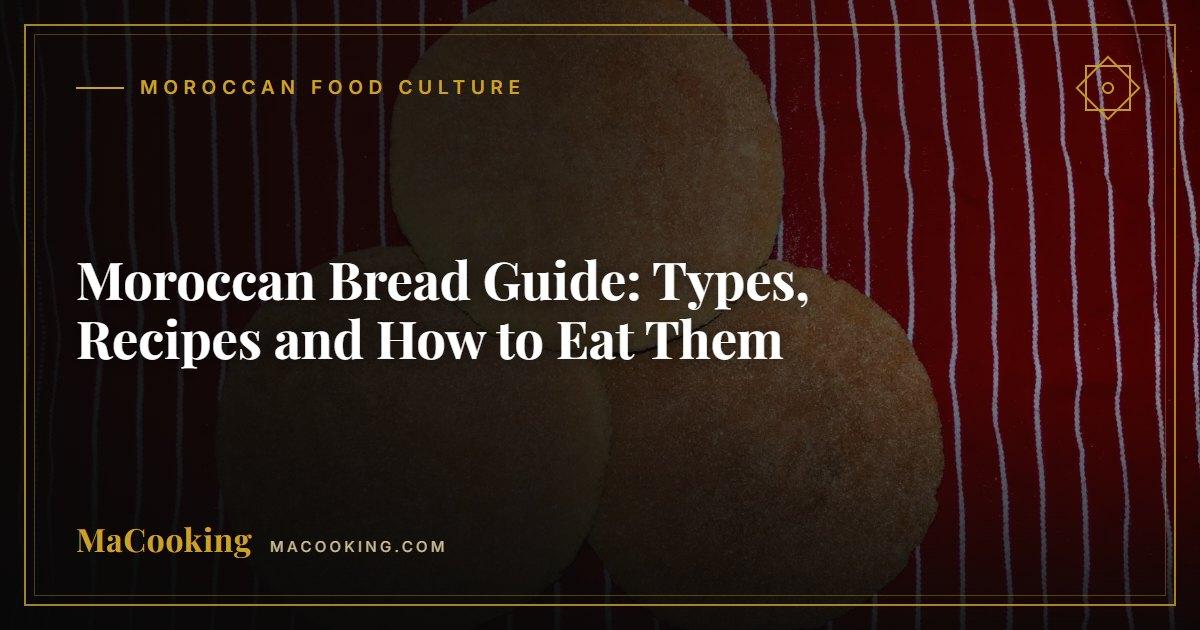
Moroccan bread types range from the round, crusty everyday loaf called khobz to pan-cooked batbout, layered msemen, semolina harcha and spongy baghrir. Each has a role: some are for scooping tagine, others for breakfast with honey, butter or tea. This guide explains them all and shows how to make and eat them.
Key Takeaways
- Khobz is the daily loaf of Moroccan homes. It works as a plate, a spoon and a napkin for most savoury dishes.
- Breakfast and tea-time breads (msemen, baghrir, harcha, rghaif) are mostly griddle-cooked and don't need an oven.
- Most Moroccan bread ingredients are simple: flour, semolina, water, salt and yeast. Technique and hydration matter more than the shopping list.
- Match the bread to the dish. Sturdy khobz suits saucy tagines, soft batbout suits sandwiches and lighter sauces.
- Bread is eaten with the right hand and treated with respect. Tearing a piece and using it to scoop is the norm.
What Are the Main Moroccan Bread Types?
Morocco has no single "national bread". Different loaves and flatbreads sit side by side, and names shift between regions and even between families. Some are leavened with yeast, others are unleavened or semolina-based. Some are baked, others are cooked on a flat griddle or in a pan. The table below covers the ones you will meet most often.
| Bread | What it is | Cooking method | Typically eaten |
|---|---|---|---|
| Khobz | Round, yeasted loaf of wheat flour, often with some semolina or whole wheat | Oven or communal oven | With tagines, salads, dips, at nearly every meal |
| Batbout | Small, soft, puffy rounds that split into pockets | Dry griddle or pan | Stuffed with kefta, eggs, cheese or olives; with soups and tagines |
| Msemen | Square, flaky, laminated flatbread (the rolled-and-coiled round version is often called mlaoui) | Pan-fried on a griddle | Breakfast and tea, with honey, butter or cheese |
| Rghaif | Thin, folded layers of pan-fried dough, sometimes filled | Griddle | Breakfast, snacks |
| Harcha | Thick semolina griddle cake with a crisp edge and a crumbly centre | Pan, dry or lightly greased | Breakfast with jam, honey or cheese |
| Baghrir | "Thousand-hole" semolina pancake, cooked on one side only | Non-stick pan | Breakfast, Ramadan; soaked in butter and honey |
| Barley bread (khobz shaeer) | Denser loaf made with barley flour | Oven or griddle | Traditional in some rural and mountain areas |
Everyday breads versus special-occasion breads
Khobz and batbout belong to the everyday table. Msemen, baghrir and harcha are weekend and guest-friendly breads, since they take more hands-on time. Laminated breads in particular have a slightly celebratory feel. If you want a deeper dive into the folding technique, our guide on how to make Moroccan msemen walks through it step by step.
What Is Moroccan Khobz and Why Is It at Every Meal?
Moroccan bread khobz is the loaf that anchors the table. It is typically round and slightly flattened, about the size of a large side plate, with a golden crust and a soft, even crumb. Many versions are dusted with fine semolina or topped with sesame, aniseed or nigella seeds. The word khobz is simply the Arabic word for bread, related to the term used across the Arab world (see the overview of Moroccan cuisine on Wikipedia for broader context).
In Moroccan homes khobz does the work of cutlery. You tear a piece, pinch food between bread and fingers, and eat the two together. That is why the crumb needs to be sturdy: a loose, airy loaf collapses under a sauce of onions, olive oil and spices.
The communal oven tradition
In many Moroccan towns and neighbourhoods, the ferran (communal oven) is where loaves have traditionally been baked. Families shape their dough at home and take it to be baked in a wood-fired oven, which gives khobz its characteristic smoky, blistered crust. Home bakers outside Morocco can mimic this with a very hot oven and a baking stone or steel.
White, whole wheat or semolina?
Home recipes vary widely. Some households bake mostly whole-wheat loaves, some use white flour and some blend in semolina for a slightly sandy bite. There is no single correct version, so you can adjust it to your pantry and taste.
What Are the Essential Moroccan Bread Ingredients?
Moroccan bread ingredients are modest. The difference between a flat, bland loaf and a good one comes from fermentation time, how much water the dough holds and the heat of the oven. The substitutions below suit Western pantries.
| Ingredient | Role | Western substitute |
|---|---|---|
| Wheat flour (white, whole wheat or a blend) | Structure and flavour | Strong bread flour, or plain/all-purpose flour with slightly less water |
| Fine semolina | Gives a slightly sandy bite; used for dusting and in harcha, baghrir and msemen | Fine semolina (not coarse); in a pinch, a little polenta for dusting only |
| Yeast | Leavening for khobz and batbout | Instant (fast-action) or active dry yeast |
| Salt | Flavour and dough strength | Fine sea salt |
| Water or milk | Hydration; milk makes a softer crumb | Lukewarm tap water |
| Olive oil or butter | Used in laminated breads and some soft breads | Neutral oil for msemen; butter for harcha |
| Sesame, aniseed, nigella seeds | Topping and aroma | Black sesame in place of nigella if needed |
How Do You Make Moroccan Bread (Khobz) at Home?
If you want to learn how to make Moroccan bread, start with khobz. This version makes two loaves and follows the usual approach: a moderately wet dough, a long, patient rise and a very hot oven. For the full method with photos-free, step-by-step detail, see our Homemade Moroccan Khobz (Everyday Bread) recipe.
Ingredients (makes 2 loaves)
- 350 g (about 2¾ cups) strong bread flour
- 150 g (about ¾ cup plus 1 tbsp) fine semolina, plus extra for dusting
- 7 g (2¼ tsp) instant yeast
- 10 g (about 2 tsp) fine salt
- 1 tsp sugar
- About 350 ml (1½ cups) lukewarm water
- 1 tbsp olive oil (optional)
- Sesame or aniseed for topping (optional)
Method
- Mix. Combine flour, semolina, yeast, salt and sugar in a large bowl. Add the water and olive oil and stir until no dry flour remains.
- Knead. Knead on a lightly floured surface for 8-10 minutes until smooth and elastic. The dough should be soft and just a little tacky.
- First rise. Cover and leave in a warm place for 1 to 1½ hours, until roughly doubled.
- Shape. Divide in two. Fold each piece into a tight ball, then flatten gently into a disc about 2-3 cm (1 inch) thick. Place on trays dusted with semolina.
- Second rise. Cover loosely and rest for 30-45 minutes. Meanwhile preheat the oven to 230°C (450°F) with a baking stone, steel or heavy tray inside.
- Prick and top. Prick the surface with a fork a few times to stop large bubbles forming. Brush with a little water and add seeds if you like.
- Bake. Slide onto the hot surface and bake for 20-25 minutes, until deep golden and hollow-sounding when tapped underneath.
- Cool. Rest on a rack for at least 15 minutes. Cutting too early compresses the crumb.
Common mistakes
- Dough too dry. A stiff dough gives a heavy loaf. Aim for soft and slightly sticky.
- Cold oven or tray. A properly preheated surface gives the lift and crust you want.
- Skipping the second rise. Without it the loaf bakes dense.
- Too much semolina in the dough. It absorbs water. Keep to about 30 percent of the flour unless you adjust the hydration.
Which Moroccan Bread Goes Best With Tagine?
For Moroccan bread for tagine, khobz is the default. Its dense crumb and firm crust mean you can scoop sauce and meat without the bread dissolving. Batbout is a lighter option, and some people like to tuck tagine fillings inside it. The pairings below are guidelines, not rules.
| Tagine style | Best bread | Why it works |
|---|---|---|
| Rich, sweet-savoury meat tagines (such as prunes or apricots) | Khobz | Sturdy crumb holds thick, syrupy sauces |
| Chicken with preserved lemon and olives | Khobz or batbout | Soaks up the bright, oily sauce |
| Egg and tomato tagines | Khobz | Perfect for scooping runny yolk and tomato |
| Fish tagines with chermoula | Batbout or soft khobz | Light bread suits more delicate sauces |
| Kefta and vegetable tagines | Batbout | Pockets can be filled, sandwich-style |
Try it with our Beef Tagine with Prunes, where thick, glossy sauce is made for tearing and scooping. For something brighter, serve the Chicken Tagine with Preserved Lemons with warm khobz. The Egg Tagine with Fresh Tomatoes is a quick lunch where bread is the only cutlery you need. A delicate fish dish such as the Fish Tagine with Chermoula and Olives pairs nicely with small batbout.
How Do You Eat Moroccan Bread the Traditional Way?
Bread is more than a side dish in Morocco: it is the way food reaches your mouth, and it is treated with respect. A few customs and habits are worth knowing.
- Use your right hand. Tear off a piece of bread rather than cutting it with a knife.
- Scoop from your side of the dish. In a shared tagine, eat from the section nearest to you.
- Pinch meat and vegetables with the bread. Hold the food in place with your thumb and fingers, then lift it together.
- Don't waste it. Throwing bread away is frowned upon. Stale khobz is traditionally turned into crumbs or dunked into soups and sauces.
- Breakfast bread is sweet or buttery. Msemen, baghrir and harcha are typically eaten with honey, butter, jam or soft cheese, with mint tea or coffee.
The "Moroccan Breads" chapter inside the full ebook The Royal Moroccan Table — The Soul of Morocco is a good next step if you want a structured look at the subject.
Beyond the table: bread as street food
Batbout is also a snack. Split open and filled with kefta, cheese, egg or olives, it becomes a quick, handheld meal. At home, it's an easy way to use leftover tagine meat or vegetables.
How Do You Store, Freeze and Reheat Moroccan Bread?
Khobz is best on the day it's baked, but it keeps reasonably well with a little care.
- Room temperature. Wrap cooled loaves in a clean cloth or paper bag for 1-2 days. Plastic softens the crust.
- Freezing. Slice or leave whole, wrap well and freeze for up to 2-3 months. Msemen and batbout also freeze well; layer with parchment so pieces don't stick.
- Reheating. Sprinkle khobz with a little water and warm at 180°C (350°F) for 5-8 minutes to revive the crust. Reheat msemen and batbout in a dry skillet for a minute or two per side.
- Using stale bread. Turn it into breadcrumbs, croutons or a base for soups and egg dishes.
Breads freeze well, so they fit neatly into batch cooking. For more ideas on preparing food ahead, see Moroccan One-Pot Meals: 10 Easy Weeknight Dinners and pair a pot with a fresh or reheated loaf. You can also browse our full collection of Breads & Pastries recipes.
Frequently Asked Questions
What is the most common bread in Morocco?
Khobz is the everyday bread of Morocco. It is a round, fairly dense loaf made from wheat flour (often part whole wheat) or semolina, with a crisp crust and a soft crumb. It is served at almost every meal and is used to scoop up tagines, salads and dips.
Can I make Moroccan bread without a special oven?
Yes. A home oven heated to 230°C (450°F) with a preheated baking stone, steel or heavy upturned tray gives a very good khobz. Batbout, msemen, harcha and baghrir need only a heavy skillet or griddle, so they suit a standard Western kitchen.
What is the difference between khobz and batbout?
Khobz is a large, round, oven-baked loaf with a thick crust, meant for tearing and scooping. Batbout is a small, soft, yeasted bread cooked on a dry griddle, which puffs up and splits open into a pocket for fillings such as kefta, eggs or cheese.
Which Moroccan bread is best with tagine?
Khobz is the classic choice because its sturdy crumb holds up to rich, saucy tagines. Its crust and density let you scoop meat and vegetables without falling apart. Batbout also works well, especially for smaller portions or for mopping up lighter sauces such as fish chermoula.
Is Moroccan bread vegan?
Basic khobz is usually vegan, made from flour, water, yeast and salt. Batbout is often vegan too. Msemen, rghaif and harcha typically use butter, oil or milk, and baghrir is often served with butter and honey, so check the recipe if you avoid animal products.
Conclusion: Start With Khobz, Then Explore
Once you understand the main Moroccan bread types, the cuisine makes more sense: every tagine, soup and breakfast spread is built around a bread that suits it. Begin with a simple khobz, add batbout for sandwiches and msemen for weekend breakfasts, and you will cover most of what a Moroccan table calls for. From there, browse more flatbread guides and keep a loaf close whenever the tagine comes to the table.